Overview
Tilapia is a common name for several species in the Cichlidae family, most prominently Nile tilapia (Oreochromis niloticus), blue tilapia (O. aureus), and Mozambique tilapia (O. mossambicus). All are warm-water fishes native to Africa and the Levant that have been domesticated and bred for aquaculture over the last century. Tilapia is the second most-produced freshwater fish in the world (after carp) by FAO statistics, with global production above 6 million tonnes per year.
Tilapia are popular in permaculture because they grow fast, accept a wide range of feed, breed readily in captivity, and tolerate marginal water quality better than most farmed fish. The constraint that defines tilapia management on the Gulf coast is also their defining biology: they do not tolerate water below about 55°F and stop feeding below 65°F. On my central Florida site (USDA zone 9b), I have evaluated a small tilapia aquaponics setup twice and decided against it both times for the same reason: a winter freeze every 3 to 5 years pushes pond and even greenhouse water below the survival threshold, and the recovery cost outweighs the production gains. Tilapia are a strong fit in well-insulated greenhouse aquaponics or in central and south Florida where freezes are rare; they are a marginal fit in any outdoor pond.
Permaculture Role
Tilapia fill three permaculture niches: high-conversion protein production in closed-loop aquaponics, pond algae and detritus control, and (in warm climates only) outdoor pond aquaculture.
Aquaponics
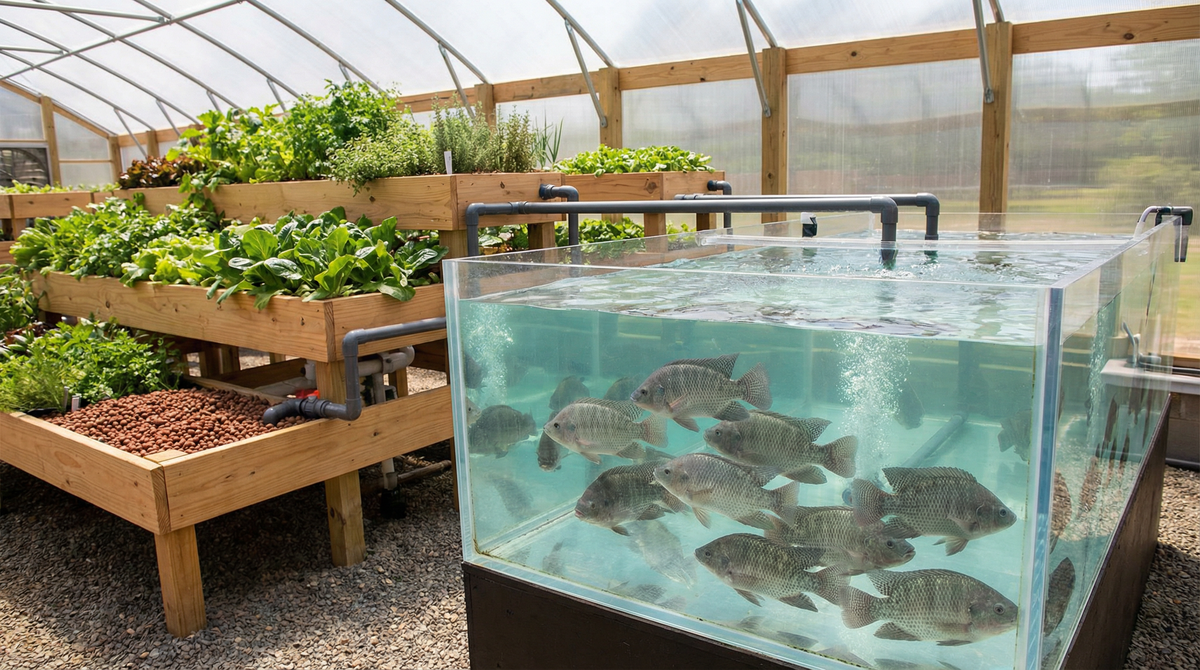
Tilapia is the standard species for closed-loop aquaponics in greenhouse and indoor settings. The system pumps nitrogen- and phosphorus-rich fish waste from the tank through grow beds where bacteria convert ammonia to nitrate and where plants take up the nitrate, returning clean water to the tank. University of the Virgin Islands and Auburn University have published the foundational aquaponics research; commercial operations from Wisconsin to Florida use the same basic design.
Pond ecology
Tilapia eat algae, aquatic plants, and detritus, which makes them effective biological controls for pond water-quality problems. In warm-climate aquaculture, tilapia stocked with catfish reduces supplemental feeding requirements for both species.
Outdoor pond production
In south Florida and the Gulf coast where overwintering is reliable, tilapia produce 2,000 to 10,000 lb of fish per acre per year on commercial farms. Backyard operations work at smaller scales but require active water-quality management.
Regulatory caveat
Tilapia introduction is regulated by the Florida Fish and Wildlife Conservation Commission. Most species require a permit. Blue tilapia (O. aureus) and Mozambique tilapia (O. mossambicus) are established invasives in Florida waters; stocking and transport rules apply.
Tank & Pond Design
Tilapia housing falls into three categories: indoor or greenhouse aquaponics tanks, outdoor earthen ponds, and cage culture in larger water bodies. The choice depends on climate, scale, and regulatory situation.
Aquaponics tanks
Standard backyard setups use 250 to 1,000 gallon round fiberglass or food-grade plastic tanks stocked at 1 lb of fish per 5 to 6 gallons of water with paired grow beds at 1:1 to 1:2 fish-tank to grow-bed volume ratio. The pump moves water continuously and the grow-bed bacteria handle nitrogen cycling. Maintain water temperature between 75 and 85°F with a tank heater in winter.
Outdoor ponds
Earthen ponds of 1/10 to 1 acre at 4 to 8 ft average depth support tilapia in zones 9b and warmer. North and central Florida (zones 8b through 9a) face periodic winter freezes that can kill the entire pond stock. A deeper end (10 to 12 ft) helps but is not a guarantee.
Cage culture
Floating mesh cages in a larger pond hold tilapia at high density (10 to 20 lb per cubic foot) and simplify harvest. Cage culture requires the pond to stay warm enough for survival year-round.
Aeration
Tilapia tolerate low oxygen better than most farmed fish but still need 4 mg per L minimum. A paddle aerator or air stone running through the warmest part of the day prevents fish kills.
Feeding
Tilapia accept a wider range of feeds than almost any farmed fish. Commercial pellets are the standard, but permaculture-leaning operations defray pellet cost with farm-produced biomass.
Commercial pellets
32 to 36 percent protein floating pellets are the production standard. Stocked fish eat 2 to 5 percent of body weight per day, dropping in cooler water. Feed conversion ratios in the 1.4 to 1.8 range are typical for healthy stock at proper density.
Farm-produced feeds
Tilapia eat duckweed (one of the highest-protein pond plants known), azolla, vegetable trim, fly-larva from black-soldier-fly bins, and worms from a connected vermicomposting system. Defraying 30 to 50 percent of commercial pellet cost with farm-produced biomass is realistic at homestead scale.
Aquatic plant warning
Water hyacinth is a Florida Prohibited Aquatic Plant and must not be introduced even though tilapia readily consume it. Use legal native and naturalized options instead.
Water quality
pH 6.5 to 9.0 is tolerated; 7.0 to 8.0 is optimal. Hardness above 50 mg per L as CaCO3 supports good growth. Ammonia and nitrite must stay near zero; biological filtration in a properly cycled system handles this automatically.
Health
Tilapia kept at appropriate temperature, density, and water quality are remarkably disease-resistant. The recurring problems are cold-shock mortality, overstocking-induced water quality crashes, and (occasionally) Streptococcus outbreaks.
Cold-shock
Below 60°F tilapia stop feeding. Below 55°F they stop swimming actively. Below 50°F they die. A single hard freeze in north or central Florida can wipe out an entire outdoor pond. Greenhouse covers, deep refuges, and tank heaters are the mitigation tools.
Stocking density
Overstocking outpaces the biological filter and crashes water quality. Track ammonia and nitrite with a basic test kit weekly during the first 6 weeks of a new system and monthly thereafter.
Streptococcus iniae
The main bacterial disease affecting farmed tilapia. Stressed, overstocked, or warm-water populations are most affected. Prevention is good water quality and lower density.
Reproduction control
Tilapia breed every 4 to 6 weeks in warm water and can quickly overwhelm a system with stunted fingerlings. All-male monosex tilapia (sex-reversed through hormone-treated fry production at the commercial supplier level) is the standard solution and is sold by most US tilapia hatcheries.
Field notes, central Florida. I have looked seriously at tilapia twice: once for the 1/4-acre outdoor pond (rejected because the December 2010 freeze still killed a neighbor’s blue tilapia pond at 8 ft depth and our current winter pattern includes a 2- to 4-night freeze every 3 to 5 years), and once for a small greenhouse aquaponics system (rejected because the heat-pump and aeration energy budget would have eaten most of the production value). For a permaculture site in zone 10 and south, or for an operator already running a heated greenhouse for vegetables, my answer would change. As designed, my outdoor aquatic production is channel catfish for the pond and red swamp crayfish for the wetland margin; tilapia stay on the maybe-someday list.
Integration
Tilapia integrate beautifully with closed-loop aquaponics, with greenhouse vegetable production, and with warm-climate outdoor ponds. They integrate poorly with cold-winter outdoor systems and with any operation that does not have a permitting plan in Florida and other regulated states.
Aquaponics
The flagship integration. Leafy greens (lettuce, basil, chard), tomatoes, peppers, and strawberries all grow well on tilapia-tank effluent in media beds, deep-water culture, or NFT systems.
Greenhouse production
Hot-water tubing through a tilapia tank can pre-heat greenhouse air on cold nights, recovering some of the energy cost of maintaining tank temperature.
Pond polyculture
In warm climates, tilapia stocked with channel catfish or red swamp crayfish forms a productive polyculture. The tilapia eat algae and detritus; the catfish or crayfish are top-trophic harvest species.
Manure use
Tank effluent and pond bottom mud are both rich in slow-release nutrients and can fertilize garden beds, orchards, or pasture during draining or sediment removal.
Frequently Asked Questions
What is the best tilapia species for permaculture?
Nile tilapia (Oreochromis niloticus) for warm-climate aquaponics. Blue tilapia (O. aureus) tolerates cooler temperatures (down to about 50°F briefly) and is the standard outdoor-pond choice where legal. Check state regulations before stocking.
How fast do tilapia grow?
From fingerling to 1 to 1.5 lb harvest size in 6 to 9 months at optimum temperature with proper feeding.
Can I keep tilapia outdoors in Florida?
In zones 10a and warmer, with a permit, usually yes. In zones 8b through 9b, periodic winter freezes make outdoor production high-risk. Greenhouse or indoor tank systems are more reliable.
Are tilapia legal everywhere?
No. Florida regulates tilapia stocking under FWC rules and most species require a permit. Several northern US states prohibit stocking entirely.
What do I do with tilapia waste?
In aquaponics, the system feeds plants directly. In standalone tank systems, tank effluent and filter sludge become high-quality fertilizer for non-edible parts of plants or for ornamental beds (USDA NOP rules apply if you are certifying organic).
References
- FAO Fisheries and Aquaculture. Oreochromis niloticus Cultured Aquatic Species Information Programme. fao.org — O. niloticus
- University of Florida IFAS Extension. Tilapia in Florida Aquaculture. edis.ifas.ufl.edu — FA012
- Auburn University. Pond Aquaculture of Tilapia. aces.edu — fish & water
- Florida Fish and Wildlife Conservation Commission. Aquaculture and Non-native Species Permits. myfwc.com
- University of the Virgin Islands. Aquaponics Research and Production. uvi.edu — aquaponics
Field notes and central-Florida observations in this article are from Lucas Summer’s permaculture site in USDA zone 9b. The honest evaluation against periodic winter freezes and the current outdoor-pond species choice (channel catfish, native red swamp crayfish) reflect on-site decision-making; aquaculture growth rates, water-quality thresholds, and regulatory information are drawn from the UF/IFAS, Auburn, and FWC sources cited above.
Foraging Behavior
In the wild, tilapia are found in turbid rivers and lakes. They are herbivores who feed mainly on plankton, algae, and other vegetable matter. In aquaculture systems, they readily adapt to commercial fish feeds.
Fencing Requirements
Containment in ponds, tanks, or other aquaculture systems is the primary fencing requirement. Standard pond fencing may be used to secure the area from predators.
Shelter Requirements
Tilapia require a body of water, such as a pond or tank, as their primary shelter. The water should be kept clean and well-aerated. In colder climates, a greenhouse or other structure is needed to maintain water temperature.
Permaculture Notes
Tilapia are a cornerstone of many permaculture systems, especially those incorporating aquaponics. Their ability to convert a wide range of organic matter into edible protein and nutrient-rich water makes them an incredibly efficient component of a closed-loop system. In an aquaponics setup, the waste produced by the tilapia provides the necessary nutrients for growing plants, which in turn filter the water for the fish. This symbiotic relationship creates a highly productive and sustainable food production system. Beyond aquaponics, tilapia can be integrated into larger permaculture designs. They can be raised in ponds and other water features within a food forest, where they contribute to the overall health of the ecosystem by controlling algae and providing a source of fertilizer when the pond is drained or the water is used for irrigation. Their manure is a valuable source of nutrients for fruit trees and other perennial plants. One of the main challenges of raising tilapia is their sensitivity to cold temperatures. In temperate climates, a greenhouse or other form of protection is necessary to maintain the optimal water temperature throughout the year. However, their fast growth rate and ease of breeding make them a worthwhile investment for many permaculturists. With proper management, tilapia can be a key element in creating a resilient and productive permaculture system.