Overview
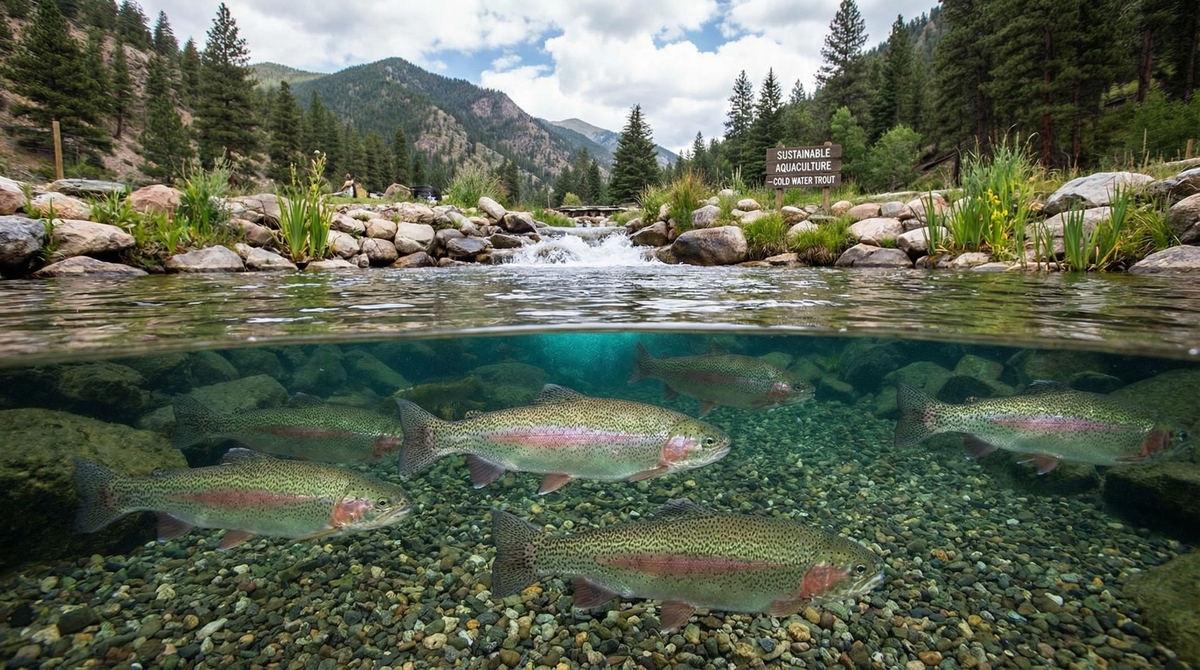
Trout is the common name for several cold-water freshwater fishes in the family Salmonidae, principally rainbow trout (Oncorhynchus mykiss), brown trout (Salmo trutta), and brook trout (Salvelinus fontinalis). All three species evolved in cold mountain streams and northern lakes, and all three require water temperatures below about 68°F to thrive. Rainbow trout is the standard aquaculture species; the US produces roughly 60 million pounds of farmed rainbow trout per year, the bulk in the Hagerman Valley of Idaho and in the Blue Ridge mountains of western North Carolina and northern Georgia.
For permaculture purposes, trout are an excellent cold-water aquaponics species and a fine choice for a spring-fed pond or raceway in zones 7 and cooler. They are not a viable outdoor species on the Gulf coast. On my central Florida site (USDA zone 9b), even my shaded spring-fed pond runs 70 to 75°F year-round, which is above the species’ thermal ceiling. I evaluated trout exactly once, very briefly, and ruled them out within an afternoon. They are included in this profile for permaculturists in the Appalachian, Pacific Northwest, and northeastern US who can give them the cold water they need.
Permaculture Role
Trout fill two permaculture niches: cold-water aquaponics protein production and natural-pond stocking in cool climates. They are not generalist farmed fish.
Cold-water aquaponics
In greenhouse or basement aquaponics systems where water temperature can be held between 55 and 65°F, rainbow trout outperform tilapia on per-pound feed efficiency and produce a premium meat. The system runs cooler than a tilapia system, which suits cool-season vegetables (lettuce, spinach, kale, herbs) and reduces summer cooling costs in temperate climates.
Spring-fed pond stocking
Where reliable cold-water springs or hill-country mountain streams feed a pond, trout stocked at low density grow on natural food (insects, small fish, crustaceans) with minimal supplemental feeding. This is the traditional southern-Appalachian and Pacific Northwest mountain-farm setup.
Caviar and table fish
A pair of broodfish in a small tank can produce harvestable eggs each fall for a niche premium market. Most homestead operations focus on table fish; the egg-and-roe operation is a specialty business decision.
What trout are not
Trout are not a warm-climate species, not a generalist pond fish, and not a low-water-quality tolerant species. They are a precise tool for the right climate, water source, and operator. Misallocating trout to a Gulf-coast site is a recurring failure mode I have seen in regional aquaponics communities.
Tank, Raceway & Pond Design
Trout housing is built around three constants: cold water, high dissolved oxygen, and rapid water exchange. The species evolved in fast-moving mountain streams and replicating that environment is the design problem.
Indoor aquaponics tanks
500 to 2,000 gallon round tanks with a chiller, paired grow beds, and a 24-hour water pump are the standard greenhouse aquaponics setup. Stocking density 0.25 to 0.5 lb of fish per gallon for production. Cool water (55 to 65°F) and aeration that maintains dissolved oxygen above 7 mg per L are essential. North Carolina State University and Penn State Extension both publish detailed design specifications.
Raceways
Concrete or earthen channels with continuous water flow from a cold spring or stream are the commercial production unit in mountain regions. Water enters one end, flows past stocked trout, and exits with elevated nutrients. Raceways require water rights or a substantial spring flow (200 to 500 gallons per minute is typical for a small operation).
Spring-fed ponds
A 1/10 to 1 acre pond fed by a cold spring at the rate of 5 to 20 gallons per minute supports low-density trout stocking with minimal feeding. The pond must hold below 68°F at peak summer depth.
Aeration
Trout need 7 to 11 mg per L of dissolved oxygen for good growth. Air stones, paddle aerators, or Venturi injection are all standard tools. Power outage during summer heat is a leading cause of trout-farm losses; backup aeration is non-negotiable.
Feeding
Trout are carnivorous fish and require a high-protein, high-fat feed. Commercial pelleted trout diets are the standard; permaculture-leaning operations can defray some pellet costs with farm-produced inputs but not to the same extent as with tilapia.
Commercial pellets
40 to 45 percent protein, 12 to 22 percent fat, floating or sinking pellets depending on system. Stocked fish eat 1 to 3 percent of body weight per day depending on water temperature. Feed conversion ratios in the 1.0 to 1.4 range are typical for healthy stock, which is exceptional efficiency for any livestock species.
Farm-produced supplements
Trout will eat black-soldier-fly larvae from a connected larva-bin system, earthworms, mealworms, and pond crustaceans. These can substitute 10 to 25 percent of the commercial pellet budget in well-designed homestead operations.
Pasture and natural forage
In spring-fed ponds with adequate insect, crustacean, and small-fish populations, stocked trout at low density can self-feed. The yield drops from 5,000 lb per acre per year in fed-pond aquaculture to a few hundred pounds per acre per year on natural forage, but the labor and feed costs drop proportionally.
Water quality
pH 6.5 to 8.0, alkalinity above 20 mg per L as CaCO3, ammonia and nitrite near zero. Trout are less tolerant of water quality lapses than tilapia and demand more attention from the operator.
Health
Trout in cool, well-oxygenated, low-density systems are healthy. The recurring failure modes are temperature spikes, oxygen crashes, and bacterial gill disease in crowded operations.
Temperature
Above 70°F trout stop feeding and become stressed. Above 75°F sustained, mortality climbs sharply. Summer heat waves and aquifer drawdown that warms spring water are the main risks in southern raceways. In the Florida panhandle, the few existing trout aquaculture operations rely on chilled-water groundwater pumped from deep wells.
Oxygen
Below 5 mg per L dissolved oxygen, trout stop feeding. Below 3 mg per L, mortality begins within hours. Aeration redundancy with a battery or generator backup is industry-standard.
Bacterial gill disease and furunculosis
Crowding and poor water quality are the typical triggers. Prevention is lower density and better water exchange. Outbreaks are typically treated with feed-medicated antibiotics under veterinary oversight.
Whirling disease
Myxobolus cerebralis, a parasitic protozoan that causes skeletal deformation, has affected wild and farmed rainbow trout populations across the West and is reportable in several US states. Buy stock from certified disease-free hatcheries.
Field notes, central Florida. I evaluated trout exactly once, very briefly, before turning my attention to channel catfish for the same pond. Even the deepest part of the 1/4-acre pond on my place sits around 72 to 75°F in mid-summer, which is above the species’ useful range. The only realistic local trout option I have seen near me is a chilled-water indoor system pumping cold groundwater through an insulated tank, which carries a continuous energy cost that does not pencil out for me. If I lived in the southern Appalachians or anywhere with a reliable 55°F mountain spring, my outdoor aquatic stack would look very different.
Integration
Trout integrate well with cold-water aquaponics, with cool-season greenhouse vegetable production, and with traditional spring-fed mountain-farm pond and raceway systems. They do not integrate with any warm-climate outdoor pond operation.
Cool-season aquaponics
Lettuce, spinach, kale, chard, herbs, and pak choi all grow well in the 60 to 70°F water of a trout-aquaponics system. Tomatoes and peppers grow more slowly but acceptably. Warm-season fruits (cucumber, melon) suit tilapia systems better.
Greenhouse integration
A trout tank in a passive-solar greenhouse acts as a thermal mass, smoothing the daily temperature swing. In summer, the tank may need shade or a chiller; in winter, the tank holds heat into the night.
Mountain farm stocking
Spring-fed ponds and short stream stretches on Appalachian and Pacific Northwest farms have supported trout stocking for over a century. Stocking rates of 100 to 500 fingerlings per surface acre, fed lightly or not at all, produce 50 to 200 lb of harvestable fish per year.
Manure use
Trout tank effluent and bottom mud are nutrient-rich and can fertilize garden beds during system drain-downs or sediment removal.
Frequently Asked Questions
Can I raise trout in Florida?
Outdoors, no. Florida summer water temperatures exceed the species’ thermal ceiling almost everywhere in the state. Indoor or chilled-greenhouse systems are technically feasible but rarely pencil out economically.
How fast do trout grow?
From 6-inch fingerling to 1 lb harvest size in 8 to 14 months at optimum temperature with proper feeding.
What is the difference between rainbow, brown, and brook trout?
Rainbow trout (Oncorhynchus mykiss) is the standard aquaculture species. Brown trout (Salmo trutta) is more tolerant of slightly warmer water and is the European stream-stocking standard. Brook trout (Salvelinus fontinalis) is the eastern North American native and requires the coldest water of the three.
Do trout need fast-flowing water?
In raceways, yes; the standard is at least one pond-volume of water exchange every 2 to 4 hours. In aquaponics tanks, recirculation through a biofilter at high turnover rates substitutes for natural flow.
Are trout legal to stock everywhere?
Generally yes within natural range, but state fish and wildlife agencies regulate stocking. Check before introducing.
References
- USDA Agricultural Research Service. National Cold Water Marine Aquaculture Center. ars.usda.gov — NCWMAC
- NC State Extension. Aquaculture in North Carolina: Trout. content.ces.ncsu.edu
- Penn State Extension. Trout Production. extension.psu.edu — aquaculture
- US Fish and Wildlife Service. National Fish Hatchery System: Rainbow Trout. fws.gov — fish hatcheries
- USDA APHIS. Reportable Aquatic Diseases. aphis.usda.gov — aquaculture
Field notes and central-Florida observations in this article are from Lucas Summer’s permaculture site in USDA zone 9b. The Florida outdoor-pond rejection (pond temperatures above the species ceiling) reflects on-site decision-making; trout aquaculture production figures, water quality thresholds, and disease information are drawn from the USDA-ARS, NC State Extension, and Penn State Extension sources cited above.
Foraging Behavior
Trout are carnivorous and opportunistic feeders. In the wild, their diet consists of a wide variety of aquatic and terrestrial insects, crustaceans, and other small fish. In an aquaculture setting, they are typically fed a pelleted diet.
Fencing Requirements
Trout are typically raised in tanks, raceways, or ponds. Containment is the primary concern, so the structure must be secure to prevent escape. Fencing around the area can also deter predators.
Shelter Requirements
Trout require a shaded and cool environment to maintain optimal water temperatures. The tanks or ponds should be deep enough to allow the fish to escape from direct sunlight and predators. Overhead netting can be used to protect against avian predators.
Permaculture Notes
Trout are an excellent choice for cold-water aquaponics systems. Their waste provides nutrient-rich water for growing a variety of plants, such as leafy greens and herbs. The plants, in turn, filter the water for the fish, creating a closed-loop, symbiotic system. When designing a trout aquaponics system, it is crucial to maintain optimal water temperature and oxygen levels. Trout are sensitive to water quality, so a robust filtration system is necessary. The size of the system will depend on the number of fish and the desired plant yield. A key benefit of integrating trout into a permaculture design is the production of high-quality protein in the form of fish meat and eggs (caviar). The nutrient-rich water from the fish tank is also a valuable resource for fertilizing other parts of the garden. By carefully managing the system, a permaculturist can create a highly productive and sustainable food production system.