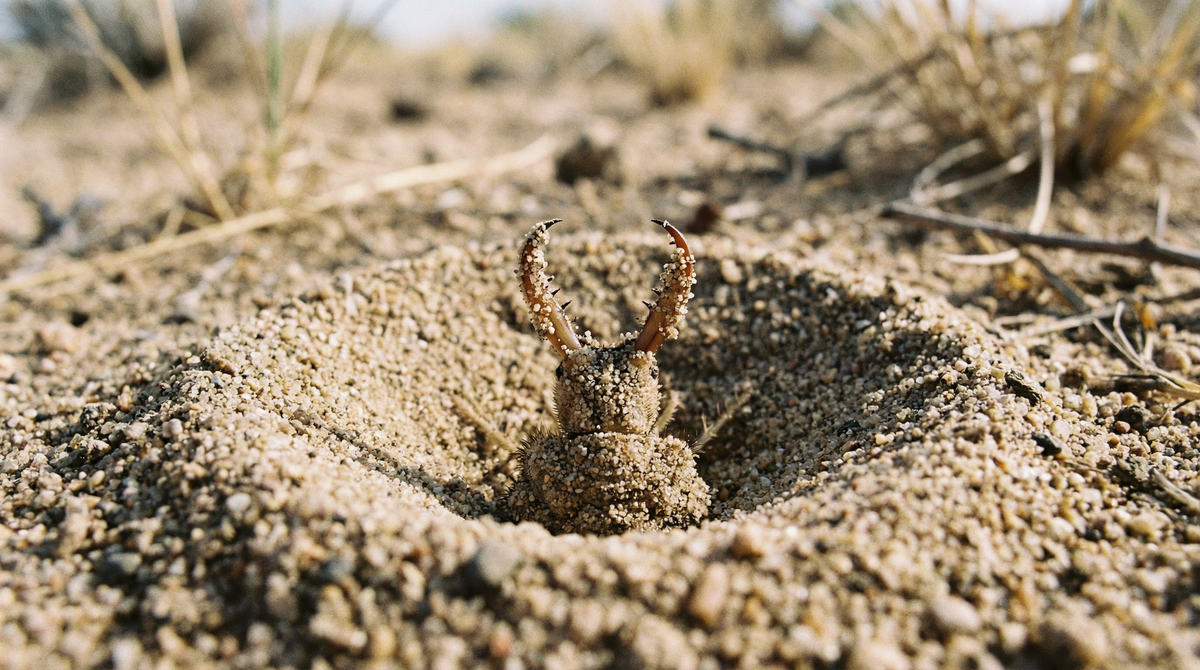
The antlion (family Myrmeleontidae) is one of the garden's most fascinating predatory insects, best known for the ingenious sand traps its larvae build to capture ants and other small prey. Belonging to the order Neuroptera — the net-winged insects — antlions are found on nearly every continent, reaching their greatest diversity in warm, sandy, tropical and subtropical regions. In the garden they are quiet, unobtrusive allies, and a healthy antlion population is a sign of well-drained, undisturbed soil.
Identification and Description
Antlions are most often recognized not by the insect itself but by the work of its larva. The larva — affectionately called a "doodlebug" for the meandering trails it leaves in loose sand — is a squat, bristly, brownish creature armed with a pair of long, sickle-shaped jaws. It is rarely seen above ground, spending almost its entire life buried at the bottom of a conical pit. The adult, by contrast, looks strikingly like a damselfly: a slender body, two pairs of long, finely veined wings held tent-like over the back at rest, and short, gently clubbed antennae that help distinguish it from true damselflies. Adults are weak, fluttering fliers and are most active at dusk and after dark.
Life Cycle
The antlion undergoes complete metamorphosis through four stages: egg, larva, pupa, and adult. Females lay their eggs in sandy, sheltered locations. The larval stage is by far the longest, often lasting one to three years depending on the availability of prey. During this time the larva digs its characteristic conical pit and waits, buried at the base, for insects to tumble in. When the larva reaches full size it spins a spherical cocoon of silk and sand and pupates underground for roughly a month. The emerging adult lives only about 25 to 45 days — just long enough to mate and lay the next generation. In temperate gardens, adults are generally on the wing from late spring through autumn, while larvae overwinter by digging deeper into the soil and remaining dormant through the cold months.
Habitat and Range
Antlions occur worldwide, with the richest diversity in tropical and subtropical zones, and in the United States they are found across all major regions — from the Northeast and Southeast to the Midwest, Southwest, and West. What they require is not a particular plant community but a particular soil: dry, loose, and fine enough to hold the steep walls of a pit. Look for them in gardens, meadows, forest edges, open woodland floors, river banks, scrub-clad dunes, and even true deserts. Sheltered, rain-protected pockets — beneath eaves, along building foundations, or under overhanging rocks — are classic antlion real estate.
Role in the Garden
Antlions are beneficial predators. Their larvae are voracious hunters of ants and other small, soft-bodied insects, helping to keep these populations in check naturally. Because the larva is a sit-and-wait predator, it works passively and continuously, picking off whatever wanders too close to its trap. Adults feed little, so the pest-control benefit comes almost entirely from the long-lived larval stage. For the permaculture gardener, antlions are a small but welcome strand in the web of beneficial insects that regulate pest numbers without any intervention.
Attracting and Supporting Antlions
You do not manage antlions so much as invite them. The single most important thing you can offer is undisturbed, dry, sandy or loose soil where larvae can build and maintain their pits. Good locations include the base of walls, under eaves, beneath dense shrubs, or any sheltered spot that stays relatively dry. Avoid compacting, tilling, or over-watering these areas — moisture collapses the pits, and disturbance forces larvae to rebuild at great energetic cost. On summer nights, adults are drawn to lights, so a garden that supports them will often reveal its residents around porch lamps.
Companion planting is not the route to antlions; habitat is. Rather than choosing particular plants, set aside a few undisturbed, well-drained pockets of bare or sparsely planted ground near your beds. Protected from disturbance, compaction, and excess moisture, these microhabitats will quietly recruit antlions, and the resident larvae will repay you by trapping ants and other small insects season after season.
A Quiet Ally
Few garden insects reward a hands-off approach as clearly as the antlion. Give it a dry, sandy corner and leave it be, and you gain a patient, self-sustaining predator — and one of the most charming pieces of natural engineering you will ever find at the bottom of a tiny funnel of sand.