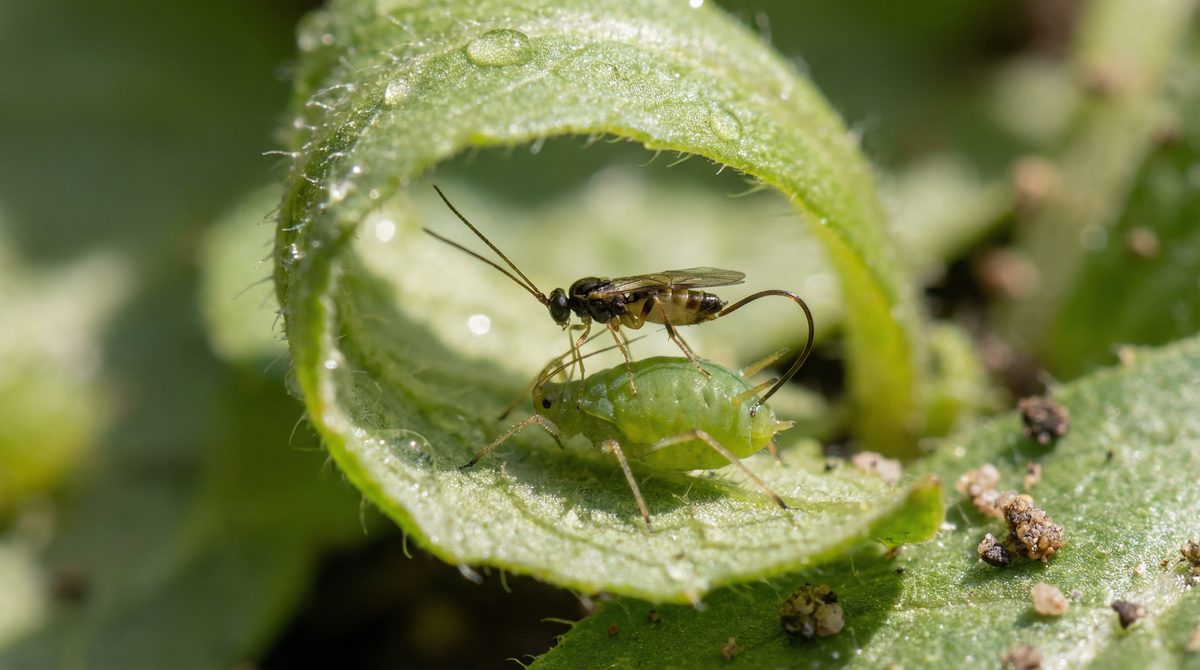
The Aphidius wasp (Aphidius spp.) is one of the most valuable allies a gardener can have, a tiny parasitoid that specializes in destroying aphids from the inside out. Barely larger than the aphids it hunts, this member of the order Hymenoptera is a cornerstone of biological pest control — so effective that several species are reared commercially and released in greenhouses and farms around the world. Where Aphidius is active, aphid outbreaks tend to collapse on their own.
Identification and Description
Adult Aphidius wasps are slender, dark brown to black insects only about two to three millimeters long, with thread-like antennae, a narrow "waist," and clear wings. They are easy to overlook in the garden. The unmistakable sign of their presence is not the wasp but its handiwork: the "aphid mummy." A parasitized aphid swells, hardens, and turns a papery golden-tan or bronze color, becoming a small dome glued to a leaf. A neat, round exit hole in the back of a mummy means a new adult wasp has already emerged to continue the cycle.
Life Cycle
Aphidius wasps undergo complete metamorphosis through egg, larva, pupa, and adult stages. A single female may lay up to 300 eggs in her life, inserting exactly one egg into each aphid she finds. The larva hatches inside its living host and feeds on the aphid's internal tissues; after seven to ten days it kills the aphid, which dries into the hardened mummy. The wasp then pupates inside that shell and emerges by chewing a circular hole in the back. From egg to adult takes only about two weeks at 70°F (21°C), so populations can build quickly during the growing season. In cold climates the wasp overwinters as a diapausing pupa within the aphid mummy — these overwintering mummies are notably more cold-hardy, allowing adults to emerge the following spring.
Habitat and Range
Aphidius wasps are found wherever aphids occur: agricultural crops, vegetable and flower gardens, greenhouses, and ornamental landscapes. The native range varies by species — Aphidius colemani, for example, is native to North America, while others originate in Europe and elsewhere — but through their use in biological control they are now distributed globally. In the United States they are present across every major region, from the Northeast and Southeast to the Midwest, Southwest, West, and Pacific Northwest. Adults are typically active from spring through autumn (roughly April to October).
Role in the Garden
Among beneficial insects, the Aphidius wasp earns the highest rating. It is a dedicated aphid parasitoid, and a healthy population provides continuous, self-renewing aphid suppression with no effort from the gardener. Because each female parasitizes hundreds of aphids and the life cycle is so short, the wasps can keep pace with — and ultimately overtake — fast-breeding aphid colonies. For anyone managing aphids on vegetables, fruit, or ornamentals, encouraging Aphidius is far more sustainable than spraying.
Attracting and Supporting Aphidius Wasps
The key to keeping these wasps in your garden is feeding the adults, which need nectar and the sugary honeydew that aphids themselves produce. Plant flowering insectary plants with small, accessible blooms: members of the carrot family (Apiaceae) such as dill, fennel, and cilantro are outstanding, as are composite flowers like daisies and yarrow. A succession of these flowers across the season gives adults a reliable food source and keeps them patrolling for aphids.
Just as important is what to avoid. Do not use broad-spectrum pesticides — they kill the wasps along with the pests, and aphids rebound far faster than their parasitoids. If intervention is unavoidable, choose selective, short-lived products and spot-treat. Control ants, too: ants "farm" aphids for honeydew and will actively defend them from parasitoids and predators. Finally, because Aphidius are drawn to the color yellow, avoid hanging yellow sticky traps where the wasps are working, since the traps will capture and kill them; hosing dust off foliage also helps, as heavy dust disrupts their activity.
A Gardener's Best Aphid Control
The Aphidius wasp asks for very little — a few nectar-rich flowers and a pesticide-free, ant-managed garden — and returns one of the most reliable forms of natural pest control available. Learn to recognize the golden aphid mummy as a sign of success, not damage, and let these tiny parasitoids do the work for you.