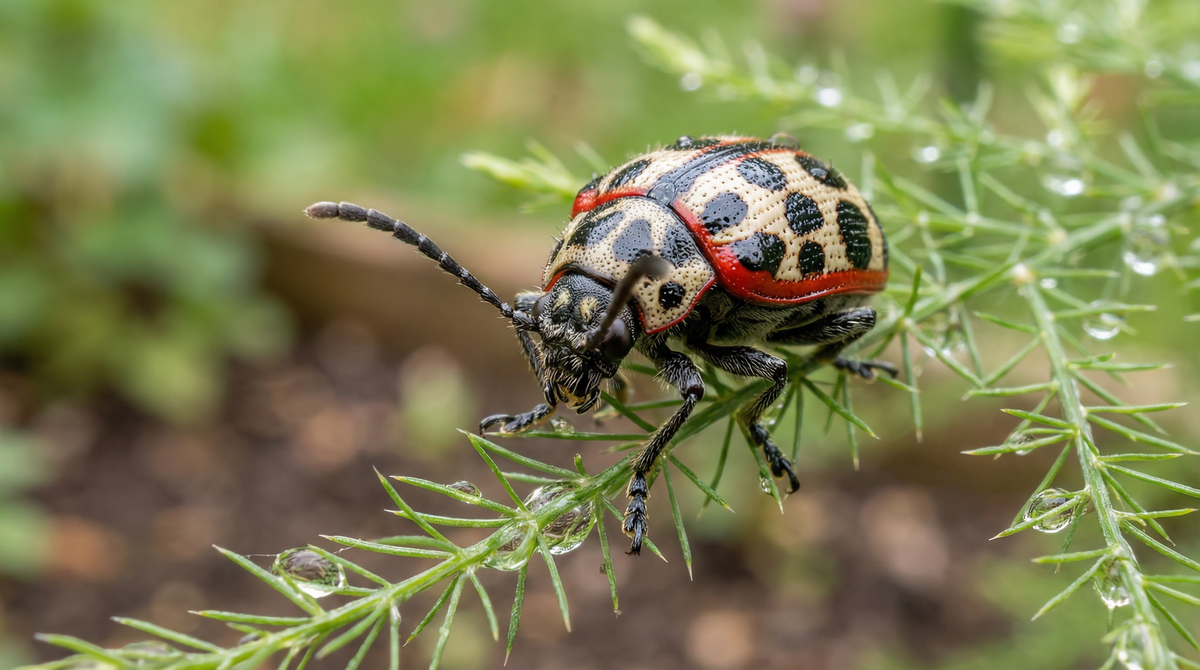
The common asparagus beetle (Crioceris asparagi) is the most troublesome pest of cultivated asparagus, and for gardeners who grow this long-lived perennial it is a familiar springtime adversary. A small leaf beetle in the family Chrysomelidae, it appears just as the first spears push up and can disfigure both the harvest and the ferny summer growth that feeds next year's crop. Native to Europe and northern Asia, it has spread with asparagus cultivation across much of North America.
Identification and Description
Adults are about 6 to 7 millimeters long, slender, and strikingly marked: a metallic blue-black body with three to six cream or yellow squares on the wing covers and a reddish border, set off by a rusty-red thorax. The eggs are unmistakable — dark, rod-shaped, and stood on end in neat rows along the spears and ferns. Larvae are plump, slug-like, and gray to olive-green with a darker head and legs. Both adults and larvae feed on the plant, and disturbed beetles often drop from the foliage or scuttle to the far side of a stem to hide.
Life Cycle
Asparagus beetles overwinter as adults, sheltering in plant debris, hollow asparagus stems, and brush. They become active in spring exactly as new spears emerge, and females begin laying their dark, rod-shaped eggs in rows on the spears and developing ferns. Eggs hatch in about a week, and the slug-like larvae feed for roughly two weeks before dropping to the ground to pupate in the soil. A new generation of adults emerges about a week later, and the cycle repeats — producing two to three overlapping generations over a single growing season (typically April through September). This rapid turnover is why populations can build so quickly if left unchecked.
Habitat and Range
The beetle is found in gardens and agricultural fields wherever asparagus is grown. Its native range is Europe and northern Asia, but in the United States it is now widespread, occurring across the Northeast, Southeast, Midwest, West, and Pacific Northwest. Because the insect is so tightly tied to a single host plant, its presence is almost always centered on the asparagus bed itself.
Role in the Garden
This is a pest, not a beneficial. Adults and larvae chew on emerging spears, scarring and browning them and rendering the harvest unsightly, while feeding on the summer ferns weakens the crowns and can reduce the following year's yield. Egg-laying on spears also makes the harvest unappetizing. Damage is rarely fatal to an established planting, but heavy, repeated infestations steadily sap the vigor of this long-lived perennial, so early-season attention pays off.
Managing the Asparagus Beetle
An integrated, organic approach keeps this pest well below damaging levels. Begin with sanitation: cut down and destroy the old fern growth and clear plant debris in autumn to remove the adults' overwintering shelter. During the harvest season, pick spears frequently and thoroughly — this removes eggs along with the crop and denies larvae a place to develop. Handpick adults, larvae, and eggs in the morning when the beetles are sluggish, knocking them into a bucket of soapy water; rub egg rows off spears as you harvest.
Encourage natural enemies, which can be remarkably effective. The tiny parasitic wasp Tetrastichus asparagi attacks the eggs and may parasitize up to 70 percent of them, and lady beetle larvae and other generalist predators consume eggs and young larvae — so avoid broad-spectrum insecticides that would wipe these allies out. Companion planting is often used as a supporting tactic: interplanting or bordering the bed with tomatoes (which emit solanine), parsley, basil, nasturtium, tansy, or calendula is widely reported to help repel the beetles. Combined with diligent harvesting and fall cleanup, these measures usually make chemical controls unnecessary.
Staying Ahead of the Beetle
Because the asparagus beetle reproduces several times a season, the gardener's best weapon is consistency: harvest often, crush the eggs, clean up in fall, and protect the parasitic wasps and predators that do much of the work unseen. Stay on top of it early in spring and this classic asparagus pest remains a minor nuisance rather than a serious threat.