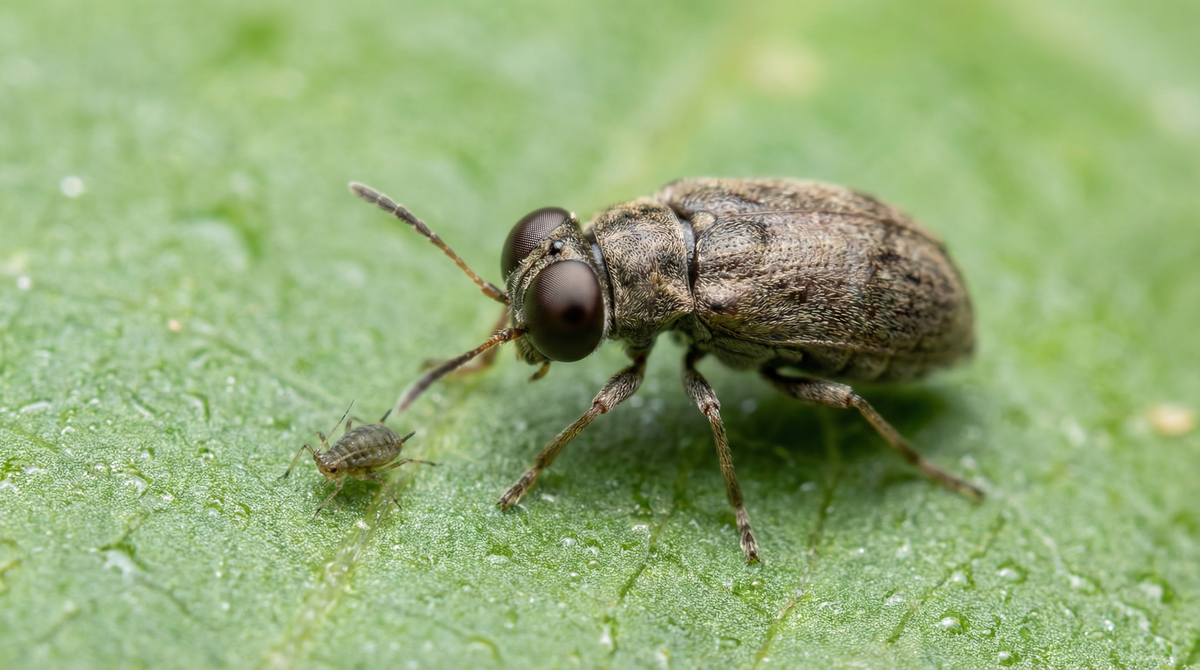
The big-eyed bug (Geocoris spp.) is a small but mighty predator that punches well above its weight in the garden. Named for the pair of large, bulging eyes that dominate its broad head, this true bug in the order Hemiptera preys on a long list of common pests — aphids, spider mites, thrips, whiteflies, insect eggs, and small caterpillars among them. Quick, abundant, and easy to overlook, big-eyed bugs are among the unsung heroes of natural pest control.
Identification and Description
Big-eyed bugs are only about three to four millimeters long, with a stout, somewhat flattened, oval body in shades of tan, gray, or black, often finely speckled. Their defining feature is unmistakable: the wide head bears two prominent, kidney-shaped eyes set far apart, giving the insect a perpetually wide-eyed look. They are sometimes confused with the similar-sized chinch bug, a plant pest — but the big-eyed bug's broader head and bulging eyes set it apart, and its habits are wholly beneficial. They move quickly across foliage and the soil surface in search of prey.
Life Cycle
Like other true bugs, the big-eyed bug develops by incomplete metamorphosis, passing through egg, nymph, and adult stages with no pupal phase. Females lay eggs singly or in small clusters on leaves and stems. The nymphs progress through five instars, each lasting roughly four to six days, so the entire cycle from egg to adult takes only about 30 days in warm conditions — allowing several overlapping generations during the growing season. Adults are active over a long stretch of the year, often from early spring into late autumn (roughly March through November). They typically overwinter as adults in sheltered places such as leaf litter, crop debris, weedy areas, or under bark, though some species overwinter as eggs.
Habitat and Range
Big-eyed bugs are found in gardens, meadows, fields, row crops, turf grass, and low-growing plant cover throughout the United States, occurring across the Northeast, Southeast, Midwest, Southwest, West, and Pacific Northwest. Several species are native to North America (such as Geocoris pallens and Geocoris punctipes), while others, like Geocoris grylloides, are native to Europe. They favor dense, low vegetation where prey is plentiful and the ground surface offers hunting territory.
Role in the Garden
Big-eyed bugs are highly beneficial generalist predators. Both nymphs and adults hunt actively, piercing prey with their mouthparts and feeding on a wide range of soft-bodied pests and insect eggs. A single big-eyed bug can consume large numbers of spider mites or aphids over its life, and because the insect is so common and reproduces quickly, populations can deliver meaningful, season-long suppression of pests. They are also partly plant-feeding — taking pollen, nectar, and plant juices — which lets them persist in the garden even when prey is temporarily scarce, ready to respond when pest numbers rise.
Attracting and Supporting Big-Eyed Bugs
Because big-eyed bugs supplement their diet with pollen and nectar, a diverse, season-long succession of flowering insectary plants is the single best way to attract and retain them. These blossoms provide an alternative food source when prey is low, encouraging the bugs to stay put and keep patrolling. Low-growing and groundcover plantings suit their hunting style especially well.
Equally important is restraint with pesticides: avoid broad-spectrum insecticides, which kill big-eyed bugs along with their prey and quickly undo natural control. Provide ground cover and leave some leaf litter and weedy edges to supply overwintering shelter for the adults. With diverse flowers, undisturbed cover, and a pesticide-free approach, big-eyed bugs will establish themselves and quietly hunt across your beds.
A Small Predator with a Big Appetite
Few beneficial insects are as widespread or as easy to support as the big-eyed bug. Give it flowers, cover, and freedom from broad-spectrum sprays, and this wide-eyed little hunter will reward you by devouring aphids, mites, thrips, and pest eggs throughout the season.