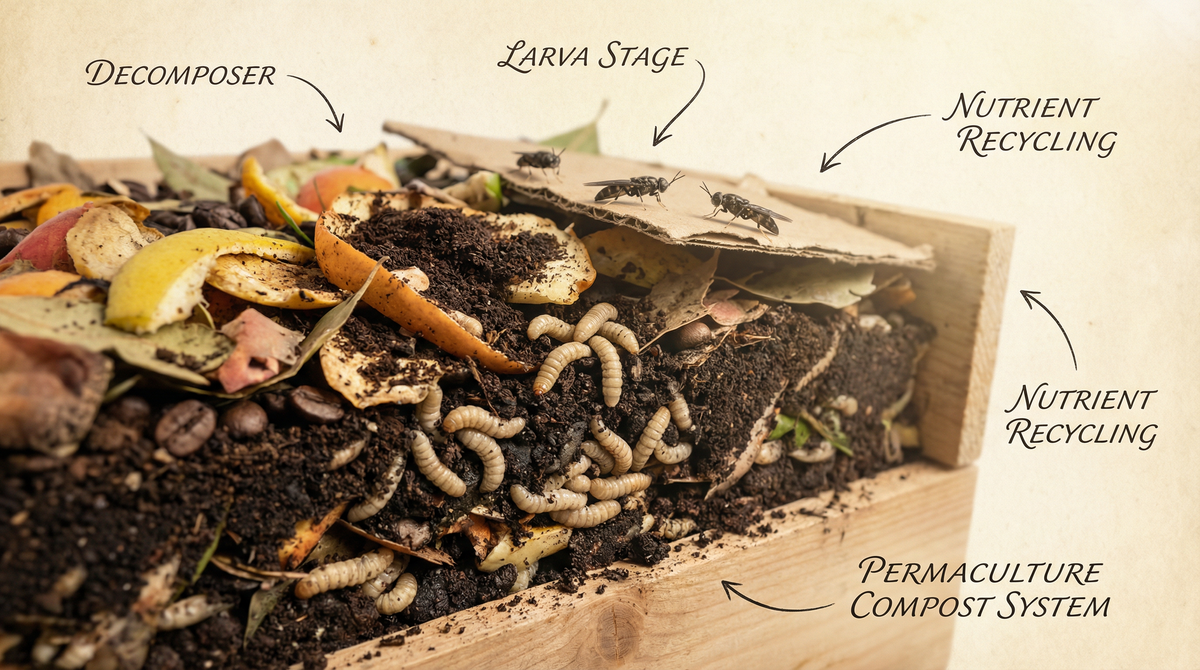
The black soldier fly (Hermetia illucens) is one of the most useful insects a permaculture gardener can encourage. Far from a nuisance, this large, harmless fly is a composting powerhouse: its larvae devour decomposing organic matter at astonishing speed, turning food scraps and manure into rich castings and a high-protein feed for poultry and fish. A member of the order Diptera and the soldier fly family (Stratiomyidae), it is a quiet workhorse of waste recycling.
Identification and Description
Adult black soldier flies are roughly 15 to 20 millimeters long, slender and black, with a faint metallic blue or green sheen and two pale, translucent "windows" near the base of the abdomen. They are wasp mimics in appearance but completely harmless — they do not bite, sting, or even feed as adults, and because they avoid human food and dwellings, they are not associated with spreading disease the way house flies are. The larvae are the more familiar stage to anyone who composts: flattened, segmented, grayish-tan grubs that can reach about 25 millimeters, tough-skinned and constantly writhing in a feeding mass.
Life Cycle
The black soldier fly undergoes complete metamorphosis through egg, larva, prepupa, pupa, and adult. Females lay clusters of several hundred eggs in dry crevices near—but not in—decaying organic matter. The larvae hatch and feed voraciously through several instars, growing rapidly on almost any moist, decomposing material. When mature, a larva empties its gut and enters a darkened "prepupal" stage, during which it instinctively crawls up and away from the wet feedstock to find a dry place to pupate—a behavior known as self-harvesting that makes the larvae remarkably easy to collect. After pupation the adult emerges, lives only about a week on stored fat reserves, mates, lays eggs, and dies. Under warm conditions the whole cycle can complete in roughly six weeks, faster in heat and slower in cool weather.
Habitat and Range
Native to the warmer regions of the Americas, the black soldier fly has spread to become cosmopolitan across tropical, subtropical, and temperate zones worldwide. In the United States it is well established in the South and is found wherever summers are warm enough to support its development. It is most active in the warm months and overwinters in mild climates; in colder regions it persists chiefly in heated indoor systems and compost piles that retain warmth. It thrives anywhere abundant decomposing organic matter is available—compost heaps, manure, fallen fruit, and food-waste systems.
Role in the Garden
This is a top-tier beneficial insect. Its larvae are among the fastest and most efficient decomposers known, rapidly breaking down food scraps, fruit and vegetable waste, and even manure into a stable, nutrient-rich residue (frass) that makes an excellent soil amendment. Just as valuably, the harvested larvae are a clean, high-protein, high-fat feed for chickens, ducks, and fish, closing a nutrient loop on the homestead. Black soldier fly larvae also help suppress house flies and other pest flies: by colonizing and rapidly consuming decaying matter—and producing conditions those pests dislike—they outcompete the species that actually bother people and livestock.
Attracting and Supporting Black Soldier Flies
In warm climates, black soldier flies often find compost and food-waste systems on their own, but you can invite and support them deliberately. Provide a steady supply of moist, decomposing organic matter—kitchen scraps, spent produce, or manure—in a bin that drains well and stays warm. Dedicated "BSF bins" and bioPods take advantage of the larvae's self-harvesting instinct by including a ramp that lets mature prepupae crawl out into a collection bucket, ready to feed to livestock. Keep the feedstock damp but not flooded, shelter it from heavy rain, and avoid drowning the colony. Because the adults need warmth and a little sunlight to mate, an open, sun-touched compost area in summer encourages egg-laying. As with all beneficial insects, avoid contaminating the feedstock with pesticides.
A Composting and Protein Powerhouse
The black soldier fly turns waste into wealth: faster compost, free livestock protein, and fewer pest flies, all from an adult that never bites and never raids the kitchen. For closed-loop, regenerative systems, few insects are as quietly transformative—give its larvae something to eat and a warm, well-drained place to work, and they will do the rest.