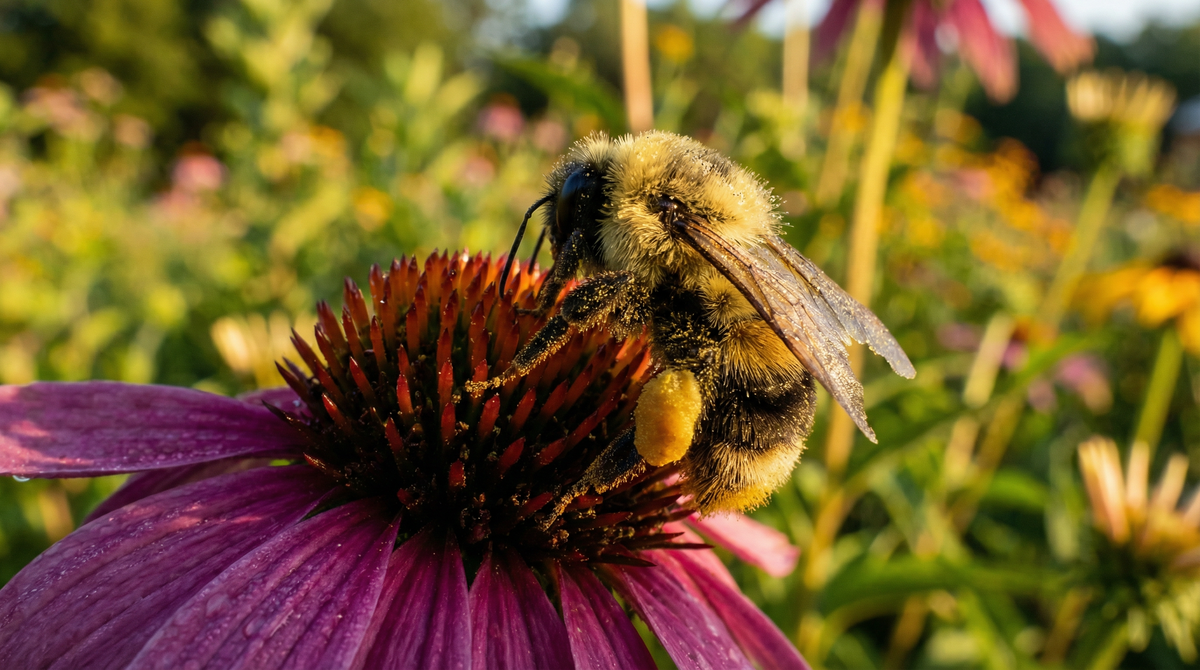
The bumblebee (Bombus spp.) is among the most important and beloved pollinators in the garden. Large, fuzzy, and unmistakably industrious, these social bees in the family Apidae work earlier in the morning, later in the evening, and in cooler, cloudier weather than most other bees — extending the pollination day across the whole growing season. For the permaculture gardener, a thriving bumblebee population is both a sign of ecological health and a direct boost to fruit and seed set.
Identification and Description
Bumblebees are robust, rounded bees clothed in dense hair, typically banded in black with yellow, orange, or white. They are noticeably larger and furrier than honey bees and, unlike the shiny, bald-abdomened carpenter bee, are fuzzy all over. Females carry pollen in smooth "baskets" (corbiculae) on their hind legs, often visible as bulging orange or yellow loads. Bumblebees are gentle and not aggressive away from the nest; only females can sting, and they rarely do unless threatened.
Life Cycle
Bumblebees follow an annual colony cycle. In spring, a mated queen emerges from hibernation and founds a new nest, laying her first batch of eggs. These hatch into larvae within four to six days, are fed pollen and nectar for about two to three weeks, then pupate for roughly another two weeks before the first female workers emerge. Through summer the colony expands as workers take over foraging and brood care. In late summer the queen produces new queens and males, which leave to mate. As autumn arrives the original colony — old queen and workers — dies off, and only the newly mated queens survive, hibernating underground or under leaf litter through winter to begin the cycle again. Most species produce a single colony generation per year, with adults active roughly March through October.
Habitat and Range
Bumblebees are found across the Northern Hemisphere and parts of South America, and in the United States they occur in every major region — Northeast, Southeast, Midwest, Southwest, West, and Pacific Northwest. They occupy a wide range of habitats: gardens, meadows, woodlands, wetlands, agricultural areas, and forest edges. Nests are usually in the ground (often in abandoned rodent burrows), in tussocks of long grass, compost heaps, or cavities — generally dry, insulated, undisturbed spots.
Role in the Garden
Bumblebees are top-tier pollinators and earn the highest beneficial rating. They are especially valuable because of "buzz pollination" (sonication): by gripping a flower and vibrating their flight muscles, they shake loose pollen that many plants hold tightly inside their anthers. This makes bumblebees outstanding — often essential — pollinators of tomatoes, peppers, eggplants, blueberries, cranberries, and many other crops that honey bees pollinate poorly. Their tolerance for cool, dim conditions also means they keep working when other bees stay home, improving fruit and seed set across the season.
Attracting and Supporting Bumblebees
Supporting bumblebees comes down to flowers, nest sites, and avoiding poisons. Plant a diverse succession of nectar- and pollen-rich blooms from early spring (when queens are founding nests and most vulnerable) through late autumn. Bumblebee favorites include clover, comfrey, borage, catmint, lavender, oregano, rosemary, asters, and bee balm; they are strongly drawn to blue, purple, and white flowers in particular. Aim for overlapping bloom so there is always forage available.
Provide nesting habitat by leaving some areas undisturbed: tufts of long grass, compost heaps, log piles, and quiet, untilled ground all serve as natural nest sites, and commercial bumblebee houses can supplement them. Above all, avoid pesticides — broad-spectrum and systemic insecticides are lethal to bumblebees, and even sub-lethal exposure impairs their foraging and navigation. With abundant flowers, undisturbed nesting cover, and a pesticide-free garden, bumblebees will establish and flourish.
A Pollinator Worth Protecting
Many bumblebee species are in decline from habitat loss, pesticides, and disease, which makes the gardener's role more important than ever. A garden rich in season-long flowers and free of insecticides is a genuine refuge — and it repays the effort directly, with better-pollinated crops and the cheerful, steady hum of one of nature's hardest-working pollinators.