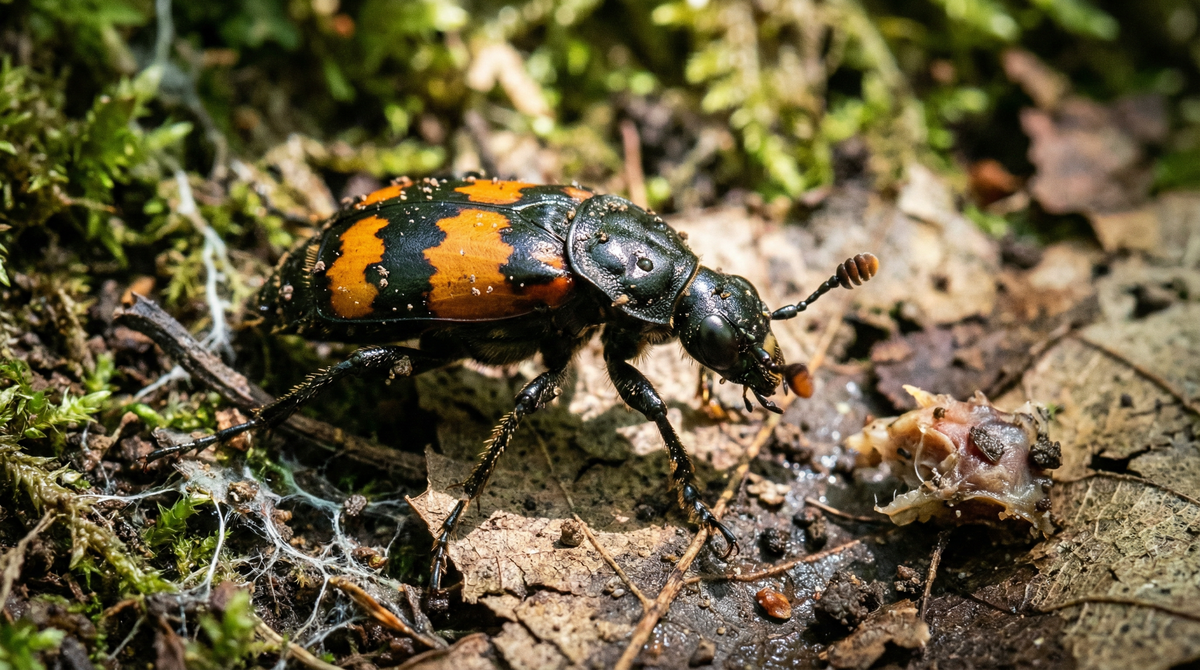
The burying beetle (Nicrophorus spp.), also called the sexton beetle, is one of nature's most remarkable recyclers — and one of the very few insects that cares for its young. A member of the carrion beetle family (Silphidae) in the order Coleoptera, it finds, buries, and consumes the carcasses of small animals, returning their nutrients to the soil and removing carrion that would otherwise breed flies and disease. Quietly and out of sight, it performs an essential sanitation service in gardens, meadows, and woodlands.
Identification and Description
Burying beetles are large, striking beetles, often 12 to 35 millimeters long, with shiny black bodies boldly marked by orange or orange-red bands across the wing covers (elytra). Their antennae end in distinctive orange-tipped clubs packed with sensory organs so acute they can detect a fresh carcass from a great distance, sometimes within an hour of death. They are strong fliers, mostly active at night, and are frequently seen carrying tiny orange mites — harmless hitchhikers that ride from carcass to carcass and help the beetles by eating fly eggs and maggots that would compete with the beetle larvae.
Life Cycle
The burying beetle has a roughly one-year life cycle, with adults active from late spring through early fall once nighttime temperatures stay above about 59°F (15°C). When a male and female locate a suitable small vertebrate carcass — a mouse, vole, or songbird — they cooperate to bury it, working the soil away beneath until it sinks underground, safe from competitors. They strip away fur or feathers, work the flesh into a compact ball, and coat it with secretions that slow decay. The female lays her eggs in the soil nearby; they hatch in about six days, and the larvae crawl to the carcass to feed. Remarkably, both parents remain to provide care, feeding the larvae regurgitated food and guarding them from predators — a level of parental investment almost unheard of among beetles. The larvae mature over several days, then pupate in the soil, and new adults (tenerals) emerge in summer to overwinter as the next year's breeding stock. The whole process, from burial to new adults, takes about 30 to 65 days.
Habitat and Range
Burying beetles inhabit gardens, meadows, forests, and grasslands across temperate eastern North America, occurring in the Northeast, Southeast, and Midwest. They favor habitats with loose, workable soil for burial and a healthy supply of small wildlife. They are nocturnal and rarely noticed unless one happens upon a pair at work beneath a carcass or finds them drawn to lights at night.
Role in the Garden
Burying beetles are beneficial decomposers and a sign of a healthy, balanced ecosystem. By rapidly burying and consuming small carcasses, they recycle nutrients directly into the soil and, crucially, remove the breeding material for flies and the bacteria associated with rotting flesh — a natural sanitation service. They do no harm to plants or crops. The family also includes the American burying beetle (Nicrophorus americanus), once widespread but now federally protected after dramatic declines, which makes the whole group a meaningful indicator of environmental health.
Supporting Burying Beetles
As beneficial insects, burying beetles need no control — only a healthy, undisturbed environment. The single most important factor is the presence of small animal carcasses, which a diverse, wildlife-friendly garden naturally provides; this is not something a gardener supplies deliberately, but a landscape that supports rodents, birds, and other small creatures will support their decomposers too. Leave some areas of the garden undisturbed to offer habitat and loose soil for burial, encourage overall biodiversity, and — most importantly — avoid broad-spectrum pesticides, which kill these beetles and the wildlife web they depend on.
Nature's Undertaker
The burying beetle is easy to admire once you know its story: a devoted parent, a tireless recycler, and a quiet steward of the nutrient cycle. Protect garden biodiversity and skip the broad-spectrum sprays, and these handsome, orange-banded beetles will keep doing their essential, unseen work beneath the soil.