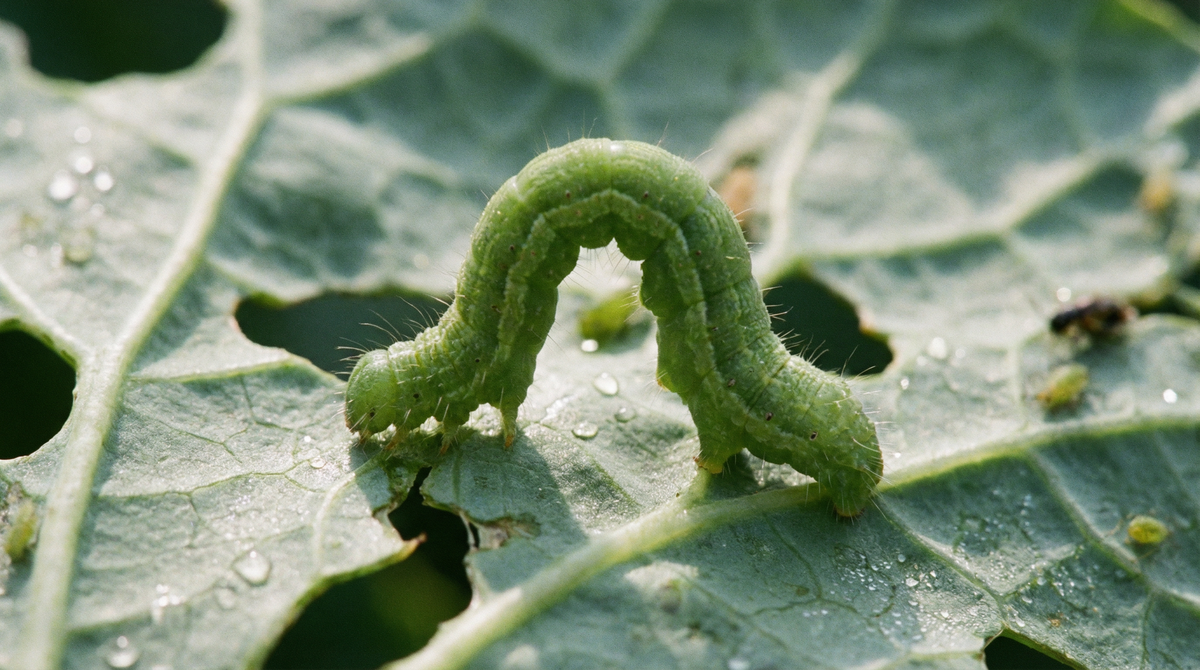
The cabbage looper (Trichoplusia ni) is a familiar and frustrating pest of vegetable gardens, especially of cabbage and its relatives. The caterpillar of a night-flying moth in the family Noctuidae, it chews ragged holes in leaves and can quickly skeletonize a crop. With an extremely broad appetite — more than 160 host plants — and several generations a year, it demands attention from spring through autumn, but a combination of prevention, biological control, and good garden hygiene keeps it well in check.
Identification and Description
The looper caterpillar is smooth and pale green with thin white stripes running down its back. Its name comes from its movement: lacking the full set of prolegs that other caterpillars have, it arches its body into a loop and then extends forward, "inching" along like a measuring worm. This looping gait is the easiest way to tell it from the imported cabbageworm, a fuzzy, velvety-green caterpillar that crawls without looping. The adult is a mottled grayish-brown moth, about 2.5 centimeters across, marked with a small silvery figure-eight or "Y" on each forewing. It flies at night and is rarely seen by day.
Life Cycle
The cabbage looper develops through complete metamorphosis: egg, larva, pupa, and adult. Female moths lay single, dome-shaped, whitish-yellow eggs on the undersides of host leaves, and these hatch in about three days. The larval stage — the damaging phase — lasts 9 to 14 days through four to seven instars, the caterpillar growing and feeding the whole time. It then spins a thin silken cocoon on the underside of a leaf and pupates for 4 to 13 days depending on temperature before the adult emerges. The complete cycle takes just 24 to 33 days, so multiple overlapping generations occur in a single season (adults active roughly May through October). Pupae overwinter in crop debris or soil, while in the warm South and Mexico the insect may breed year-round.
Habitat and Range
Native to North America, the cabbage looper is found throughout the United States — Northeast, Southeast, Midwest, Southwest, West, and Pacific Northwest — in gardens and agricultural fields alike. Although strongly associated with cabbage-family (brassica) crops such as cabbage, broccoli, cauliflower, kale, and bok choy, it also attacks lettuce, spinach, beets, peas, tomatoes, and a wide range of other vegetables and flowers.
Role in the Garden
This is a pest. Young larvae chew small holes, but larger loopers consume whole leaves, bore into developing cabbage and broccoli heads, and foul the crop with dark green pellets of frass. Damage is worst on heading brassicas, where contamination renders heads unmarketable, and on seedlings, which can be quickly defoliated. Because the insect is so prolific and feeds on so many plants, populations can surge rapidly if ignored.
Managing the Cabbage Looper
An integrated, organic approach is highly effective. The most reliable treatment is Bacillus thuringiensis (Bt, the kurstaki strain), a naturally occurring bacterium that is harmless to people, pets, and beneficial insects but lethal to caterpillars when eaten — spray it on the foliage (especially leaf undersides) while larvae are small. Spinosad-based sprays are another organically acceptable option. For prevention, cover susceptible crops with floating row covers to stop the night-flying moths from laying eggs in the first place, and inspect leaf undersides regularly; handpicking caterpillars and crushing egg clusters is very effective in a home garden.
Encourage natural enemies, which provide free, continuous control: parasitic wasps such as Trichogramma, Copidosoma, Hyposoter, and Microplitis, along with the tachinid fly Voria ruralis, all attack looper eggs or larvae — so plant insectary flowers to sustain them and avoid broad-spectrum insecticides that would wipe them out. Companion planting can further reduce egg-laying: aromatic herbs like thyme, peppermint, hyssop, and tansy help mask the scent of brassicas, while marigolds, nasturtiums, onions, and garlic interplanted among the crop discourage the moths. Finally, clean up crop debris and till lightly in autumn to destroy overwintering pupae.
Keeping Loopers in Check
Because the cabbage looper breeds so quickly and feeds so widely, consistency is the gardener's best defense: cover the crop, scout leaf undersides, treat early with Bt, protect the parasitic wasps that hunt it, and tidy up at season's end. With these layered tactics, this persistent brassica pest stays a manageable nuisance rather than a crop-wrecker.