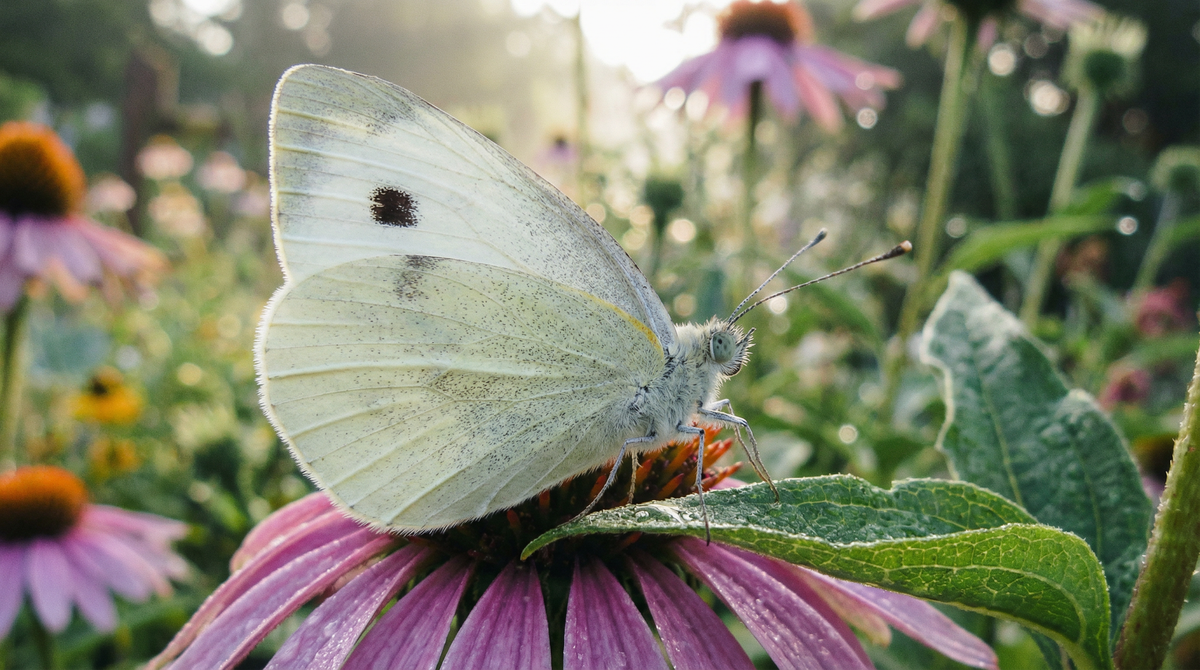
The cabbage white butterfly (Pieris rapae) is one of the most familiar butterflies in the world — and one of the most damaging garden pests. While the adult is a harmless, even charming flower-visitor, its green caterpillar, known as the imported cabbageworm, is a voracious feeder on cabbage and other brassicas. Introduced from Europe and now found across North America, this prolific insect produces several generations a season and is a perennial challenge for vegetable gardeners.
Identification and Description
The adult is a medium-sized white butterfly with charcoal wingtips; females bear two black spots on each forewing and males one. It flutters by day over open, sunny gardens. The damaging stage is the larva: a velvety, matte-green caterpillar with a faint yellow stripe down the back and a row of small yellow spots along each side. It is easily confused with the cabbage looper, but the imported cabbageworm is fuzzier and crawls smoothly, whereas the looper is smooth-skinned and moves by arching its body into a loop. The caterpillar's green color blends almost perfectly with brassica leaves, so damage is often noticed before the culprit is.
Life Cycle
The cabbage white undergoes complete metamorphosis through egg, larva, pupa, and adult. Females lay single, yellowish, oblong eggs on the undersides of host leaves; these hatch in four to eight days. The larval stage lasts two to three weeks, during which the caterpillar feeds heavily on leaves and heads. It then pupates, usually on the host plant or nearby, as a green or grayish chrysalis for one to two weeks before the adult emerges. The full cycle takes three to six weeks, allowing three to five generations per year (adults active roughly April through October). The insect overwinters as a pupa attached to host plants, fences, or other surfaces, ready to emerge in spring.
Habitat and Range
Originally native to the eastern Mediterranean region of Europe, Pieris rapae is now established throughout the United States — Northeast, Southeast, Midwest, Southwest, West, and Pacific Northwest. It favors open, sunny places: gardens, towns, valley bottoms, forest clearings, and farmland. Its host plants are members of the cabbage family — cabbage, kale, broccoli, cauliflower, bok choy — as well as wild crucifers like charlock and hedge mustard.
Role in the Garden
The caterpillar is the problem. It chews large, irregular holes in leaves, bores into the centers of cabbage and broccoli heads, and contaminates the harvest with dark green frass. Young brassica transplants can be defoliated, and heading crops are easily spoiled. It is worth noting that the adult butterfly does visit flowers and provides minor incidental pollination — but with three to five generations a year of leaf-devouring larvae, the cabbage white is firmly on the pest side of the ledger for the vegetable gardener.
Managing the Cabbage White
Prevention is the first line of defense: cover brassicas with floating row covers or fine netting from the day they go in, so the butterflies cannot reach the leaves to lay eggs. Timing helps too — planting cabbage early so it matures before butterfly numbers peak reduces damage, as does growing more resistant varieties such as savoy and red types. Scout leaf undersides regularly and handpick caterpillars and rub off egg clusters; in a home garden this alone can keep numbers low.
The most effective spray is Bacillus thuringiensis kurstaki (Btk), a naturally occurring bacterium harmless to people and beneficial insects but lethal to caterpillars when eaten — apply it about every seven days once larvae appear, coating the leaf undersides. Encourage natural enemies, too: parasitic wasps such as Cotesia and Trichogramma attack the larvae and eggs, so avoid broad-spectrum insecticides. Companion planting can discourage egg-laying — interplant brassicas with aromatic herbs like thyme, dill, oregano, lavender, rosemary, mint, marjoram, sage, and chamomile, along with onions, garlic, and marigolds, whose strong scents help mask the crop. Finally, remove crop debris in autumn to eliminate overwintering pupae.
Outsmarting a Persistent Pest
Because the cabbage white is so common and breeds so quickly, the winning strategy is layered and proactive: exclude the butterflies with covers, scout and handpick, treat early with Btk, protect the wasps that parasitize the caterpillars, and mask the crop with aromatic companions. Stay ahead of it, and this ubiquitous white butterfly remains a manageable visitor rather than a brassica-bed disaster.