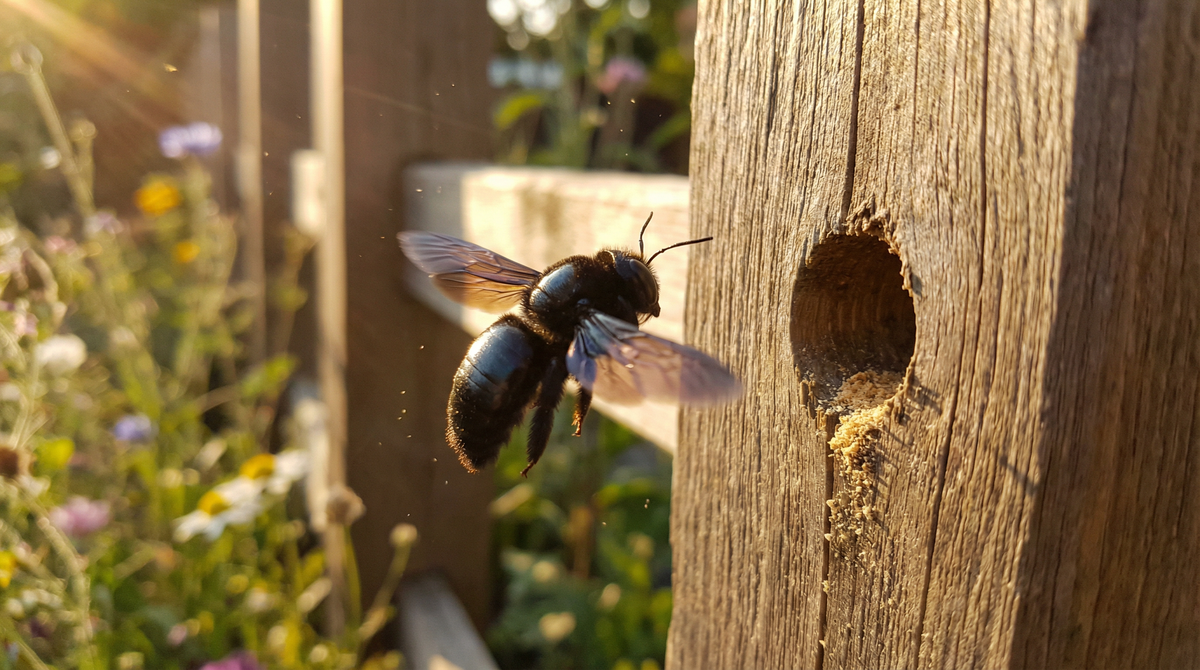
The carpenter bee (Xylocopa virginica) is a large, conspicuous native bee that occupies an interesting middle ground in the garden: it is a genuinely valuable pollinator, yet its habit of boring nest tunnels into wood can make it an unwelcome guest around decks, fences, and eaves. Understanding this dual nature lets a gardener welcome the bee for its pollination services while steering it away from structures.
Identification and Description
Carpenter bees are big, robust bees, roughly the size of a bumblebee, but the two are easy to tell apart by the abdomen: the bumblebee's is densely furry, while the carpenter bee's is shiny, smooth, and black — almost bald. The thorax is covered in yellow or buff hairs. Males often have a pale yellow patch on the face and are notoriously territorial, hovering and darting at passersby; reassuringly, males cannot sting at all. Females can sting but are docile and almost never do unless handled. Their loud, low buzz and the perfectly round, half-inch holes they leave in wood are tell-tale signs of their presence.
Life Cycle
Carpenter bees develop through complete metamorphosis — egg, larva, pupa, adult — with typically one generation per year. Adults emerge in spring to mate. The female then excavates a tunnel in wood, chewing a round entrance hole and turning to bore along the grain. Inside, she builds a series of brood cells: into each she packs a ball of pollen and nectar, lays a single egg, and seals the cell with chewed wood pulp before starting the next. The larvae develop within their cells through summer and emerge as new adults in late summer, who return to the tunnels to overwinter and breed the following spring. Unlike honey bees or bumblebees, carpenter bees are solitary — each female works her own nest, though many may tunnel in the same favored piece of wood.
Habitat and Range
Native to eastern North America, Xylocopa virginica is common across the Northeast, Southeast, and Midwest, in gardens, meadows, and forest edges. For nesting it seeks out soft, untreated, weathered wood — bare cedar, pine, redwood, cypress, and the like — which is why it so often turns up in fence rails, deck railings, eaves, and untreated structural timber.
Role in the Garden
On balance, carpenter bees are beneficial. They are effective pollinators of many flowers and crops, and like bumblebees they can perform buzz pollination, vibrating flowers to release pollen that other bees cannot — a real asset for tomatoes, eggplants, and similar plants. Their main drawback is structural: their tunnels can, over years and with repeated use, weaken untreated wooden structures, and woodpeckers sometimes enlarge the damage hunting for larvae. They also occasionally "rob" nectar by slitting the base of long flowers rather than entering the front, bypassing pollination on those blooms. For most gardens, though, the pollination benefit outweighs the modest nuisance — hence a middle-of-the-road rating.
Supporting — or Redirecting — Carpenter Bees
To enjoy carpenter bees as pollinators, plant a diversity of flowering plants, especially open-faced and shallow blooms, and offer alternative nesting sites: blocks of soft, untreated wood placed away from buildings give the females somewhere to tunnel that is not your deck. A flower-rich, pesticide-free garden will keep them foraging productively.
To keep them out of structures, make the wood unappealing. Carpenter bees avoid finished surfaces, so paint or varnish exposed wood — bare timber is far more attractive than a sealed surface. Plug existing tunnels (ideally in late summer or fall after the bees have emerged) and then paint or caulk over the entrances to discourage reuse. Citrus oil and almond oil are reported to repel them and can be applied around vulnerable wood. These deterrents redirect the bees rather than killing them, preserving their pollination value while protecting your structures.
A Pollinator Worth Tolerating
The carpenter bee asks only for flowers and a bit of soft wood, and in return it pollinates broadly — including the buzz-pollinated crops many bees skip. Offer it untreated nesting blocks away from the house, seal and finish the wood you want to protect, and this big, glossy native bee becomes far more ally than nuisance.