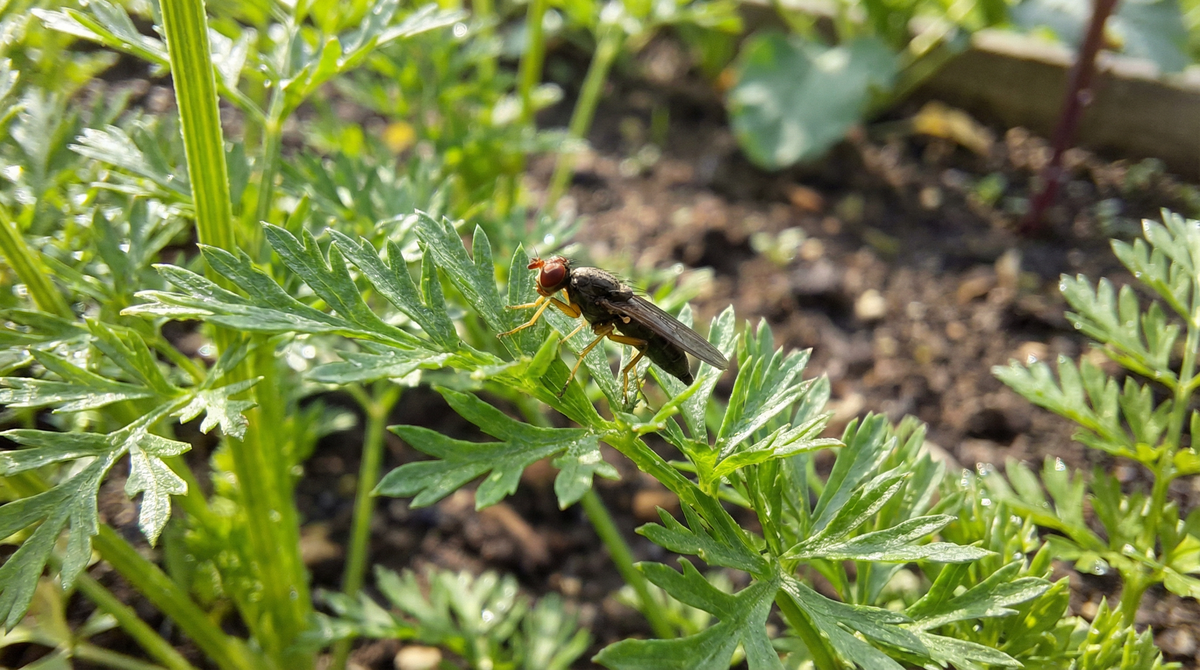
The carrot rust fly (Chamaepsila rosae) is one of the most damaging pests of carrots and their relatives. Though the adult is a small, inconspicuous fly, its larvae tunnel through the roots, scarring and discoloring them and ruining the harvest. Native to Europe and now established in cooler regions of North America, this persistent pest is best handled through prevention and disruption of its life cycle rather than sprays.
Identification and Description
The adult is a small, slender fly about 6 to 8 millimeters long, with a shiny black body, a reddish-brown or orange head, and conspicuous yellowish legs and clear wings. It is a weak flier that stays low to the ground, drifting along rows in search of host plants, so it is easily overlooked. The real damage is done unseen: the larvae are small, slender, creamy-yellow maggots that feed within the roots. Their feeding leaves the telltale sign that gives the pest its name — winding, rust-colored tunnels and brown scarring just beneath the skin of the root, often most concentrated near the crown and root tip. Heavily infested roots may rot, crack, or develop a bitter taste.
Life Cycle
The carrot rust fly overwinters as pupae in the soil near the previous year's host plants, or as larvae inside roots left in the ground or in storage. The first generation of adults emerges in spring, roughly mid-April through June. Females lay their eggs in the soil near the crown of a suitable host plant; the hatching larvae burrow down and feed on the roots for several weeks before pupating in the soil. A second generation of adults emerges from August into September, and in milder regions a third generation may follow, with adults active into October. Depending on climate, there are one to three generations per year — and it is the late-season generations that often cause the worst storage-root damage.
Habitat and Range
Originally from Europe, the carrot rust fly is established in the cooler parts of the United States, particularly the Northeast, Midwest, and Pacific Northwest, where it occurs in gardens and agricultural fields. It attacks members of the carrot family (Apiaceae): carrots, parsnips, celery, celeriac, parsley, and chervil are all hosts. Cool, moist conditions favor it, which is why it is most troublesome in northern and coastal climates.
Role in the Garden
This is a serious pest with no redeeming role in the garden. By tunneling through the edible roots, the larvae directly destroy the harvest, and their damage opens the door to secondary rots in the ground and in storage. A single bad infestation can render an entire carrot or parsnip bed unusable, which is why this pest earns the lowest beneficial rating. The key to managing it is to break its cycle before the larvae ever reach the roots.
Managing the Carrot Rust Fly
Exclusion is the most effective tactic. Cover carrots and other host crops with floating row covers as soon as they emerge, sealing the edges so the low-flying females cannot reach the soil to lay eggs; because the flies stay near the ground, even a low barrier or fine-mesh fence around the bed can help. Use yellow sticky traps to monitor adult flight and time your protection. Rotation is essential — never plant carrots or other Apiaceae in the same spot two years running, and site new plantings well away from last year's bed, since the weak-flying adults disperse poorly.
Timing and sanitation also pay off. Delaying sowing until after the first generation has passed (late May to early June) lets the most vulnerable seedling stage avoid the spring flight. At season's end, harvest all roots promptly and remove crop debris to eliminate overwintering larvae and pupae; do not leave culls or volunteers in the ground. Beneficial nematodes such as Steinernema applied to the soil can attack the larval stage. Finally, companion planting helps mask the crop: interplanting strongly aromatic onions, leeks, chives, garlic, rosemary, and sage throughout the carrot patch confuses the flies' scent-based search for host plants.
Staying Ahead of the Rust Fly
Because the carrot rust fly is so destructive and persistent, layered prevention is the only reliable answer: cover the crop, rotate beds, delay sowing, mask the scent with alliums, harvest cleanly, and clear debris in fall. Combine these tactics and you can grow clean, unblemished roots even where this troublesome fly is established.