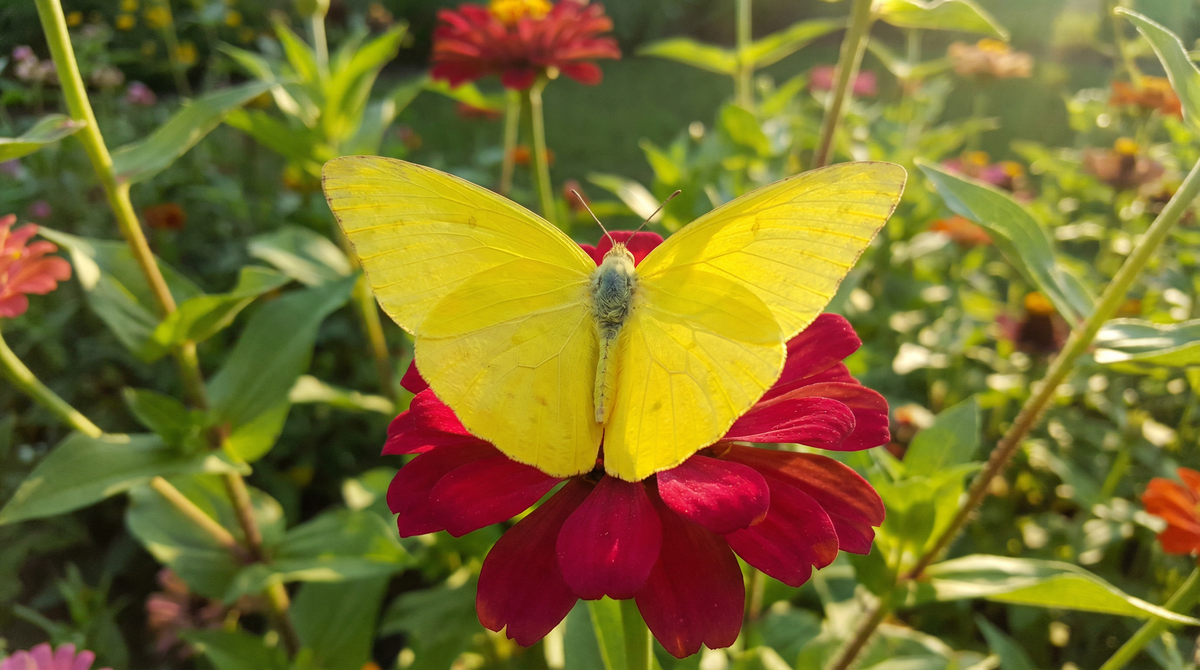
The cloudless sulphur (Phoebis sennae) is a large, brilliant lemon-yellow butterfly and a cheerful, beneficial presence in the garden. A strong-flying member of the family Pieridae, it ranges widely across the Americas, drifting through gardens and open country in search of nectar and its leguminous host plants. As an adult it is a welcome pollinator, and its larvae feed mostly on wild and ornamental sennas rather than food crops, making it an easy butterfly to enjoy and encourage.
Identification and Description
Adults are among the larger sulphurs, with a wingspan of roughly 5 to 6.5 centimeters and clear, unmarked lemon-yellow wings (females may show faint dark borders and a small spot). Their fast, looping flight and bright color make them easy to spot bouncing across a sunny garden. The caterpillar is variable: typically green with yellow side stripes and small blue patches, but when it feeds on yellow senna flowers rather than leaves it becomes yellow with black bands. The larva is fond of building a shelter by folding a leaf over itself and binding it with silk. The chrysalis is distinctive too — pointed at both ends with a humped middle, and colored either green or yellow to match its surroundings.
Life Cycle
The cloudless sulphur develops through complete metamorphosis. The female lays pitcher-shaped white eggs, often on the buds and leaves of host plants; the eggs turn pale orange before hatching in about six days. The caterpillar feeds and grows within its folded-leaf shelter, then forms its two-pointed chrysalis, from which the adult later emerges. There are multiple generations per year, and in warm regions the butterfly breeds more or less continuously (adults can be seen roughly March through November). The cloudless sulphur is notably migratory — populations move northward through the warm season and migrate south to warmer climates for winter rather than overwintering in the cold; some related sulphurs instead overwinter as chrysalids.
Habitat and Range
Native to the Americas, the cloudless sulphur is widespread across the United States, occurring in the Northeast, Southeast, Midwest, Southwest, and West, with the strongest, year-round populations in the warm South. It is a butterfly of open, sunny places: gardens, meadows, forest edges, glades, seashores, watercourses, clover and alfalfa fields, mowed fields, vacant lots, and roadsides. Its larval host plants are legumes, especially sennas (Senna spp.) and partridge pea (Chamaecrista spp.).
Role in the Garden
The cloudless sulphur is a beneficial, low-impact garden visitor. Adults are active nectar feeders and provide pollination as they move from flower to flower; with their long proboscis they are especially drawn to deep, tubular, red and pink blooms that many shorter-tongued insects cannot reach. The caterpillars feed primarily on sennas and partridge peas rather than vegetables, so they rarely cause any crop damage. Add to this the simple pleasure of a big yellow butterfly drifting through the beds, and the cloudless sulphur is firmly a welcome species — beneficial, beautiful, and essentially harmless.
Attracting the Cloudless Sulphur
To bring cloudless sulphurs to the garden, provide both larval host plants and adult nectar. Plant sennas and partridge pea to give females somewhere to lay eggs and raise the next generation — these are attractive, nitrogen-fixing legumes in their own right. For the adults, offer nectar-rich flowers, with an emphasis on red and tubular blooms that suit their long tongue: cardinal flower, hibiscus, lantana, cordia, bougainvillea, wild morning glory, and clovers are all favorites, along with dandelions, milkweeds, goldenrods, and asters across the season. Keep the garden chemical-free, since pesticides harm butterflies at every life stage. In the rare case that caterpillars trouble a valued ornamental senna, simply handpick and move them to a sacrificial host plant rather than spraying.
A Splash of Garden Sunshine
Few insects add as much warmth and movement to a garden as the cloudless sulphur. Plant its senna hosts, fill the beds with red, tubular nectar flowers, and skip the sprays, and you will be rewarded with generations of these bright yellow butterflies — gentle pollinators that ask for little and give the garden a constant flicker of sunshine.