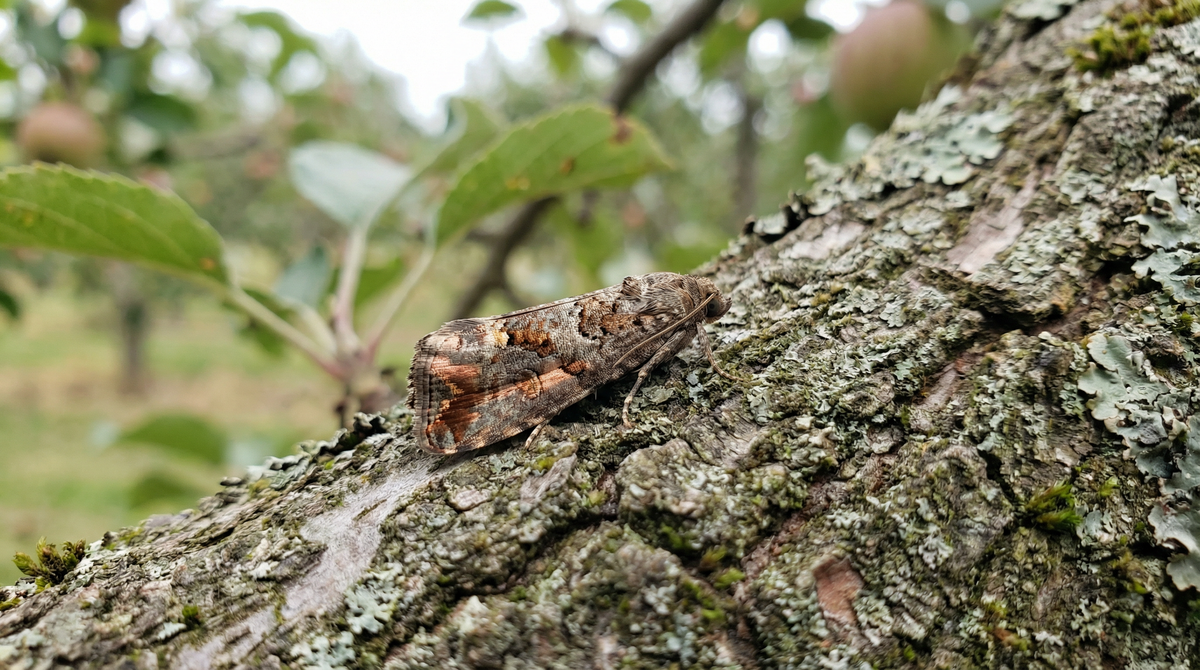
The codling moth (Cydia pomonella) is the single most damaging pest of apples and pears worldwide — the original "worm in the apple." A small, inconspicuous moth in the family Tortricidae, it does its harm entirely as a larva, tunneling straight to the core of developing fruit. Native to Eurasia, it has followed apple and pear cultivation across the globe and is now established throughout the temperate fruit-growing regions of North America. For anyone tending a backyard apple, pear, or walnut tree, understanding its life cycle is the key to keeping fruit clean without heavy spraying.
Identification and Description
The adult is a small grayish-brown moth, roughly 1 centimeter long, with finely banded, mottled forewings tipped by a coppery-bronze patch at the wing tip — a useful field mark that distinguishes it from other small orchard moths. It is easily overlooked, flying mostly at dusk. The damaging stage is the larva: a pinkish-white to creamy caterpillar with a dark brown head, growing to about 1.5 centimeters. The telltale sign of infestation is a small entry hole in the fruit, often plugged with reddish-brown crumbly excrement called frass, leading to a tunnel bored into the seed-filled core.
Life Cycle
The codling moth overwinters as a full-grown larva spun into a tough silken cocoon, tucked under loose bark scales or in debris and soil at the base of the tree. In early spring the larva pupates, and adults emerge from roughly mid-March into April. After mating, each female lays 30 to 70 tiny, flattened, disc-shaped eggs singly on fruit, nuts, or nearby leaves. The newly hatched larvae bore into the fruit or nut to feed on the core or kernel. After three to five weeks of feeding, mature larvae exit the fruit — dropping to the ground or crawling along the trunk — to pupate and continue the cycle. Depending on climate, there are two to four overlapping generations per year (adults active April through September), which is why infestations can build quickly through a season.
Habitat and Range
Originally from Eurasia, the codling moth is now widespread across the United States, including the Northeast, Midwest, West, and Pacific Northwest. It is a creature of orchards and gardens, anywhere its host plants grow. Its preferred hosts are apples and pears, along with English walnuts, crabapples, quince, and large-fruited hawthorn.
Role in the Garden
The codling moth is a serious pest with no redeeming garden value — a beneficial rating of −5. A single larva ruins a fruit, and because there are several generations a year, an untreated tree can lose a large share of its crop, with tunneled, frass-filled apples and pears that rot prematurely. It offers no pollination or beneficial-predator role; the goal is straightforward suppression.
Managing the Codling Moth
Effective organic control relies on a layered, well-timed approach rather than any single fix. Sanitation is foundational: promptly pick up and destroy dropped fruit and remove infested fruit from the tree so larvae can't complete their life cycle. Physical barriers work well at backyard scale — bagging individual fruits four to six weeks after bloom keeps egg-laying moths off the developing fruit. Trunk banding with corrugated cardboard in early summer traps larvae as they crawl down to pupate; remove and destroy the bands regularly to break the cycle. For active control, kaolin clay sprays coat the fruit in a film that deters egg-laying, and well-timed biological insecticides — Spinosad and Cyd-X (a granulosis virus specific to codling moth) — are effective when applied to coincide with egg hatch. Pheromone traps help monitor adult flights so these sprays land at the right moment.
Companion Planting
Aromatic, strongly scented plants can help mask host trees and confuse egg-laying moths. Interplanting lavender, mint, chives, garlic, tansy, yarrow, artemisia, marigold, borage, and parsnip near susceptible fruit trees is a useful supporting tactic, and nasturtium in particular is valued as a deterrent. These plantings won't replace sanitation and trapping, but they round out an integrated pest-management plan.
Keeping Fruit Clean
The codling moth is persistent, but it is also predictable. By combining diligent sanitation, physical barriers like fruit bagging and trunk bands, monitoring with pheromone traps, and carefully timed organic sprays — supported by aromatic companion plantings — backyard growers can bring this classic orchard pest down to manageable levels and enjoy clean, worm-free apples and pears.