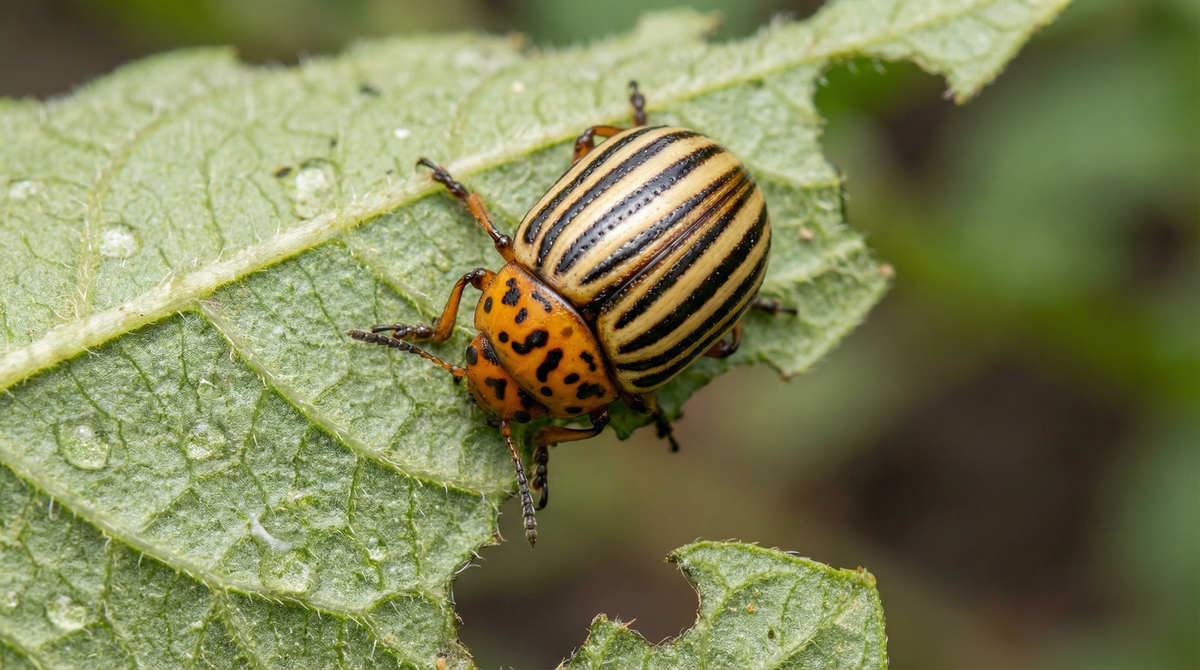
The Colorado potato beetle (Leptinotarsa decemlineata) is one of the most notorious pests of the vegetable garden, capable of stripping a potato or eggplant patch to bare stems in a matter of days. A striped, dome-backed member of the leaf-beetle family Chrysomelidae, it is famous both for its appetite and for its remarkable ability to develop resistance to insecticides — which makes integrated, organic management all the more important. Once a modest beetle feeding on wild nightshades in the American Southwest, it spread explosively across the continent as cultivated potatoes gave it an abundant new food source.
Identification and Description
The adult is a rounded, convex beetle about 1 centimeter long with a yellow-orange body and ten distinctive black lengthwise stripes running down its hardened wing covers (the species name decemlineata means "ten-lined"). The head and thorax are orange with black markings. Eggs are bright orange-yellow, laid in tidy clusters of 20 to 30 on the undersides of leaves. The larvae are unmistakable and arguably more destructive than the adults: plump, humpbacked, brick-red to orange grubs with two rows of black spots along each side, growing larger through four stages of development.
Life Cycle
The Colorado potato beetle overwinters as an adult buried 5 to 10 inches deep in the soil, in or near the previous year's potato patch. In spring the adults emerge to feed, mate, and lay eggs — a single female can produce 300 to 800 eggs over four to five weeks, laid in clusters on leaf undersides. Eggs hatch in 4 to 15 days, and the larvae feed voraciously through four instars over two to four weeks before the mature larvae drop and burrow into the soil to pupate. Adults emerge 5 to 10 days later. Depending on climate there are typically one to three generations per year (activity running May through September), and overlapping generations mean eggs, larvae, and adults are often all present at once.
Habitat and Range
Native to the southwestern United States and Mexico, the Colorado potato beetle is now found across essentially every region of the country — Northeast, Southeast, Midwest, Southwest, West, and Pacific Northwest. It thrives in potato fields, vegetable gardens, and agricultural areas, anywhere its nightshade hosts are grown. Its food plants are members of the nightshade family (Solanaceae): potato above all, but also eggplant, tomato, tomatillo, and related wild and cultivated species.
Role in the Garden
The Colorado potato beetle is a serious pest with a beneficial rating of −5 and no garden value to offset its damage. Both adults and larvae are leaf-feeders, and a heavy infestation can completely defoliate plants, severely reducing potato yields or killing young transplants outright. Because the beetle is so prone to evolving resistance to chemical insecticides, gardeners who rely on a single spray often find it stops working — another reason a diversified, organic strategy is the most durable defense.
Managing the Colorado Potato Beetle
Physical removal is one of the most effective tactics in a home garden: handpick adults, crush the orange egg clusters on leaf undersides, and knock larvae into soapy water, checking plants every few days during the season. Row covers placed over young plants exclude emerging and migrating beetles — just remember to remove them at flowering if the crop needs pollination, and rotate covers off beds where beetles overwintered. Crop rotation is powerful because the overwintered adults emerge with limited flight range; moving nightshades far from last year's patch forces beetles to search and buys the crop time. Trap crops of early potatoes can concentrate beetles for easy destruction. For active control, Spinosad is a highly effective organic insecticide, with neem oil, pyrethrins, and kaolin-clay films (such as Surround) as additional options. Encouraging beneficial predators — ladybugs, lacewings, predatory stink bugs, and ground beetles — helps suppress eggs and young larvae.
Companion Planting
Aromatic and pungent companions can help repel egg-laying beetles. Catnip, tansy, and sage are classic deterrents, and horseradish is widely planted at the corners of potato beds for the same purpose. Bush beans make an especially good partner: beans help repel the potato beetle while the potatoes return the favor by deterring the Mexican bean beetle. Marigolds, nasturtium, coriander, and onion round out a planting that discourages this and other garden pests.
Staying Ahead of the Beetle
The Colorado potato beetle is fast-breeding and adaptable, but it is also vulnerable to consistent, layered management. Rotate your nightshades, cover young plants, scout and handpick relentlessly through the season, support natural predators, and lean on Spinosad and aromatic companions rather than a single repeated spray — and you can keep this striped defoliator from claiming your potato harvest.