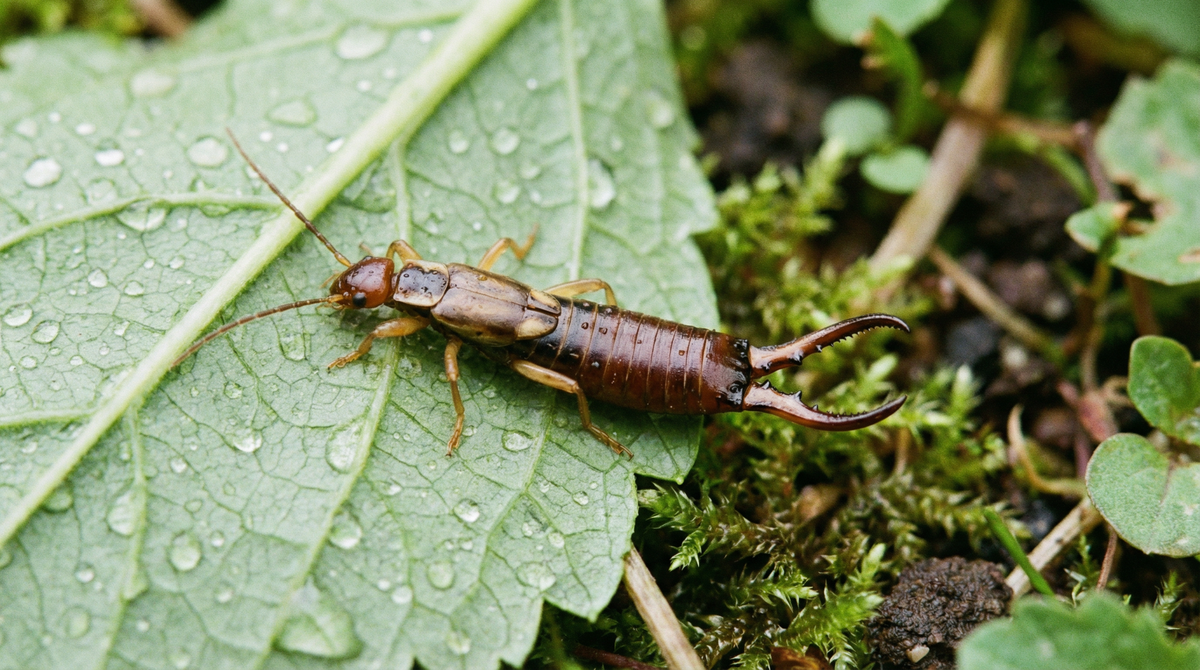
The European earwig (Forficula auricularia) is one of the garden's most misunderstood insects — instantly recognizable by the pincers at the tip of its abdomen, and the subject of an ancient (and entirely false) myth that it crawls into sleepers' ears. In truth the earwig is a mixed character in the garden: it chews holes in soft fruits, flowers, and seedlings, yet it also preys on aphids and other soft-bodied pests and helps break down decaying matter. With a modest beneficial rating of −2, it sits on the line between nuisance and helper, and the goal for most gardeners is simply to keep its numbers in check rather than wage all-out war.
Identification and Description
Earwigs are slender, flattened insects about 1.3 to 1.5 centimeters long, reddish-brown, with short leathery wing covers and — most distinctively — a pair of curved pincers (cerci) at the rear. Males have strongly curved, robust pincers while females' are straighter; the insect uses them for defense, capturing prey, and courtship, not for harming people. Despite having functional wings folded beneath those short covers, earwigs rarely fly. The nymphs look like smaller, paler, wingless versions of the adults. Earwigs are nocturnal, hiding by day in tight, dark, moist crevices and emerging after dark to feed.
Life Cycle
Earwigs undergo incomplete metamorphosis — egg, nymph, adult — and are notable among insects for their maternal care. In the fall the female lays a clutch of 50 to 90 shiny white eggs in an underground nest, sometimes digging surprisingly deep to escape the cold. She then guards the eggs through the winter and continues to tend the newly hatched nymphs in spring, even bringing them food — unusually devoted parenting for an insect. The nymphs pass through five molts before maturing. The female typically dies by midsummer, and the young reach adulthood between late August and early October, ready to mate and begin the cycle again. There is generally one generation per year, with activity from roughly April through October; adults and eggs overwinter in soil nests.
Habitat and Range
Native to Europe, the European earwig is now established across the entire United States — Northeast, Southeast, Midwest, Southwest, West, and Pacific Northwest. It favors gardens, meadows, forests, woodpiles, and the dark, damp spaces under stones and boards. Moisture and tight hiding places are the common thread in earwig habitat, which is the key to both understanding and managing them.
Role in the Garden
The earwig earns a beneficial rating of −2 because it does real but limited damage and also provides some benefit. On the harmful side, it chews ragged holes in the leaves and petals of plants like dahlias, zinnias, marigolds, hostas, and hollyhock, and feeds on soft fruits and tender crops — strawberries, lettuce, celery, seedling beans, beets, corn silks, and young grass shoots. On the helpful side, earwigs are opportunistic predators that eat aphids, insect eggs, and other small soft-bodied pests, and they scavenge decaying organic matter. In orchards in particular they can be net-beneficial aphid controllers. Damage is usually cosmetic and tolerable; problems arise mainly when populations spike in warm, moist, debris-rich gardens.
Managing Earwigs
Control centers on trapping and habitat modification rather than spraying. Traps exploit the earwig's craving for tight, damp daytime shelter: lay rolled-up damp newspaper, corrugated cardboard, or short lengths of hose in the garden before dusk, then in the morning shake the earwigs hiding inside into a bucket of soapy water. Oil-baited cans also work well — sink a low can (a tuna or cat-food tin) to its rim and fill it with vegetable oil plus a drop of bacon grease or fish oil to draw them in. Habitat modification is the long-term fix: reduce moisture with good drainage, manage mulch, and clear debris, leaf litter, thick ground covers like ivy, and woodpiles to eliminate hiding spots — earwigs dislike dry, open conditions. For fruit trees, a sticky barrier such as Tanglefoot around the trunk stops them climbing to the fruit. Spinosad-based baits are an effective, environmentally friendly option for heavier infestations. Note that earwigs are drawn to bright lights, so switching outdoor fixtures to yellow or sodium-vapor bulbs reduces the numbers they attract.
Encouraging Predators
Natural enemies help keep earwig numbers down. Toads, birds, and poultry — chickens and ducks in particular — all relish earwigs, so a garden friendly to these predators tends to stay in balance. Combined with trapping and a tidy, well-drained layout, that natural pressure usually keeps earwigs at tolerable levels.
Living With the Earwig
The earwig is rarely worth a chemical battle. Set out a few damp-newspaper or oil-can traps when damage appears, tidy away the moist debris it shelters in, protect fruit trees with a sticky band, and welcome the toads and birds that eat it — and you can hold this pincered nocturnal forager to a level where its appetite for aphids outweighs the nibbles it takes from your flowers and fruit.