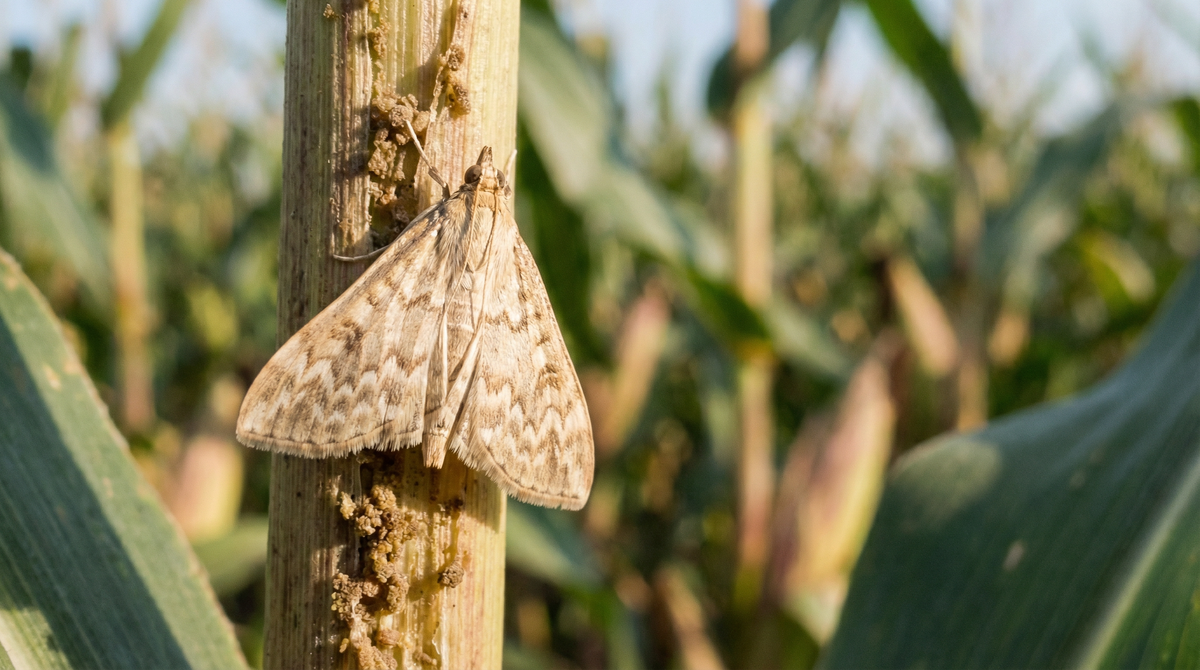
The European corn borer (Ostrinia nubilalis) is one of the most economically damaging insect pests of corn in North America, and a frequent spoiler of backyard sweet corn. A small moth in the family Crambidae, it does its harm as a caterpillar that tunnels into stalks and ears, weakening plants and ruining the harvest from the inside out. Introduced from Europe in the early twentieth century, it spread rapidly through the Corn Belt and beyond, attacking not only corn but a surprisingly wide range of other crops. For the home gardener, a few well-timed organic measures make the difference between clean ears and borer-riddled stalks.
Identification and Description
The adult is a small, inconspicuous moth with a wingspan of about 2.5 to 3 centimeters. Males are darker, pale brown with wavy dark bands across the wings; females are larger and paler yellowish-tan. Both fly at night and hide among foliage by day. The damaging larva is a grayish-pink to creamy caterpillar up to about 2.5 centimeters long, with a dark brown head and a row of small dark spots down its back. Eggs are laid in overlapping, fish-scale-like masses of 15 to 30 on the undersides of leaves, creamy white at first and developing a dark "black-head" stage just before hatching. The telltale signs of infestation are pencil-sized entry holes in stalks and ears, sawdust-like frass at leaf axils, and broken tassels or stalks.
Life Cycle
The European corn borer undergoes complete metamorphosis through egg, larva, pupa, and adult. Adult moths emerge in late spring and early summer and lay their scale-like egg masses on leaf undersides. The eggs hatch in about a week, and the larvae — the destructive stage — first feed on leaves and within the whorl before boring into stalks, midribs, and ears. The larval stage passes through five to six instars over roughly 50 days, followed by a pupal stage of about 12 days that takes place inside the plant. Depending on climate there can be one to four generations per year, with activity from May through September. The borer overwinters as a full-grown larva inside corn stalks and other crop debris left standing in the field — which is exactly why fall cleanup is so important.
Habitat and Range
Native to Europe, the European corn borer is now well established in the United States, particularly across the Northeast, Southeast, and Midwest Corn Belt. It inhabits gardens and agricultural fields wherever its host plants grow. While corn is the primary host, it also attacks peppers, apples, soybeans, and cotton, and it breeds in weedy hosts such as foxtails, pigweeds, ragweeds, and smartweeds — making weedy field margins a hidden reservoir.
Role in the Garden
The European corn borer is a serious pest with a beneficial rating of −5 and no redeeming garden value. By tunneling into stalks it disrupts the flow of water and nutrients, weakening plants and causing stalks and tassels to break; boring into ears it directly damages the kernels and opens the way for mold and rot. Because there can be several generations a season and the larvae are protected inside the plant, infestations are difficult to reverse once larvae have bored in — which puts the emphasis squarely on prevention and timing.
Managing the European Corn Borer
Effective organic control is layered. Monitoring with pheromone traps tracks adult flights so that controls are applied during egg-laying and hatch, before larvae bore into the plant — the only window when sprays can reach them. Biological control is especially valuable: releasing Trichogramma wasps, tiny parasitoids that destroy borer eggs, can substantially reduce the next generation. Bacillus thuringiensis kurstaki (Btk) and Spinosad sprays target young larvae while they are still feeding in the whorl and leaf surfaces, before they tunnel out of reach. Cultural practices are the backbone of long-term control: shred and destroy corn stalks and crop residue after harvest to kill overwintering larvae, and keep fields and margins weed-free to remove the alternative hosts that sustain populations.
Companion Planting
Interplanting with aromatic, umbel-flowered herbs and cover crops helps by attracting the beneficial insects that prey on borer eggs and larvae. Dill, coriander/cilantro, and buckwheat are all useful companions among or near corn — their flowers feed parasitoid wasps and predatory insects that add natural pressure on the borer. These plantings support, rather than replace, monitoring, biological releases, and fall sanitation.
Keeping Corn Clean
The European corn borer is most beatable before it disappears into the stalk. Track the moths, release Trichogramma wasps and spray Btk or Spinosad during egg hatch, plant dill, cilantro, and buckwheat to recruit natural enemies, and above all shred and remove corn debris each fall to deny the borer its overwintering refuge. Together these steps keep this introduced tunneler from hollowing out your harvest.