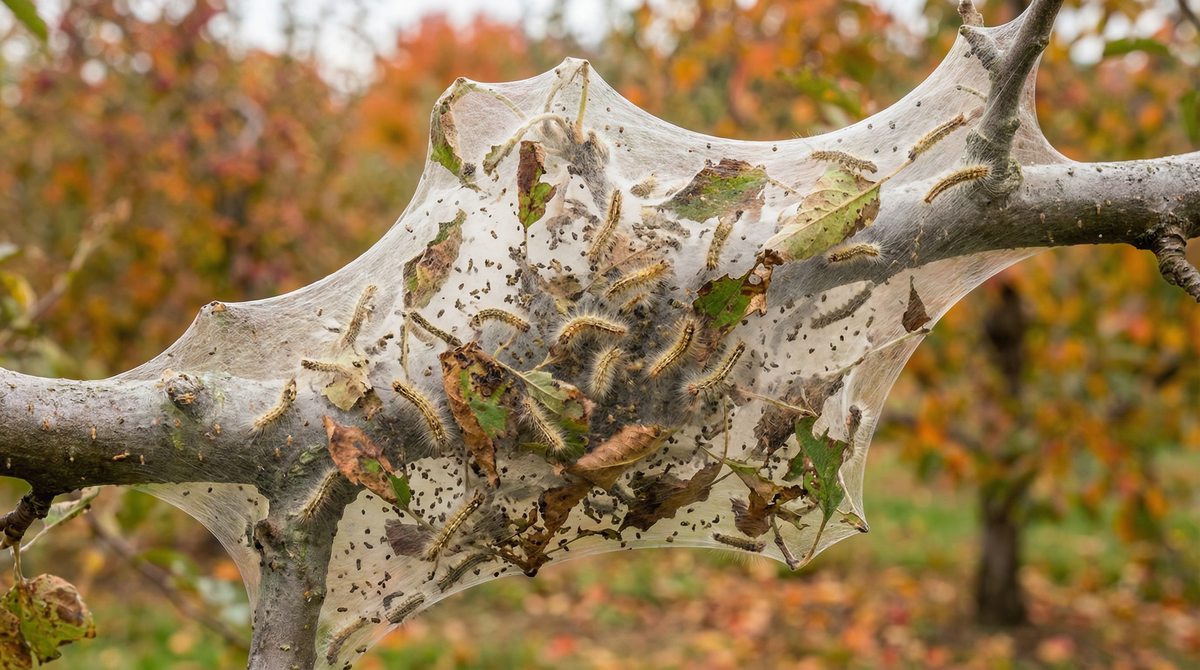
The fall webworm (Hyphantria cunea) is the maker of those conspicuous, gauzy silken nests that engulf the tips of tree branches in late summer and autumn. A native North American moth in the family Erebidae, it feeds on a huge range of deciduous trees, and its sprawling communal webs can look alarming. The good news is that the damage is usually far more unsightly than serious: healthy, established trees tolerate the late-season feeding with little lasting harm. With a beneficial rating of −2, the fall webworm is best thought of as a cosmetic nuisance to manage rather than a threat to panic over.
Identification and Description
The most recognizable sign of the fall webworm is its nest — a loose, dirty-white silken web spun over the ends of branches and enclosing the leaves the caterpillars are eating (this distinguishes it from the eastern tent caterpillar, whose tighter tents sit in the forks and crotches of branches in spring). The caterpillars are hairy and variable, generally pale yellowish-green with a black head or tan with a red head, growing to about 2.5 to 3 centimeters and covered in long, fine tufts of hair. The adult is a mostly white moth, sometimes flecked with small dark spots on the wings, with a wingspan around 3 to 4 centimeters. As the colony grows, the caterpillars keep expanding the web to enclose fresh foliage.
Life Cycle
The fall webworm has one to two generations per year depending on latitude. In late spring or early summer the adult moth emerges from its overwintering pupal case and lays several hundred eggs in a mass on the underside of a leaf. The eggs hatch in one to two weeks, and the young larvae immediately begin feeding together, spinning the communal silk web at the branch tips and feeding on the enclosed leaves. The larval stage lasts about four to six weeks; the caterpillars are most conspicuous from midsummer into fall (activity spans roughly June through October). When fully grown, the larvae leave the web to find a sheltered spot to pupate. The pupa overwinters inside a cocoon in the soil, in leaf litter, or in cracks and crevices in tree bark, completing the cycle the following spring.
Habitat and Range
Native to North America, the fall webworm is found across the entire United States — Northeast, Southeast, Midwest, Southwest, West, and Pacific Northwest — and inhabits gardens, woodlands, forest edges, and roadsides. It is a generalist feeder with an enormous host list: mulberry, walnut, hickory, elm, sweetgum, poplar, willow, oak, linden, ash, apple, and many other fruit and shade trees. Its broad diet and wide range are why those telltale webs turn up almost everywhere by late summer.
Role in the Garden
The fall webworm rates a −2: a minor pest whose bark is worse than its bite. Because the caterpillars feed late in the season — often after trees have already done most of their growing and stored energy for the year — the defoliation rarely causes lasting damage to healthy, established trees, which simply leaf out normally the following spring. The webs are unattractive and a heavy infestation on a young or already-stressed tree can be more taxing, but in most landscapes the fall webworm is a tolerable, mainly aesthetic problem. It also serves as food for many birds and parasitic insects, fitting into the native food web.
Managing the Fall Webworm
Control focuses on mechanical removal and targeted biological sprays. The simplest, most effective approach is to prune out the webs while they are still small and newly formed — clip off the affected branch tips and destroy the nest by bagging it or dropping it in soapy water. For nests too high to reach easily, a pole pruner works, or a forked stick can be twisted into a larger web to wind it up and pull it down. Avoid the temptation to burn webs in the tree, which damages the bark and the branch far more than the caterpillars do. For active feeding, Bacillus thuringiensis (Bt) is the ideal organic insecticide — it specifically targets caterpillars and spares other insects — and works best on young larvae; opening the web first helps the spray reach them. Spinosad and pyrethrin-based products are additional organic options. Encouraging natural enemies — birds, predatory stink bugs, and parasitoid wasps and flies — helps keep populations in check over the long term.
Keeping Perspective on the Webs
Those late-summer webs look dramatic, but the fall webworm seldom warrants more than a little pruning. Snip out and destroy nests while they are small, reach for Bt if caterpillars are actively feeding, support the birds and parasites that prey on them, and remember that an established tree will shrug off the damage. A bit of timely attention keeps this native caterpillar's untidy tents from becoming an eyesore without resorting to harsh chemicals.