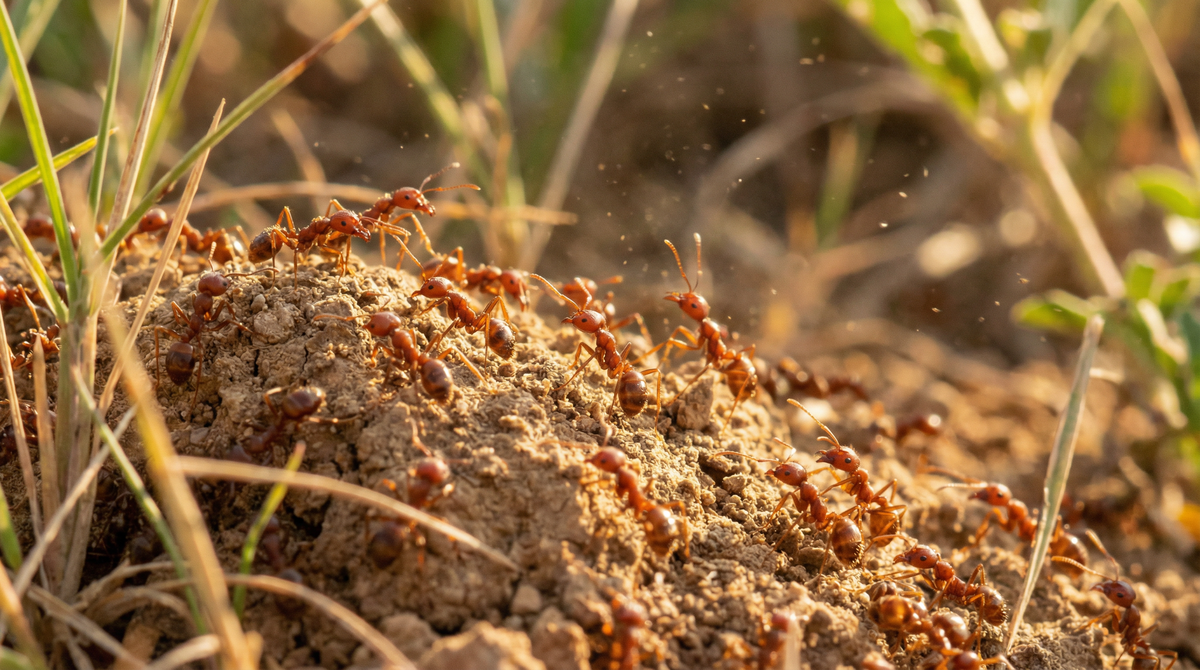
The red imported fire ant (Solenopsis invicta) is one of the most troublesome invasive insects in the southern United States — an aggressive, stinging ant whose mounds dot lawns, pastures, and gardens, and whose painful stings make working the soil a hazard. Accidentally introduced from South America in the early twentieth century, it has spread across the warm Southeast and into the Southwest and West, displacing native ants and disrupting ecosystems along the way. With a beneficial rating of −5, the fire ant offers little upside for the gardener and a great deal of trouble, making informed, persistent management essential where it has taken hold.
Identification and Description
Fire ants are small, coppery reddish-brown to dark ants, with workers of varying sizes (a polymorphic colony) ranging from about 2 to 6 millimeters. The clearest sign of their presence is the mound: a dome of loose, fluffy soil with no obvious central entrance hole, often appearing or expanding after rain. Disturb a mound and the response is unmistakable — workers boil out aggressively and swarm up anything in contact with it, gripping with their jaws and delivering repeated stings. The sting injects venom that produces a burning sensation (hence "fire" ant) and characteristically forms a small white pustule a day or two later. Some people react severely, so caution is warranted.
Life Cycle
Fire ants pass through four stages — egg, larva, pupa, and adult — with the entire cycle taking roughly a month. The queen lays eggs that hatch into grub-like larvae in 6 to 10 days; the larval stage lasts 12 to 14 days, during which workers feed and groom them, followed by a pupal stage of 9 to 16 days before the adult emerges. Unfertilized eggs become winged males, while fertilized eggs become sterile female workers or — with richer feeding — new winged reproductive queens. Mating flights send these winged reproductives out to found new colonies. A mature colony can contain tens to hundreds of thousands of ants and, in some forms of the species, multiple queens. Fire ants are active much of the year (roughly March through November) and overwinter within their mounds, moving deeper to escape cold and emerging to forage on warm days; they fatten up on stored carbohydrates in fall.
Habitat and Range
Native to South America, the red imported fire ant is established in the United States across the Southeast, Southwest, and West. It thrives in open, sunny, disturbed ground — gardens, lawns, meadows, parks, playgrounds, pastures, open fields, and roadsides. Colonies are drawn to and sustained by easy resources: overflowing trash, food crumbs, leaky pipes and standing water, other insects to prey on, and organic matter such as lawn clippings, leaves, and compost.
Role in the Garden
The fire ant rates a −5 and is overwhelmingly a problem species. Its stings make routine gardening painful and can be dangerous to sensitive people, children, pets, and livestock, and its mounds damage lawns and can interfere with equipment. Ecologically it is destructive, outcompeting and preying on native ants and other ground fauna and reducing biodiversity. Fire ants do consume some pest insects and aerate soil, but these minor benefits are far outweighed by the harm — and they often protect sap-sucking pests like aphids and scale in exchange for honeydew, worsening other infestations.
Managing Fire Ants
Fire ant control takes persistence and a combination of methods. Boiling water poured directly onto a mound — at least 3 gallons, ideally on a cool morning when ants are near the surface — kills a meaningful share of the colony (roughly 20 to 60 percent), and adding soap increases its effect; it must usually be repeated. A traditional organic fermentation slurry of warm water, molasses, apple cider vinegar, and instant yeast poured on the mound encourages a fungal growth lethal to the ants. Diatomaceous earth sprinkled around mounds and foraging trails abrades and dehydrates the ants, and orange oil (d-limonene) acts as a repellent and contact killer. Spinosad is an effective biological pesticide and is available in fire-ant baits — but note it is highly toxic to bees, so apply baits carefully, away from blooming plants and never broadcast onto flowers. Reduce what attracts them by sealing food and trash, fixing leaks and standing water, and keeping compost contained.
Repellent Plantings and Long-Term Strategy
While no plant reliably eliminates fire ants, strongly aromatic species — rosemary, mint, catnip, sage, pennyroyal, citronella grass, eucalyptus, and lavender — are often cited as deterrents and are worth incorporating around problem areas. The most durable approach is ecological: build healthy, biodiverse soil and habitat that supports natural competitors and predators, which helps suppress fire ant dominance over time. In areas where the ant is well established, expect ongoing management rather than a one-time fix.
Staying Ahead of the Mounds
The red imported fire ant is a tenacious invader, but a layered, attentive approach keeps it manageable. Treat mounds promptly with boiling water, fermentation slurry, diatomaceous earth, or carefully placed Spinosad bait; remove the food, water, and shelter that draw colonies in; ring problem spots with aromatic herbs; and foster a diverse ecosystem that keeps the ants in check. Consistency, more than any single remedy, is what protects your garden and household from this fiery pest.