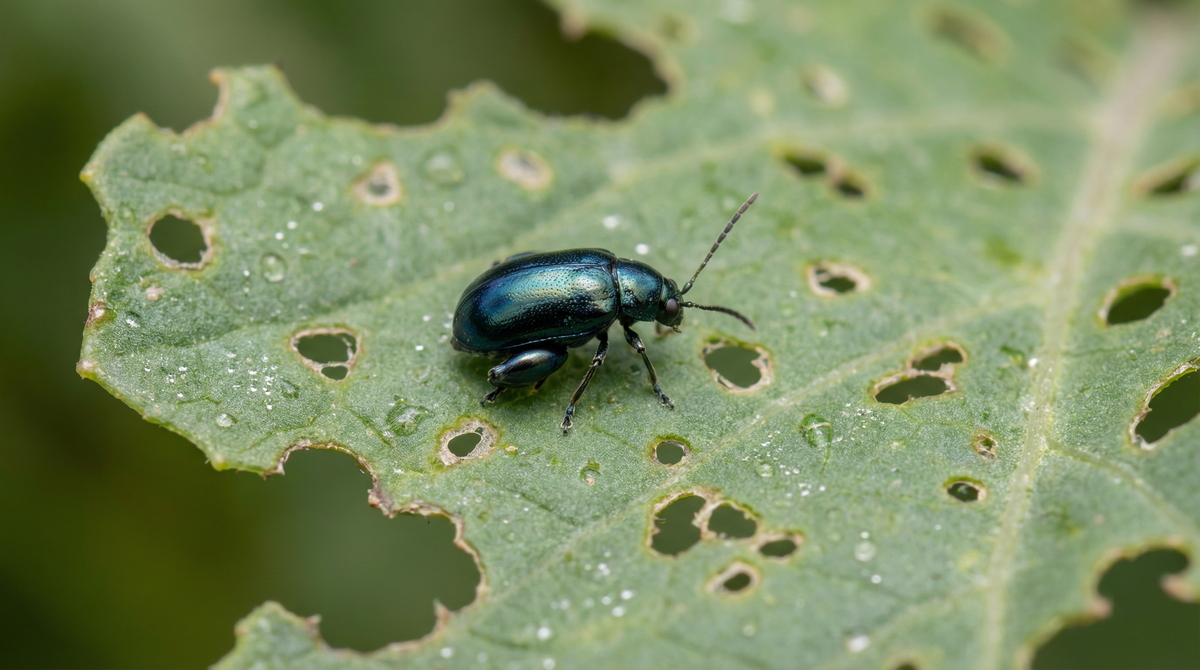
Flea beetles are tiny, jumping leaf beetles (family Chrysomelidae) that pepper the leaves of vegetables with countless small round holes, giving foliage a characteristic "shothole" or buckshot appearance. The name covers many genera and species — Phyllotreta, Epitrix, Disonycha, and Systena among them — but all share the same habits: they leap away explosively when disturbed and swarm tender seedlings in spring. Though small, they can be devastating to young plants, earning a beneficial rating of −4. For gardeners growing brassicas, eggplant, and other favorites, getting plants past the vulnerable seedling stage is the central challenge.
Identification and Description
Flea beetles are very small, generally 1.5 to 3 millimeters long, with hard, often shiny bodies in black, bronze, blue, brown, or striped patterns depending on the species. Their defining feature is a pair of greatly enlarged hind legs, which they use to spring away like a flea the instant they are disturbed — making them surprisingly hard to catch or even spot at first. The damage they leave is the easiest way to identify them: numerous tiny, rounded pits and holes scattered across leaves, especially on young foliage, which can give heavily fed leaves a lacy, wilted look. The larvae are small, pale, slender grubs that live in the soil and feed on roots, generally causing less visible harm than the adults.
Life Cycle
Adult flea beetles overwinter in leaf litter, crop residue, hedgerows, and wooded areas, then become active in early spring, typically around May, when they move to host plants to feed and mate. Females lay eggs in the soil at the base of host plants; the eggs hatch in about 11 to 13 days, and the larvae feed on root hairs and small roots for roughly 25 to 30 days before pupating in the soil for 10 to 15 days. The first generation of new adults appears in late June, with a second generation often emerging in late July — typically one to two generations per year, with activity spanning May through September. This life cycle means the overwintered adults hit seedlings just as they emerge, which is why early-season protection matters so much.
Habitat and Range
Flea beetles are found throughout the United States — Northeast, Southeast, Midwest, Southwest, West, and Pacific Northwest — with native ranges varying by species; many are native to North America. They inhabit gardens, agricultural fields, weedy areas, hedgerows, and wooded edges. Their host range is broad: brassica crops are favorites (bok choy, Napa cabbage, mustard, radishes, broccoli, cabbage, turnips), along with eggplant, peppers, tomatoes, potatoes, spinach, melons, sunflowers, coreopsis, and many weeds, which serve as alternate hosts and reservoirs.
Role in the Garden
Flea beetles are damaging pests rated −4. The shothole feeding by adults is most serious on young seedlings and transplants, where heavy populations can stunt or kill plants outright before they establish; established, vigorous plants usually tolerate the cosmetic holes far better. Beyond the direct leaf damage, some flea beetle species transmit plant diseases — such as bacterial wilt and certain viruses — as they feed, which can be more costly than the chewing itself. The root-feeding larvae add a secondary, less visible drain on the plant.
Managing Flea Beetles
Cultural controls are the first line of defense. Row covers placed over seedlings at planting create a physical barrier that excludes the beetles during the vulnerable early weeks — the single most reliable method, removed only when plants are sturdy or need pollination. Crop rotation and destroying crop residue after harvest remove overwintering sites and break the cycle. Trap crops such as radishes or other fast-growing brassicas can lure beetles away from main crops for concentrated treatment or removal. Delayed planting, mulching, and intercropping further reduce pressure. For biological control, encourage natural enemies — the parasitic wasp Microctonus vittatae, lacewing larvae, big-eyed bugs, and damsel bugs — and apply entomopathogenic nematodes to the soil to attack the larvae. Among organic insecticides, kaolin clay (Surround WP) forms a protective film that deters feeding, while Spinosad (Entrust), pyrethrins (PyGanic), and azadirachtin (neem) provide active knockdown when needed.
Companion Planting
Interplanting can confuse and deter flea beetles. Aromatic herbs — catnip, sage, mint, hyssop, nasturtium, basil, and cilantro — help repel them and mask host crops. To recruit the predators and parasitoids that suppress flea beetles, plant umbrella-flowered species such as yarrow, Queen Anne's lace, fennel, and dill, along with alyssum, cosmos, zinnias, allium, statice, and thyme. Radishes double as both a trap crop and a sacrificial lure planted at the edges of valuable beds.
Getting Seedlings Through
Flea beetles are most dangerous for a short, predictable window — the seedling stage in late spring. Cover young plants, rotate and clean up beds, set out radish trap crops, support beneficial predators with flowering companions, and reach for kaolin clay or Spinosad if pressure spikes. Protect plants through those first vulnerable weeks and most will outgrow the shothole damage and thrive.