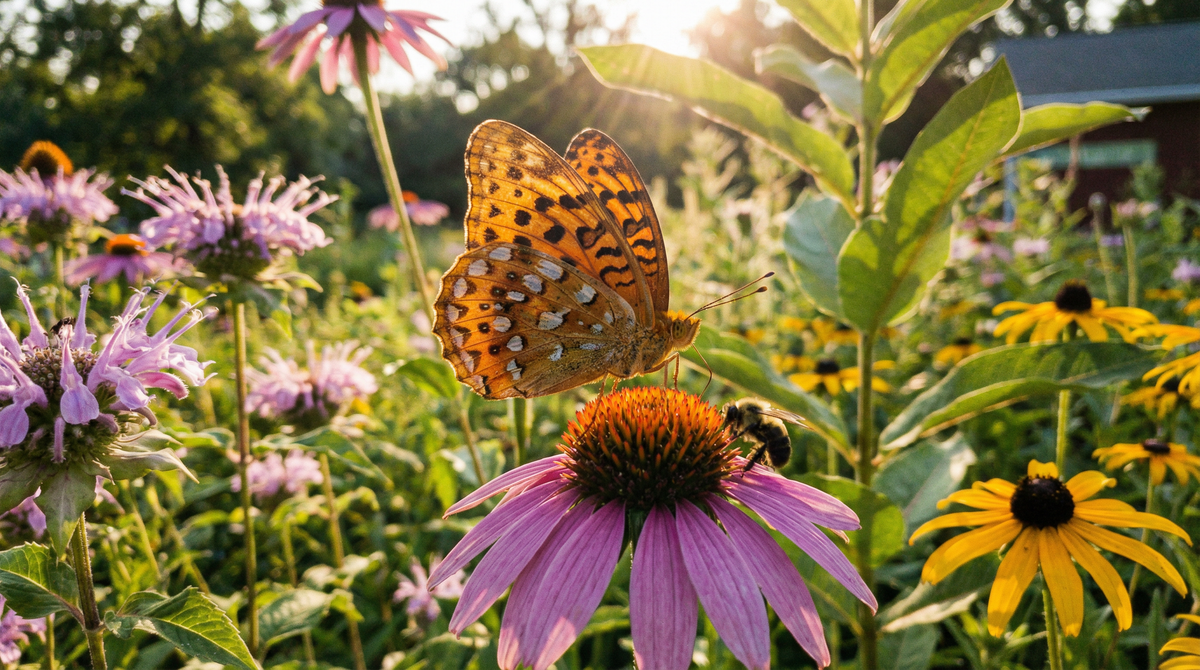
Fritillary butterflies are among the most beautiful and welcome visitors to a summer garden — large, richly patterned orange butterflies that drift from flower to flower, pollinating as they feed. The great spangled fritillary (Speyeria cybele) is one of the most familiar of these, a member of the brush-footed family Nymphalidae whose caterpillars depend entirely on native violets. With a beneficial rating of 4 out of 5, the fritillary is a pure asset to the garden: a pollinator as an adult, a harmless leaf-feeder on wild violets as a larva, and a living indicator of a healthy, pesticide-free landscape.
Identification and Description
Adult fritillaries are medium to large butterflies, with the great spangled fritillary spanning roughly 6 to 9 centimeters. The upperwings are a warm tawny orange laced with a network of black dashes, spots, and crescents. The real signature is on the underside of the hindwing: a band of bright, metallic silver spangles set against a reddish-brown background — the "spangled" of the name — which flashes as the butterfly basks. The caterpillar is velvety black with rows of branching orange-based black spines, and feeds at night, hiding by day. Several related Speyeria and other fritillary species share the same general appearance and habits across the continent.
Life Cycle
The fritillary's life cycle is closely tied to violets and has an unusual seasonal rhythm. In late summer the female lays her eggs on or near the host plant — for most fritillaries this is violet (Viola species) — often scattering them in the vicinity rather than directly on the leaves. The eggs hatch in fall, and the tiny newly hatched caterpillars do something remarkable: they immediately seek shelter in leaf litter and overwinter without feeding, surviving the cold as first-instar larvae. In spring they emerge and feed on the fresh new growth of violets, passing through several instars over about two to three weeks. The caterpillar then forms a chrysalis, and after roughly two weeks the adult emerges. There is typically one generation per year, with adults on the wing from late spring through early fall (active roughly May through October) and living about a month.
Habitat and Range
Native to North America, fritillaries such as the great spangled are found across much of the United States — Northeast, Southeast, Midwest, and West. They favor open, sunny, flower-rich settings: gardens, meadows, forest edges, open grasslands, and parks, typically where their violet host plants grow in nearby woodland edges and moist ground. The combination of violets for the caterpillars and abundant nectar flowers for the adults defines ideal fritillary habitat.
Role in the Garden
Fritillary butterflies are beneficial, rated 4, and bring real value along with their beauty. As adults they are active pollinators, transferring pollen as they nectar at a wide range of flowers, and they are an important part of the native food web. Their caterpillars feed only on wild violets — not on garden vegetables or ornamentals — so they cause no meaningful crop damage; the modest leaf feeding on violets is exactly what these butterflies need to reproduce. There is no reason to control them, and every reason to make room for them.
Attracting Fritillaries
Because fritillaries are beneficial, the goal is to attract and support them. The most important and most overlooked step is to plant and tolerate native violets (Viola species) as host plants — without violets, fritillaries cannot complete their life cycle, so resist the urge to weed them all out and instead let patches persist in semi-shaded, undisturbed corners. For the adults, provide a succession of nectar-rich flowers blooming spring through fall: milkweeds, coneflowers, ironweed, and lantana are all excellent, and passion vine (Passiflora) serves as the host plant for the related Gulf fritillary. Leave leaf litter undisturbed over winter, since that is where the young caterpillars shelter until spring. Provide a water and mineral source — a shallow dish with stones or a damp patch of mud lets adults "puddle" for moisture and minerals. Above all, avoid pesticides, especially broad-spectrum insecticides, which kill caterpillars and adults alike and remove the nectar insects they share the garden with.
A Flash of Silver and Orange
The fritillary rewards a gardener's restraint. Let violets grow, plant a long season of nectar flowers, leave the autumn leaves where they fall, and skip the sprays, and you can host these spangled orange butterflies year after year — adding both pollination and a flash of silver-spotted color to the summer garden.