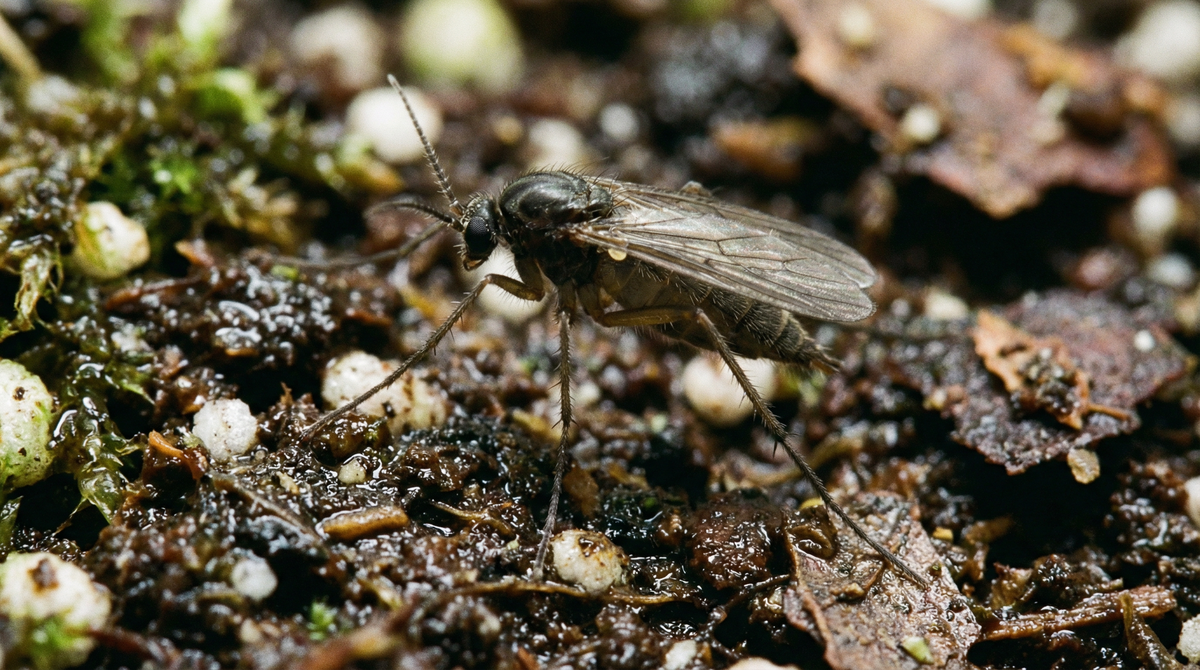
Fungus gnats are the small, dark flies that flit up in clouds whenever you water a houseplant or disturb a tray of seedlings. Belonging mainly to the family Sciaridae (genera such as Bradysia) along with some Orfelia and related species, they thrive anywhere soil stays moist and rich in organic matter. While the adults are mostly a nuisance, their soil-dwelling larvae can damage tender roots and seedlings, especially in greenhouses and indoor plantings — earning the fungus gnat a modest beneficial rating of −2. For most gardeners they are an easily managed problem once you understand their moisture-loving life cycle.
Identification and Description
Adult fungus gnats are tiny, delicate, mosquito-like flies, generally 2 to 4 millimeters long, with slender dark bodies, long legs, a single pair of clear wings, and threadlike antennae. They are weak, erratic fliers that tend to run or hop across the soil surface and foliage as much as fly, and they are drawn to light. The damaging larvae are small, legless, translucent-white maggots up to about 5 millimeters long, with a distinctive shiny black head capsule — they live in the top inch or so of moist soil, where their glistening trails can sometimes be seen on the surface. They are easy to confuse with shore flies, but fungus gnats are more slender and longer-legged.
Life Cycle
Fungus gnats undergo complete metamorphosis — egg, larva, pupa, adult — and breed astonishingly fast in warm conditions, completing a generation in as little as 17 days at around 75°F. Females lay eggs in moist soil or organic debris (a single female can lay 200 to 300 eggs), and these hatch in about 3 to 4 days. The larval stage passes through four instars over roughly 10 days, during which the larvae feed on fungi, decaying organic matter, and plant roots and root hairs. The pupal stage lasts about 4 days, after which short-lived adults (up to about 10 days) emerge to mate and lay again. The result is multiple overlapping generations and explosive population growth in steadily moist soil. Indoors they can breed year-round; outdoors most overwinter as larvae or pupae in moist soil, and a few exceptionally hardy species survive freezing by producing natural antifreeze proteins.
Habitat and Range
Fungus gnats occur worldwide and throughout the United States — Northeast, Southeast, Midwest, Southwest, West, and Pacific Northwest. They are creatures of moisture and decay, common in gardens, greenhouses, on houseplants, and in any damp setting with decomposing organic matter: overwatered potting soil, compost piles, leaf mold, and the rich, peaty mixes used for seedlings. They are drawn to moisture, fungi, decaying organic matter, root hairs, and light — which is why they so often turn up around indoor and greenhouse plants.
Role in the Garden
Fungus gnats rate a −2: more nuisance than catastrophe, but capable of real harm in the wrong setting. In open garden soil their larvae mostly recycle organic matter and fungi and do little damage. The trouble comes in the moist, enclosed conditions of greenhouses, nurseries, and houseplant collections, where high larval numbers feed on fine roots and seedling stems, stunting growth, causing wilting and yellowing, and opening wounds that invite root-rot fungi. The adults, while harmless to plants themselves, can also spread fungal plant pathogens like Pythium as they move between pots. Seedlings and cuttings are the most vulnerable; mature, established plants usually shrug off the feeding.
Managing Fungus Gnats
The single most effective control is moisture management: let the top inch or two of soil dry out completely between waterings, since the eggs and young larvae cannot survive in dry surface soil. Physical barriers help too — a layer of coarse sand, fine gravel, or diatomaceous earth over the soil surface blocks egg-laying and dries out the zone the larvae need. For larval control, soil drenches with Bacillus thuringiensis subspecies israelensis (Bti) or applications of beneficial nematodes (Steinernema feltiae) are highly effective and safe, and predatory mites (Stratiolaelaps scimitus) can be added to the soil to eat eggs and larvae. To knock down adults and monitor populations, use yellow sticky traps laid flat on the soil or an apple cider vinegar trap with a drop of dish soap. Improving drainage, avoiding overwatering, using well-finished (not raw) compost, and bottom-watering all make the environment less hospitable.
Companion and Habitat Strategies
No specific plants reliably repel fungus gnats, though chamomile, cinnamon, and lavender or peppermint oils are sometimes cited as deterrents. A genuinely useful biological ally is carnivorous plants — sundews (Drosera) and butterworts (Pinguicula) trap and consume the adult gnats and double as attractive specimens. The core "companion" strategy, however, is cultural: ensure good drainage and avoid overwatering across all your plants so the soil never becomes the perpetually damp nursery these gnats require.
Drying Out the Problem
Fungus gnats breed fast but die out just as quickly once their moist habitat disappears. Let the soil surface dry between waterings, top pots with sand or diatomaceous earth, drench with Bti or nematodes for stubborn larvae, and trap adults on yellow cards — and you can clear an infestation without harsh chemicals while protecting your seedlings and houseplants from this damp-loving fly.