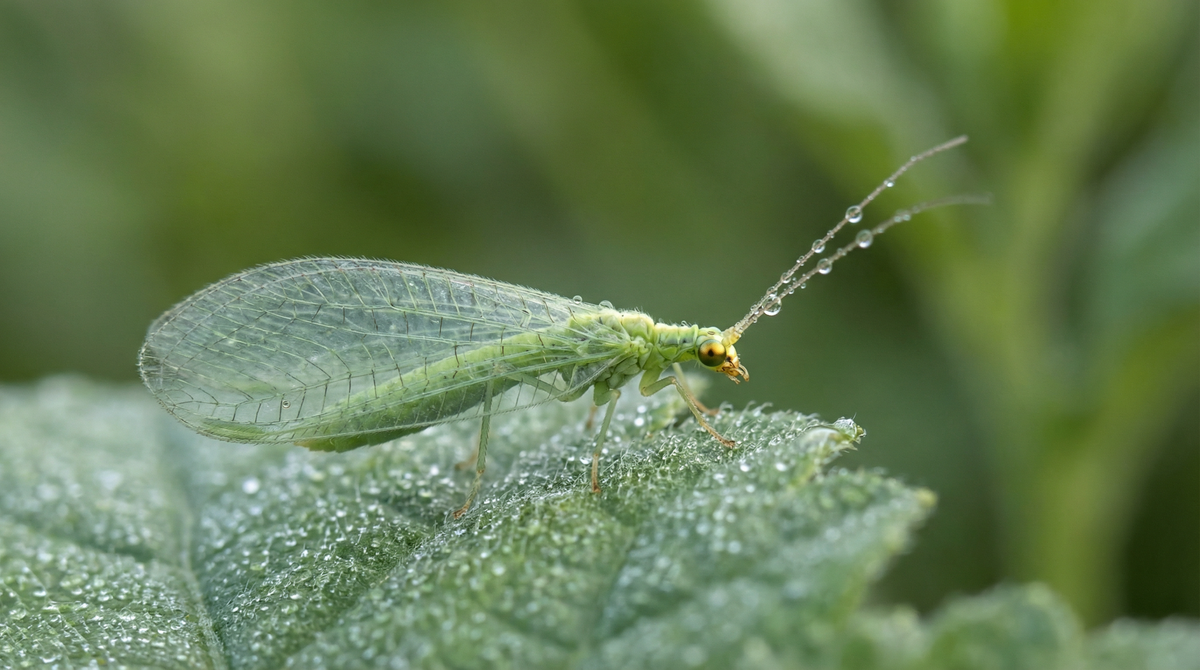
The green lacewing (Chrysoperla carnea) is one of the most valuable predators a gardener can host — a delicate, gauzy-winged insect whose fierce larvae devour aphids and other soft-bodied pests by the hundreds. Belonging to the order Neuroptera and the family Chrysopidae, adult lacewings are ethereal and beautiful, but it is their alligator-like young, aptly nicknamed "aphid lions," that do the real work of natural pest control. With a beneficial rating of 5 out of 5, the green lacewing is a cornerstone of any organic garden's living defense system, and attracting a resident population is one of the smartest things a grower can do.
Identification and Description
Adult green lacewings are slender, pale green insects about 1 to 2 centimeters long, with long antennae, striking golden or coppery eyes, and two pairs of large, transparent, intricately veined wings held tent-like over the body — the lacy wings that give them their name. They fly weakly at night and are often drawn to lights. The eggs are unmistakable and a delight to find: each pale green oval is perched at the end of a fine, hair-like silken stalk, standing up from the leaf surface like a tiny lollipop — an adaptation that protects them from predators, including their own siblings. The predatory larva looks like a miniature, flattened alligator: spindle-shaped, mottled brown and cream, with prominent sickle-shaped jaws it uses to seize and drain prey.
Life Cycle
The green lacewing undergoes complete metamorphosis through egg, larva, pupa, and adult. A female lays 100 to 300 eggs, each on its own silken stalk attached to a leaf or stem near pest colonies. The eggs hatch in 3 to 6 days into larvae, and this larval stage — lasting two to three weeks through three instars — is the primary predatory phase, the larva growing from under 1 millimeter to about 8 millimeters as it feeds voraciously. When mature, the larva spins a small round silken cocoon in a sheltered spot and pupates for 10 to 14 days before the adult emerges. The full cycle takes about 4 to 6 weeks in summer, producing two to several overlapping generations a year (active roughly April through October). Adults typically overwinter in sheltered places — leaf litter, under bark, at field edges — and in colder climates some species overwinter as pupae in their cocoons.
Habitat and Range
Native to North America, the green lacewing is found across the entire United States — Northeast, Southeast, Midwest, Southwest, West, and Pacific Northwest. It flourishes in gardens, agricultural fields, meadows, forests, orchards, and any landscape rich in flowering plants, which supply the nectar and pollen adults need. A diverse, bloom-filled garden with a steady supply of small prey is ideal lacewing habitat.
Role in the Garden
The green lacewing earns the top rating of 5 as one of the garden's premier biological controls. The "aphid lion" larvae are generalist predators with an enormous appetite, consuming aphids, thrips, mealybugs, leafhoppers, scale insects, whiteflies, spider mites, small caterpillars, and the eggs of many pests — a single larva can eat hundreds of aphids during its development. The adults of this species feed mainly on nectar, pollen, and honeydew, fueling prolific egg-laying that keeps predatory larvae coming all season. Because they attack such a broad range of pests and reproduce quickly, lacewings help hold infestations in check before they explode, reducing or eliminating the need for sprays.
Attracting and Supporting Green Lacewings
Because lacewings are wholly beneficial, the goal is to attract and keep them. The most effective strategy is to plant a diversity of insectary flowers that supply nectar and pollen to the adults — plants from the carrot family (Apiaceae) such as dill, fennel, angelica, and coriander/cilantro, and from the aster family (Asteraceae) such as cosmos, yarrow, and Queen Anne's lace provide a continuous food source across the season. Provide a water source, since the larvae are vulnerable to drying out. Crucially, avoid broad-spectrum and persistent insecticides and miticides, which kill lacewings at every life stage and remove the prey they depend on; dust and ant activity (ants defend aphids from predators) also discourage them. Tolerate a small level of aphids — for example on a sacrificial nasturtium — so there is always food to retain a resident, reproducing population. For greenhouses or targeted outbreaks, commercially available lacewing eggs or larvae can be released to boost numbers quickly.
A Predator Worth Courting
Few allies repay a gardener like the green lacewing. Fill the garden with dill, cosmos, yarrow, and Queen Anne's lace, keep water available, put away the broad-spectrum sprays, and tolerate a few aphids to keep the aphid lions fed — and you can maintain a standing army of these lacy-winged predators, ready to knock back pest outbreaks naturally, year after year.