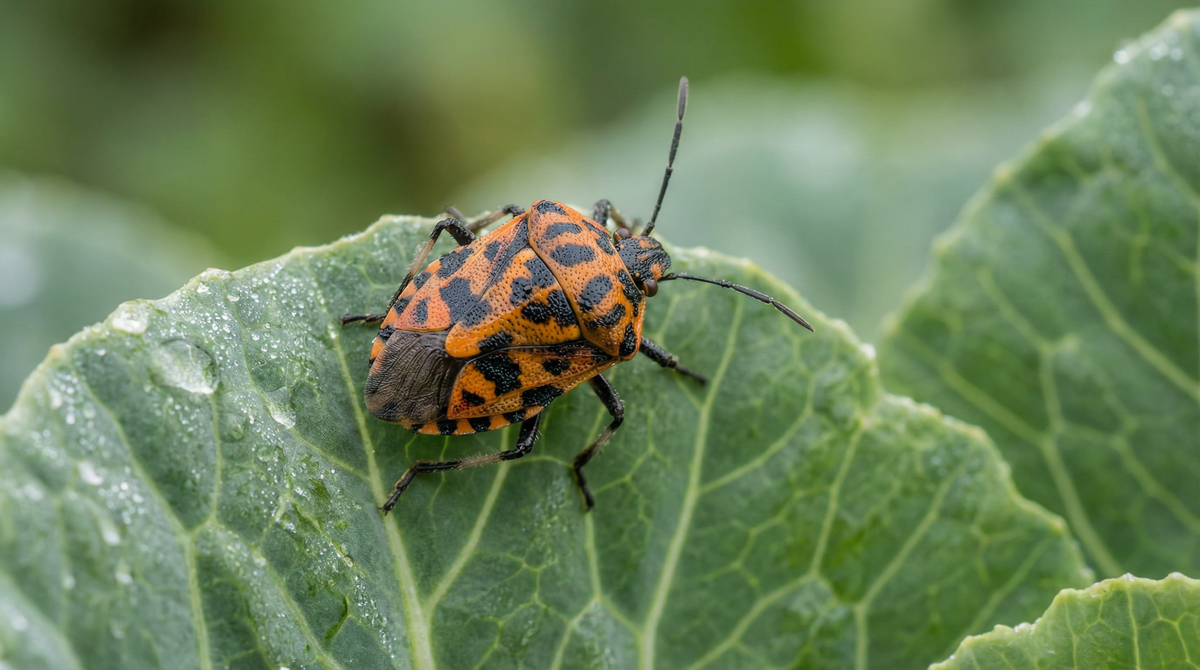
The harlequin bug (Murgantia histrionica) is one of the most damaging pests of cabbage-family crops in the warmer parts of the country — a strikingly colorful stink bug whose bold red-and-black pattern belies the serious harm it does to brassicas. A member of the stink bug family Pentatomidae, it pierces leaves and stems with its needle-like mouthparts and sucks out the plant's juices, leaving behind blotched, wilted, and often killed plants. Despite its beauty, the harlequin bug earns a beneficial rating of −5, and gardeners in its range need to stay vigilant to protect their cabbage, kale, and mustard crops.
Identification and Description
The harlequin bug is unmistakable: a flat, shield-shaped bug about 1 centimeter long, boldly patterned in shiny black with red, orange, or yellow markings — the harlequin's motley coloring that gives it its name. This warning coloration advertises that it is distasteful to predators. The barrel-shaped eggs are equally distinctive, laid in neat double rows and resembling tiny white kegs banded with two black hoops, standing upright in clusters on the undersides of leaves. The nymphs look like smaller, rounder, wingless versions of the adults, similarly marked in red and black, and darken as they mature through successive molts.
Life Cycle
The harlequin bug undergoes incomplete metamorphosis with three stages — egg, nymph, and adult — completing a generation in 50 to 80 days. Females lay their barrel-shaped eggs in clusters on leaf undersides, and the emerging nymphs pass through five instars, feeding all the while, before reaching adulthood. There are two to three generations per year, and in mild climates the bug is active across a long season (roughly March through November). Adults overwinter in sheltered spots in and around the garden — among winter crops, weeds, and organic debris — then emerge in spring to attack the earliest brassicas. That overwintering habit is the key vulnerability, since fall cleanup removes their refuge.
Habitat and Range
Native to Central America, the harlequin bug is found across much of the United States, with its greatest impact in the warmer Southeast, Southwest, and parts of the Midwest, West, and Northeast. It favors gardens and weedy areas. Its preferred hosts are brassicas — cabbage, broccoli, cauliflower, kale, collard greens, mustard, turnip, and radish — but it also feeds on a wide range of other plants including asparagus, beans, beets, eggplant, okra, peppers, tomatoes, sunflowers, cotton, fruit trees, and cleome, plus weedy hosts such as wild mustard, shepherd's purse, pigweed, and lambsquarter that sustain populations between crops.
Role in the Garden
The harlequin bug is a serious pest rated −5, with no offsetting benefit. Both nymphs and adults feed by inserting their piercing-sucking mouthparts and draining plant sap, producing pale, yellow-and-white blotches or stippling where they feed. Heavy feeding causes leaves to wilt, brown, and die, and young or lightly established plants can be killed outright. Because populations build across two or three generations and both life stages feed, an unchecked infestation can devastate a brassica planting quickly, especially in hot weather.
Managing the Harlequin Bug
Control relies on vigilance and a combination of physical and cultural methods. Handpicking is highly effective in a home garden: regularly pick and crush adults and nymphs and, most importantly, scout leaf undersides for the distinctive barrel-shaped egg clusters and destroy them before they hatch. Floating row covers placed over crops exclude the bugs, particularly valuable for protecting young plants early in the season. For larger infestations, insecticidal soap or neem oil sprayed directly on the soft-bodied nymphs gives the best results, since nymphs are far more susceptible than the tougher adults. Critically, end-of-season sanitation — removing all crop debris and controlling nearby weeds — eliminates the sheltered sites where adults overwinter, dramatically reducing next spring's population.
Trap Crops and Companion Planting
Cleome (spider flower) makes an excellent trap crop: harlequin bugs strongly prefer it, so a planting of cleome draws them away from valuable brassicas, where they can be concentrated and then removed or sprayed. Early mustard or other favored brassicas can serve the same purpose as sacrificial early plantings. To help mask the scent of host crops, interplant strongly aromatic companions such as chamomile, celery, basil, garlic, mint, rosemary, and sage. These tactics work best as part of an integrated program alongside handpicking and sanitation.
Protecting the Brassica Patch
The harlequin bug is beautiful but unforgiving on cabbage-family crops. Scout leaf undersides and crush the barrel-shaped eggs, cover young plants, spray nymphs with soap or neem when numbers climb, lure adults to cleome trap crops, and clean up thoroughly each fall to deny them a winter home. Consistent attention through the season keeps this colorful stink bug from turning your brassica bed into its buffet.