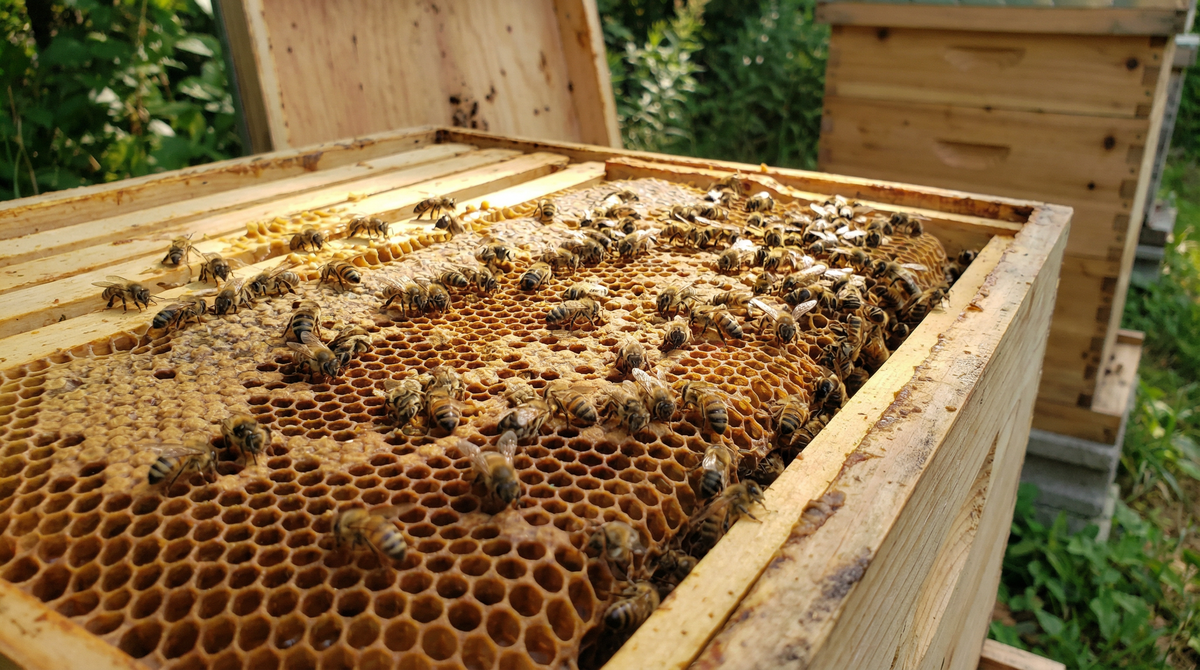
The honeybee (Apis mellifera) is perhaps the most celebrated beneficial insect in the world — the tireless pollinator behind a large share of the fruits, vegetables, nuts, and seeds we eat, and the maker of honey and beeswax. A highly social insect in the family Apidae, it lives in large, cooperative colonies whose coordinated labor pollinates crops and wildflowers across the landscape. With a beneficial rating of 5 out of 5, the honeybee is a gardener's greatest ally, and supporting bees is one of the most impactful things anyone can do for a productive, biodiverse garden.
Identification and Description
Honeybees are golden-brown to amber insects, roughly 1 to 1.5 centimeters long, with fuzzy, banded bodies, two pairs of wings, and branched body hairs that trap pollen as they forage. The pollen-collecting workers carry bright yellow-to-orange pollen loads packed onto the "baskets" of their hind legs, a familiar sight on garden flowers. A colony contains three castes: a single reproductive queen (longer-bodied, the mother of the hive), thousands of sterile female workers (the foragers, nurses, and builders you see on flowers), and seasonal male drones (stouter, with large eyes, whose role is to mate). Honeybees are often confused with bumblebees (rounder and far fuzzier), wasps (smooth, narrow-waisted), and harmless honeybee mimics like hover flies; unlike aggressive wasps, foraging honeybees are docile and sting only in defense.
Life Cycle and Colony
Honeybees undergo complete metamorphosis — egg, larva, pupa, adult — all within the wax comb of the hive. The queen lays eggs in individual cells; fertilized eggs become workers or new queens (depending on diet, with future queens fed royal jelly), while unfertilized eggs become drones. Larvae are fed by nurse workers and capped in their cells to pupate, emerging as adults after about three weeks for workers. A worker lives just a few weeks in the busy summer, progressing through in-hive jobs before graduating to foraging, while a queen may live several years. The honeybee is unusual in that the whole colony overwinters together: rather than dying off or hibernating individually, the bees cluster tightly around the queen and vibrate their flight muscles to generate heat, living through winter on stored honey. This is why a strong honey store and a healthy fall colony are essential to survival.
Habitat and Range
Originally native to Europe, Africa, and western Asia, Apis mellifera has been carried by beekeepers around the globe and is now found throughout North America and most of the world. Colonies nest in cavities — hollow trees, wall voids, and, most familiarly, managed hive boxes — and workers range up to several miles from the nest in search of nectar and pollen. Honeybees thrive wherever there is a diverse, season-long succession of flowering plants: gardens, orchards, meadows, hedgerows, and farmland all provide forage.
Role in the Garden
The honeybee is supremely beneficial, earning the top rating of 5. As it moves from bloom to bloom gathering nectar and pollen, it transfers pollen between flowers, pollinating a vast array of garden and orchard crops — apples, berries, squash, melons, cucumbers, and countless others set far better fruit with bee visitation. This pollination is the honeybee's overwhelming value to the garden, boosting yields and seed set, and it also supports the wild plants that feed other wildlife. As a bonus, managed colonies produce honey and beeswax. Honeybees cause no plant damage whatsoever; their presence is purely an asset and a sign of a healthy, flower-rich environment.
Attracting and Supporting Honeybees
Because honeybees are wholly beneficial, the goal is to attract and protect them. Plant a diversity of flowers that bloom in succession from early spring through fall, so there is always nectar and pollen available — bees especially favor single (not double) flowers and are drawn to blue, purple, white, and yellow blooms. Include bee favorites such as clover, lavender, borage, oregano, thyme, sunflowers, coneflowers, asters, goldenrod, fruit trees, and flowering herbs, and plant in generous clumps that are easy for foragers to find. Provide a shallow water source — a dish with pebbles or floating corks gives bees a safe place to drink without drowning. Most importantly, avoid pesticides, especially systemic neonicotinoids and any insecticide applied to open blooms; if treatment is ever unavoidable, apply only in the evening when bees are not foraging. Leaving some undisturbed ground, hedgerows, and flowering "weeds" like dandelions and clover further supports both honeybees and native pollinators.
Guardian of the Harvest
No insect does more to fill a garden with fruit and seed than the honeybee. Offer a long season of diverse blooms, keep clean water available, and put away the sprays, and you will draw these gentle, golden foragers to your garden — where their pollination quietly multiplies your harvest and sustains the wider web of life around it.