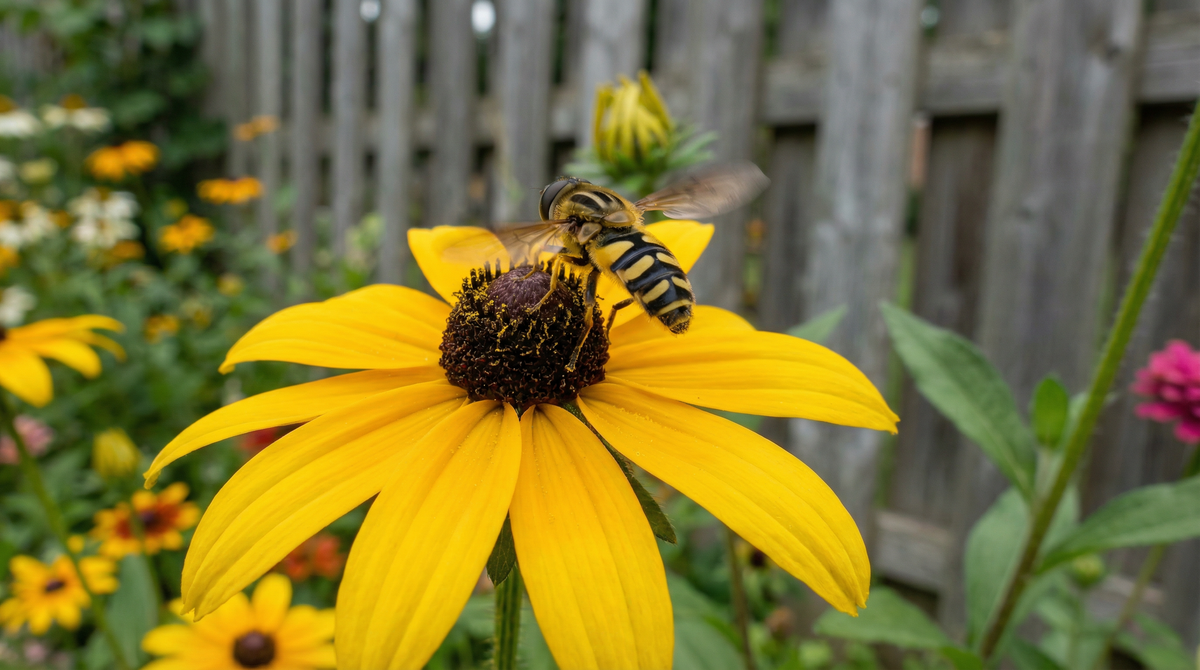
Hoverflies (family Syrphidae), also called flower flies or syrphid flies, are among the most doubly useful insects in the garden — beneficial on two fronts at once. The adults are important pollinators, hovering at flowers to sip nectar, while their unassuming larvae are ferocious predators of aphids and other soft-bodied pests. Often mistaken for bees or wasps thanks to their yellow-and-black markings, hoverflies are harmless flies that neither sting nor bite. With a beneficial rating of 5 out of 5, they are a cornerstone of natural pest control and one of the easiest beneficial insects to attract.
Identification and Description
Adult hoverflies are small to medium flies, typically 8 to 15 millimeters long, many boldly patterned in yellow and black bands that mimic bees or wasps — a defensive disguise, since they are completely harmless. The best way to tell them apart is behavior and anatomy: hoverflies have just one pair of wings (bees and wasps have two pairs), short stubby antennae, very large eyes, and the remarkable ability to hover motionless in midair and dart sideways, which no bee does. The larvae look entirely different — small, legless, tapering maggots, often greenish or translucent, that creep slug-like over foliage; despite their humble appearance they are voracious aphid hunters. The pupa is a hardened, teardrop-shaped case attached to a leaf or tucked in the soil.
Life Cycle
Hoverflies undergo complete metamorphosis through egg, larva, pupa, and adult. The female lays single, tiny white eggs on leaves, deliberately placing them right beside aphid colonies so her young hatch into a ready meal. The eggs hatch in about 3 days, and the legless larvae develop through three instars over one to three weeks, feeding voraciously the whole time — a single larva can consume up to 400 aphids before it matures. The larva then forms a teardrop-shaped pupa on the plant or in the soil, and the adult emerges in one to two weeks. With a fast cycle, there can be five to seven generations per year depending on climate (active roughly April through October). Hoverflies overwinter either as pupae in the soil and leaf litter or as adults sheltered in protected spots.
Habitat and Range
Hoverflies are widespread globally and found across the entire United States — Northeast, Southeast, Midwest, Southwest, West, and Pacific Northwest. They favor gardens, meadows, forest edges, and any fields rich in flowers and foliage. Because the adults need nectar and pollen and the larvae need aphids, gardens that combine abundant blooms with a tolerance for a few pests make ideal hoverfly habitat.
Role in the Garden
Hoverflies rate a top 5 because they deliver two benefits at once. As adults they are effective pollinators, visiting a wide range of flowers for nectar and pollen and often working in cooler or cloudier conditions when bees are less active. As larvae they are outstanding aphid predators, and they also take thrips, scale insects, small caterpillars, and other soft-bodied pests — quietly clearing infestations from the underside of leaves. This combination of pollination and pest control, delivered by a harmless insect that poses no threat to plants or people, makes the hoverfly one of the most valuable allies a gardener can cultivate.
Attracting and Supporting Hoverflies
Because hoverflies are wholly beneficial, the goal is to draw them in and keep them breeding. The key is to plant an abundance of small, open, shallow flowers that give the short-tongued adults easy access to nectar and pollen. Excellent choices include plants in the carrot family (Apiaceae) such as dill, fennel, and cilantro, and composite flowers like yarrow, cosmos, and sweet alyssum. Aim for a continuous succession of blooms from spring through fall so adults always have food, and interplant these flowers directly among aphid-prone vegetables so females lay eggs where their larvae can hunt. Provide a water source, and above all avoid broad-spectrum insecticides, which kill hoverflies at every stage and destroy the aphid prey their larvae need. Tolerating a modest level of aphids ensures there is always food to keep a resident hoverfly population at work.
A Note on Companion Planting
Interplanting flowers like yarrow, dill, fennel, and alyssum next to susceptible crops is the single most effective way to recruit hoverflies for natural aphid control — the adults come for the flowers and stay to lay eggs among the pests. Interestingly, some strongly aromatic plants and oils (mint, peppermint and clove oils, citronella, and marigolds) are noted as less attractive or even repellent to them, so lean on the open, nectar-rich blooms above when your aim is to bring hoverflies in.
Two Gifts in One Insect
Few garden visitors work as hard as the hoverfly. Fill the garden with dill, fennel, yarrow, and alyssum, keep blooms coming all season, skip the sprays, and tolerate a few aphids to feed the larvae — and you will host these hovering, bee-mimicking flies that pollinate your flowers by day and whose hungry young clear your plants of aphids from below.