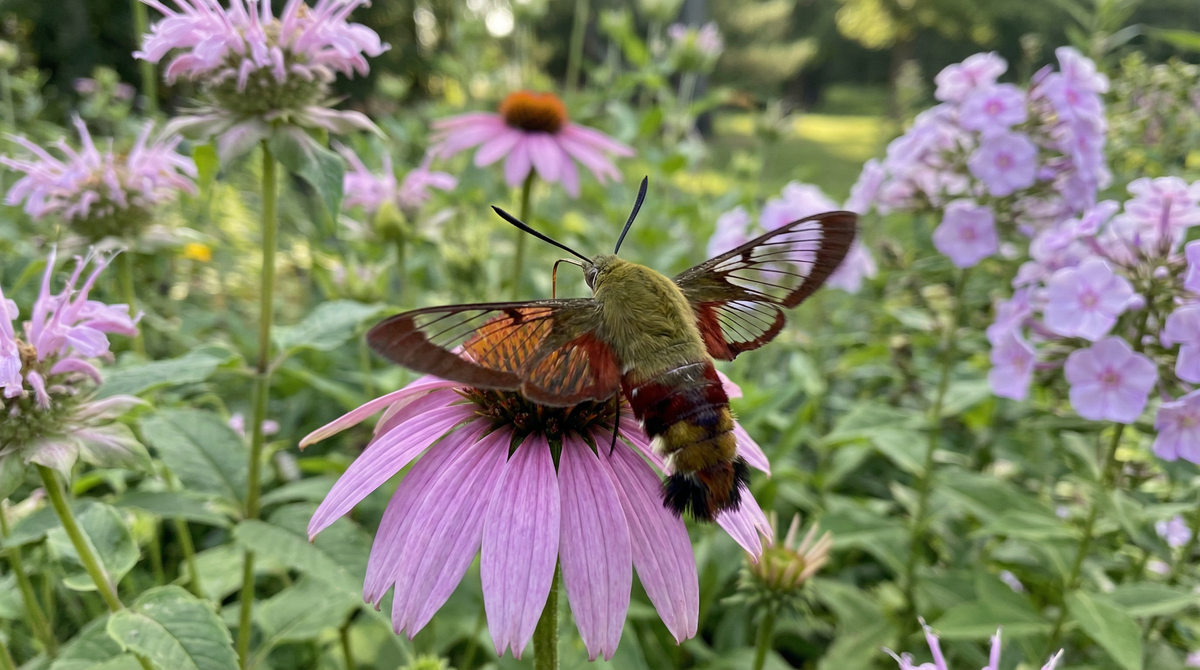
The hummingbird clearwing (Hemaris thysbe) is one of the garden's most delightful surprises — a plump, fuzzy moth that hovers at flowers in broad daylight, sipping nectar through a long tongue and beating its wings so fast it is routinely mistaken for a tiny hummingbird. A member of the sphinx or hawk moth family (Sphingidae), this day-flying pollinator brings the charm of a hummingbird at a fraction of the size. With a beneficial rating of 4 out of 5, it is a welcome and harmless visitor, and a flower-rich garden is the surest way to invite it in.
Identification and Description
The hummingbird clearwing is a stout, richly colored moth with a wingspan of roughly 4 to 5.5 centimeters. Its body is olive-green to golden on top with a burgundy or reddish-brown abdomen, and — as the name promises — its wings are largely transparent, with only reddish-brown borders and veins, the clear panels a result of scales shed shortly after emergence. It hovers at blossoms with an audible hum, uncoiling a long proboscis to feed while remaining airborne, and it flies during the day, unlike most moths. The caterpillar is a classic hornworm: yellowish-green with darker green and reddish-brown banding and the small tail "horn" typical of sphinx moth larvae. It is easily distinguished from the similar snowberry clearwing, which is more boldly black-and-yellow like a bumblebee.
Life Cycle
The hummingbird clearwing passes through complete metamorphosis — egg, larva, pupa, adult. The female lays small green eggs on the undersides of host plant leaves, and these hatch in about a week. The caterpillar feeds on the foliage of its host plants for around four weeks, growing through several instars, then descends to spin a loose cocoon at ground level and pupate in the soil or leaf litter, where it overwinters. In southern climates there are two broods a year, with adults on the wing in late spring and again in late summer; in northern regions there is a single brood. Adults are active across the warm months (roughly March through October depending on latitude). Because the pupae overwinter in leaf litter and surface soil, leaving those undisturbed helps the next generation survive.
Habitat and Range
Native to North America, the hummingbird clearwing ranges across the entire United States — Northeast, Southeast, Midwest, Southwest, West, and Pacific Northwest. It frequents gardens, meadows, forest edges, and second-growth woodlands, favoring open, sunny, flower-filled settings near the shrubs and trees its caterpillars use as hosts. Its larval hosts include honeysuckle, viburnum, snowberry, hawthorn, cherry, European cranberry bush, and dogbane, while the adults nectar at a wide range of blooms.
Role in the Garden
The hummingbird clearwing is a beneficial pollinator, rated 4. As it hovers from flower to flower drinking nectar, it transfers pollen and helps pollinate garden and wild plants, all while adding the spectacle of a hovering, hummingbird-like moth to the daytime garden. Its caterpillars feed on the leaves of woody hosts like honeysuckle and viburnum but rarely cause significant damage, and the modest feeding is simply part of producing the next generation of pollinators. There is no reason to control this moth — it is a charming asset, not a pest.
Attracting the Hummingbird Clearwing
Because this moth is beneficial, the goal is to attract and support it. Fill the garden with a variety of native, nectar-rich flowers, and lean toward pink and purple blooms, to which the hummingbird clearwing is especially drawn. Outstanding nectar choices include bee balm (Monarda), phlox, red clover, zinnias, and blueberries, along with many other tubular and open flowers. Just as important, provide larval host plants — honeysuckle, viburnum, snowberry, hawthorn, and cherry — so females have somewhere to lay eggs and the population can establish and persist. Leave leaf litter and undisturbed soil beneath and around these plants so overwintering pupae survive the winter. Above all, avoid pesticides, which kill both the adult moths and their caterpillars; there are no plants known to repel this welcome visitor, so the garden can be planned entirely around drawing it in.
A Hummingbird in Miniature
Few insects bring as much wonder as the hummingbird clearwing hovering at a patch of bee balm on a summer afternoon. Plant pink and purple nectar flowers, add honeysuckle and viburnum for the caterpillars, leave the fallen leaves in place through winter, and skip the sprays — and you can enjoy this hovering, clear-winged pollinator returning to your garden brood after brood.