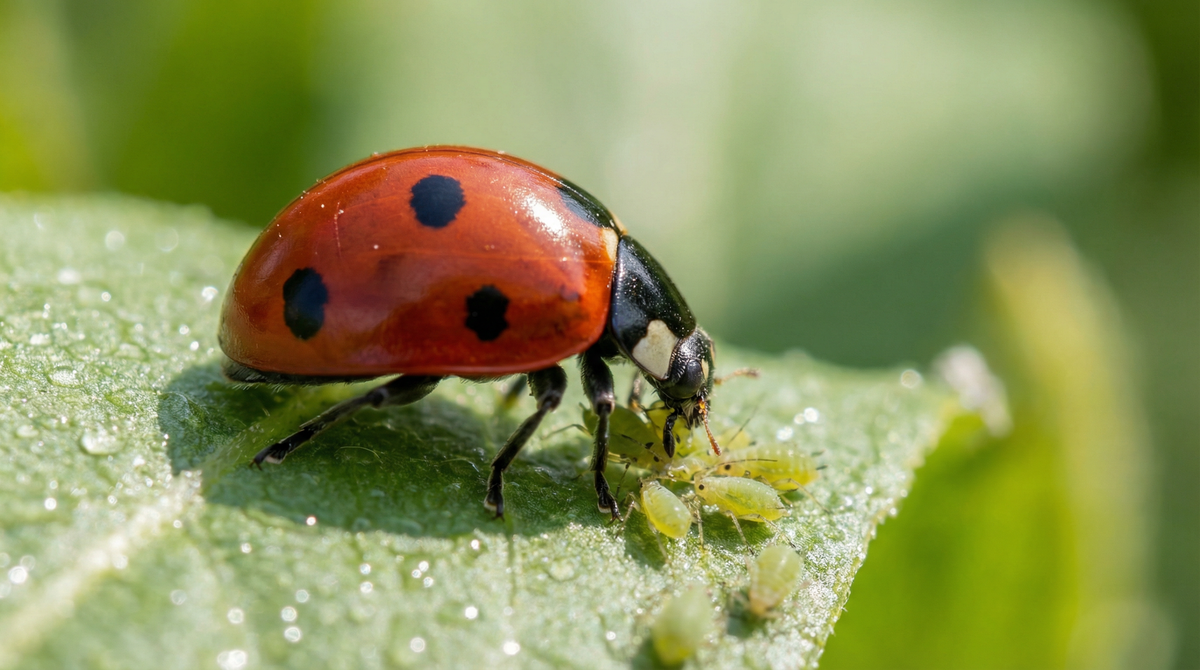
The lady beetle (family Coccinellidae) — also called the ladybug or ladybird — is the most beloved and recognizable beneficial insect in the garden, and for good reason. Behind its cheerful, polka-dotted shell is one of nature's most effective aphid predators, devouring pests by the thousands at both the larval and adult stages. With a beneficial rating of 5 out of 5, the lady beetle is a cornerstone of natural pest control, and a garden that welcomes it gains a hardworking, self-replenishing ally against many of its most common pests.
Identification and Description
Adult lady beetles are small, round to oval, dome-backed beetles, typically 1 to 10 millimeters long, most familiarly red or orange with black spots — though the family is enormously varied, including yellow, black, and spotless forms, and the number of spots differs by species. They have short legs and antennae and can tuck tightly against a leaf when threatened, sometimes releasing a bitter yellow fluid as a defense. Far less recognized but just as important are the larvae, which look nothing like the adults: elongate, tapering, alligator-like creatures, usually dark blue-gray or black with orange or yellow markings and a slightly spiny appearance. Learning to recognize these larvae is one of the most useful skills a gardener can have, since they are voracious predators and are too often mistaken for pests and destroyed. The eggs are small, spindle-shaped, and yellow to orange, laid upright in tidy clusters.
Life Cycle
Lady beetles undergo complete metamorphosis — egg, larva, pupa, adult. Females lay their spindle-shaped eggs in clusters on leaves and stems, deliberately placed near aphid colonies so the young hatch beside a food supply; a single female may lay from 20 to well over 1,000 eggs in her life. The eggs hatch in 3 to 5 days, and the larval stage lasts 20 to 30 days, during which the alligator-like larva passes through four instars, feeding ravenously the entire time. The mature larva then attaches to a leaf and pupates for 3 to 12 days depending on temperature before the adult emerges. Adults may live from a few months to over a year, and there can be up to six generations per year given warmth and abundant prey (active roughly March through October). Adults overwinter by hibernating in aggregations — sometimes large ones — tucked under leaf litter, rocks, and bark, or inside buildings and other sheltered structures.
Habitat and Range
Lady beetles are found worldwide and throughout the United States — Northeast, Southeast, Midwest, Southwest, West, and Pacific Northwest. They live in gardens, meadows, forests, and agricultural fields — essentially anywhere their prey occurs. Because they follow their food, lady beetles concentrate wherever aphids and other soft-bodied pests build up, making a pest-tolerant, flower-rich garden their ideal home.
Role in the Garden
The lady beetle is supremely beneficial, earning the top rating of 5, thanks to a prodigious appetite for pests at every active stage. Both the larvae and the adults prey on aphids above all, along with mites, scale insects, mealybugs, small caterpillars, and the eggs of many pests — a single lady beetle can consume thousands of aphids over its lifetime, and the larvae in particular are astonishingly efficient hunters. This makes them one of the most valuable biological controls available, capable of clearing heavy aphid infestations without any intervention. They pose no threat to plants or people; adults will also nibble pollen and nectar when prey is scarce, which helps keep them in the garden.
Attracting and Supporting Lady Beetles
Because lady beetles are wholly beneficial, the goal is to attract and retain them. Provide a consistent food supply — this means tolerating a modest level of aphids and other prey rather than spraying at the first sign of them, since wiping out the pests also starves the predators. Supplement prey with pollen and nectar from flowers, especially small, open blooms; dill, fennel, and yarrow are excellent choices that give adults an alternative food source when prey is scarce and encourage them to stay and reproduce. Offer overwintering shelter such as leaf litter, mulch, perennial cover, or a "bug hotel," so adults survive the winter and are on hand the following spring. Above all, avoid broad-spectrum insecticides, which kill lady beetles at every life stage; learn to recognize and protect the alligator-like larvae so they are never mistaken for pests.
A Note on Buying Ladybugs
Gardeners can buy lady beetles for release, but purchased adults often simply fly away, and wild-collected beetles can spread disease. Building habitat that attracts and keeps a resident population — steady prey, flowering companions, and safe overwintering sites — is usually far more effective and lasting than releasing bought beetles.
The Garden's Favorite Predator
The lady beetle earns its beloved reputation many times over. Plant dill, fennel, and yarrow, tolerate a few aphids to keep the beetles fed, leave leaf litter and mulch for winter shelter, put away the broad-spectrum sprays, and protect those alligator-like larvae — and you will host generations of these cheerful, hardworking predators keeping aphids and other pests in check all season long.