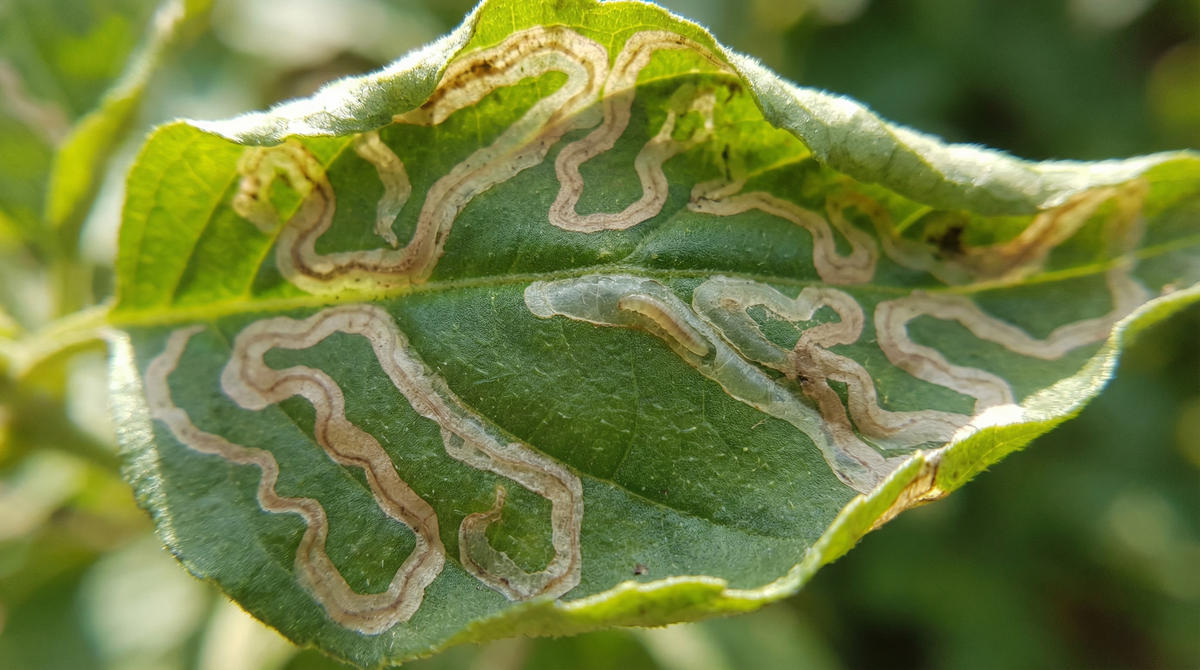
"Leaf miner" is the name for the larvae of several insects that live and feed inside a leaf, tunneling between its upper and lower surfaces and leaving winding, pale trails or blotches in their wake. The most common garden leaf miners are the larvae of small flies in the family Agromyzidae, though some moths, sawflies, and beetles mine leaves as well. Because the larva feeds safely sandwiched within the leaf, leaf miners are notoriously hard to reach with sprays — which makes prevention and cultural control the heart of managing them. In most gardens they are a cosmetic-to-moderate pest rather than a serious threat.
Identification and Description
The damage is far more recognizable than the insect itself. Leaf miners announce their presence with serpentine (squiggly) trails or irregular translucent blotches on leaves, pale green to whitish and often darkening as they age; holding a mined leaf to the light frequently reveals the tiny larva or its dark trail of frass within the tunnel. The adult agromyzid fly is small — 2 to 3 millimeters — usually grayish-black, sometimes with yellow markings, and easily overlooked. The larva is a minute, legless, pale maggot living entirely inside the leaf. Different species favor different plants, and the shape of the mine (winding line versus open blotch) can hint at which one is present.
Life Cycle
Leaf miners undergo complete metamorphosis — egg, larva, pupa, adult. The adult female punctures the leaf surface and lays her eggs within or just under the epidermis. The larvae hatch directly into the leaf and begin mining, feeding on the soft inner tissue as they tunnel, which creates the visible trails. After one to three weeks the mature larva either pupates inside the mine or drops to pupate in the soil below, and a new adult emerges to start again. In warm conditions the cycle is quick, allowing several overlapping generations per season, and populations can build rapidly. Most leaf miners overwinter as pupae in the soil or in fallen leaves, which is why garden sanitation is a key control point.
Habitat and Range
Leaf miners occur essentially everywhere their host plants grow, across gardens, greenhouses, and farmland throughout North America. Common targets include spinach, chard, and beet (the spinach leaf miner is a well-known pest of these), along with tomatoes, peppers, lettuce, brassicas, beans, and many ornamentals and weeds. Columbine, boxwood, citrus, and other specific plants each host their own specialist miners. Weedy relatives of crop plants often serve as reservoirs that sustain populations between plantings.
Role in the Garden
Leaf miners are generally a minor-to-moderate pest. Because they feed within the leaf, their damage is mostly cosmetic — unsightly trails and blotches — and established, vigorous plants tolerate a good deal of mining with little effect on overall health or yield. The exception is leafy greens grown for their foliage: on spinach, chard, and lettuce the mined leaves are what you eat, so even modest damage renders them unappealing or unmarketable. Heavy infestations on young or already-stressed plants can also reduce photosynthesis enough to matter. For most other crops, though, the trails are more of an eyesore than a real problem.
Managing Leaf Miners
Because the larvae are shielded inside the leaf, control focuses on prevention, physical measures, and disrupting the life cycle rather than spraying. Row covers are the single most effective tactic for susceptible greens — placed at planting, they physically bar the egg-laying adult flies from reaching the leaves. Handpicking and destroying mined leaves as soon as trails appear removes the larvae before they mature and breaks the generational cycle; simply crushing the larva within its trail also works on lightly affected plants. Garden sanitation — clearing crop debris and fallen leaves at season's end and controlling nearby host weeds — eliminates overwintering pupae and alternate hosts. Crop rotation keeps susceptible plantings away from where miners emerged the year before. Because the pupae develop in the soil, lightly cultivating the soil surface can expose them to predators and weather.
Biological Control and Sprays
Leaf miners have many natural enemies, chief among them tiny parasitic wasps (such as Diglyphus species) that seek out and kill the larvae inside their mines; supporting these beneficials with insectary flowers like dill, fennel, yarrow, and alyssum — and avoiding broad-spectrum insecticides that kill them — often keeps miners in check naturally. Most contact sprays fail because they cannot penetrate the leaf; where treatment is warranted, spinosad and neem (azadirachtin) have some translaminar action that reaches larvae within the leaf, and are the better organic options. Timing any treatment to the adult-fly and egg-laying stage improves results.
Living With the Trails
For most crops, leaf miner trails are best regarded as cosmetic. Cover leafy greens with row cover, pick off and destroy mined leaves promptly, clean up debris each fall, rotate plantings, and protect the parasitic wasps that hunt the larvae — and you can keep this hard-to-reach tunneling pest to a tolerable level without resorting to harsh chemicals.