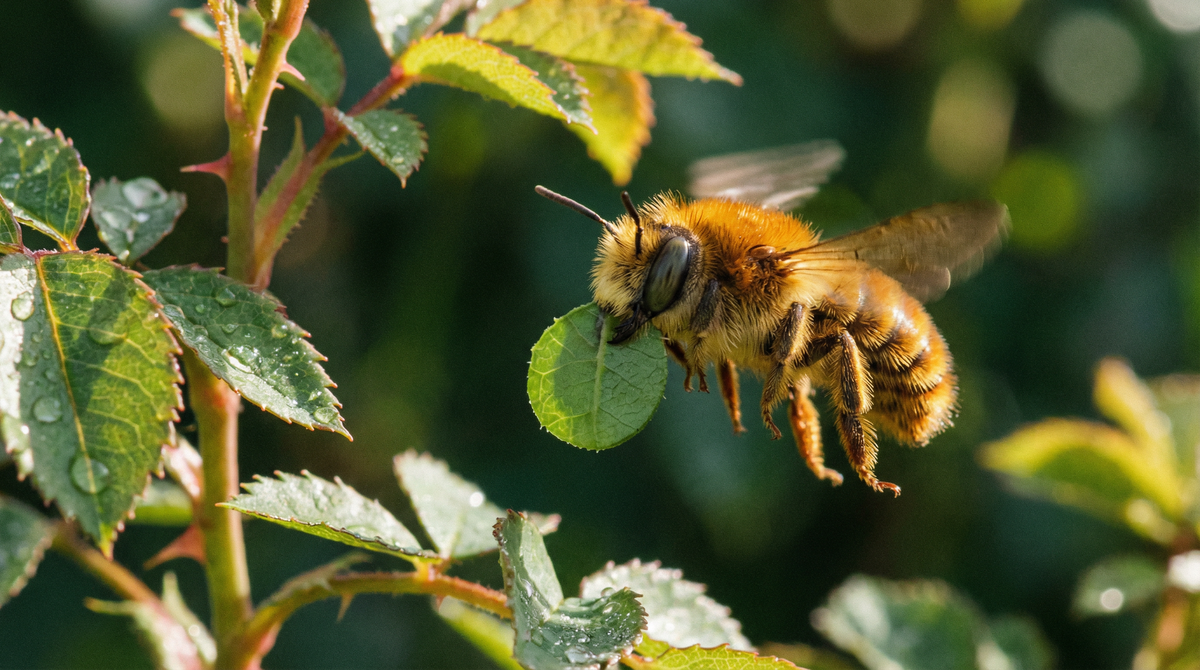
Leafcutter bees (genus Megachile) are gentle, solitary pollinators famous for the neat, circular notches they snip from the edges of leaves — pieces they use to build their nests. Fast and efficient at their work, they are excellent pollinators of gardens and crops, and the well-known alfalfa leafcutter bee (Megachile rotundata) is managed commercially to pollinate alfalfa and other seed crops. With a beneficial rating of 4 out of 5, the leafcutter bee is a welcome garden ally; the tidy holes it leaves in rose and redbud leaves are purely cosmetic and a small price for the pollination it provides.
Identification and Description
Leafcutter bees are stout, medium-sized bees, generally about the size of a honeybee or a little smaller, dark-bodied with pale hair bands across the abdomen. Their most distinctive feature is on the underside: rather than carrying pollen on their hind legs like honeybees, female leafcutter bees gather it on a dense brush of hairs beneath the abdomen called a scopa, which often appears bright yellow with collected pollen and gives them a characteristic pollen-dusted belly in flight. They have large jaws for cutting leaves. The clearest sign of their presence, though, is not the bee itself but its handiwork — smooth, semicircular pieces cut cleanly from the margins of leaves, especially roses, redbud, and similar smooth-leaved plants.
Life Cycle
Leafcutter bees are solitary — each female works alone rather than in a colony — with one generation per year. Adults emerge in late spring, the males first, and mate soon after. Each female then seeks out a suitable pre-existing cavity — a hollow stem, a tunnel in wood, or a hole in the ground — in which to build her nest. She cuts circular pieces of leaf and carefully rolls and fits them into a series of cigar-shaped cells, provisioning each with a store of pollen and nectar, laying a single egg, and sealing it before starting the next. A female may build a dozen or more cells in a nest. The larvae hatch and feed on the provisions, then overwinter as fully grown larvae inside their sealed cells. The following spring the new adults chew their way out to repeat the cycle. Adults are active mainly from late spring through summer (roughly May through August).
Habitat and Range
Leafcutter bees are found across the United States — Northeast, Southeast, Midwest, Southwest, West, and Pacific Northwest — with many species native to North America. They occupy a wide range of habitats: gardens, deserts, coastal dunes, prairies, and shrublands, nesting in rotting wood, hollow stems, and soil. Because they rely on pre-existing cavities and a supply of suitable leaves and flowers, gardens that offer nesting sites and abundant blooms make excellent leafcutter habitat.
Role in the Garden
The leafcutter bee is a beneficial pollinator, rated 4. It is a fast, effective flower visitor, and because it carries dry pollen loosely on the scopa beneath its body, it spreads pollen readily from bloom to bloom — making it an especially good pollinator of many garden flowers, vegetables, and fruit, and a commercially important one for alfalfa and other seed crops. The only "damage" it does is cosmetic: the neat circles it removes from leaves for nest-building do not harm plant health. Leafcutter bees are non-aggressive and rarely sting, so their pollination value far outweighs the tidy notches on a few leaves.
Attracting and Supporting Leafcutter Bees
Because leafcutter bees are beneficial, the goal is to attract and support them rather than control them. The most effective step is to provide nesting habitat — a bee house or a block of wood with pre-drilled holes of various diameters, hollow stems, or undisturbed patches of rotting wood and bare soil give females the cavities they need. Plant plenty of their favored flowers and leaf sources: roses, azaleas, redbuds, bougainvillea, lilac, hostas, columbine, and viburnum, along with legumes and forage like alfalfa, clover, buckwheat, and peas. Crucially, avoid insecticides, especially on the plants they visit, since sprays kill bees and contaminate the pollen provisions they collect for their young.
If Leaf-Cutting Is a Concern
The circular cuts are harmless, but if you want to protect a prized specimen plant during nesting season, simply drape it with fine netting or cheesecloth while the bees are active — this excludes them without harm. Strong deterrents such as garlic, neem oil, or chili pepper are sometimes cited as repellents, but given the bee's pollination value, gentle exclusion of a single plant is far preferable to anything that discourages them from the garden as a whole.
A Tidy, Gentle Pollinator
The leafcutter bee asks only for a few cavities to nest in and flowers to visit, and repays the gardener with excellent, gentle pollination. Put up a bee house, plant roses, redbuds, and clover, skip the sprays, and accept the harmless circles on a few leaves — and you will host these industrious solitary bees quietly boosting your garden's harvest each summer.