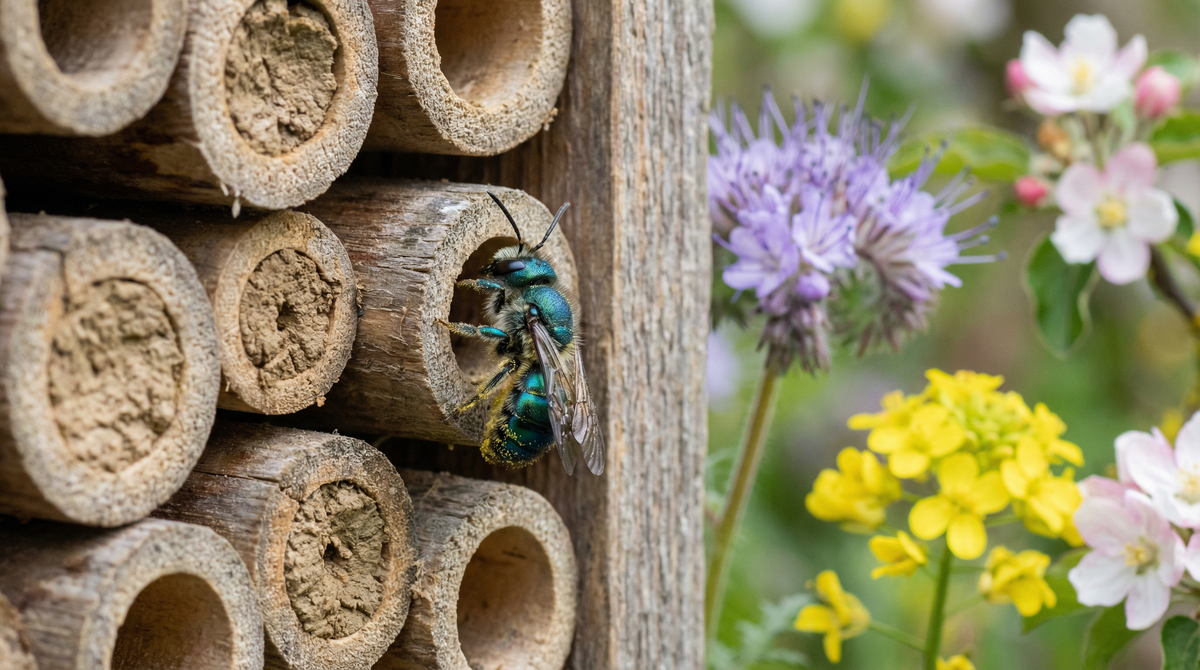
Mason bees (genus Osmia) are among the most efficient and gardener-friendly pollinators in North America — gentle, solitary native bees that pollinate fruit trees and spring flowers with remarkable effectiveness. Named for their habit of using mud to build partition walls in their nests, mason bees are early risers that emerge in cool spring weather when many other pollinators are still dormant, making them invaluable for orchards and berry patches. With a beneficial rating of 5 out of 5, the mason bee is a pollinator worth actively welcoming, and it is one of the easiest of all beneficial insects to attract and keep.
Identification and Description
Mason bees are small to medium bees, often a little smaller than a honeybee, typically with a shiny metallic blue-black or dark green sheen rather than the yellow-and-black stripes people expect of a bee — the common blue orchard bee (Osmia lignaria) is a familiar dark, blue-tinted example. They have a stout, rounded body, and like their leafcutter relatives in the family Megachilidae, the females carry pollen dry on a brush of hairs (the scopa) beneath the abdomen rather than on their legs, giving foraging females a pollen-dusted belly. They are easily mistaken for small flies at a glance. Mason bees are notably docile — the males cannot sting at all and the females sting only if handled roughly — so they are safe around children and pets.
Life Cycle
Mason bees are solitary, with one generation per year and a life cycle tuned to spring. Adults emerge from their nests in early spring, the males first, and mate soon after. Each female then works alone to nest in a pre-existing narrow cavity — a hollow stem, a beetle hole in wood, or a tube in a bee house. She builds a linear series of cells, provisioning each with a mass of pollen and nectar, laying a single egg, and then sealing the cell with a wall of mud before starting the next; she caps the finished nest with a thicker mud plug. The larvae hatch and feed on the provisions, spin cocoons, and develop into adults by late summer, then overwinter as fully formed adults inside their cocoons, waiting out the cold to emerge the following spring. This mud-and-cavity nesting and adult overwintering is central to how they are managed.
Habitat and Range
Mason bees are native to North America, with many Osmia species distributed across the continent, and they occur in gardens, orchards, woodlands, and meadows wherever there are nesting cavities, a source of moist clay-rich mud, and spring flowers. Because they forage only a short distance from the nest, they are easy to concentrate in a garden or orchard simply by providing nesting sites close to blooming plants. A nearby supply of mud is as essential to them as the flowers.
Role in the Garden
The mason bee is supremely beneficial, earning a top rating of 5, and is renowned as an exceptional pollinator. Because it carries dry, loose pollen on its belly and tumbles actively over each flower, it spreads pollen far more efficiently than a honeybee — by many estimates a handful of mason bees can pollinate a fruit tree that would otherwise require far more honeybees. It flies in cool, cloudy, and even lightly rainy spring weather when honeybees stay home, making it especially valuable for early-blooming apples, cherries, plums, pears, and blueberries. It causes no plant damage of any kind, does not swarm or defend a hive, and asks very little in return — a pure asset to the spring garden.
Attracting and Supporting Mason Bees
Because mason bees are wholly beneficial, the goal is to attract and support them, which is easy to do. Provide nesting habitat — a mason bee house of hollow reeds, paper tubes, or a drilled wooden block with holes about 5/16 inch (8 mm) across, mounted in a sunny, sheltered spot facing the morning sun. Supply a source of moist, clay-rich mud near the nest, since females need it to build their cell walls; a small patch of bare, damp clay soil is ideal. Plant an abundance of early spring flowers and fruit blossoms — fruit trees, berries, and native wildflowers — to give emerging adults nectar and pollen right when they need it. Crucially, avoid pesticides, especially sprays on blooming plants, which kill bees and contaminate the pollen they gather for their young. To help nests stay healthy year to year, keep tubes clean or replaceable to reduce mites and disease, and protect overwintering cocoons from extremes.
The Orchard's Gentle Workhorse
Few pollinators give so much for so little effort as the mason bee. Put up a simple bee house, keep a patch of damp mud nearby, fill the garden with early blossoms, and skip the sprays — and these gentle, metallic-blue native bees will return each spring to pollinate your fruit trees and flowers with unmatched efficiency, season after season.