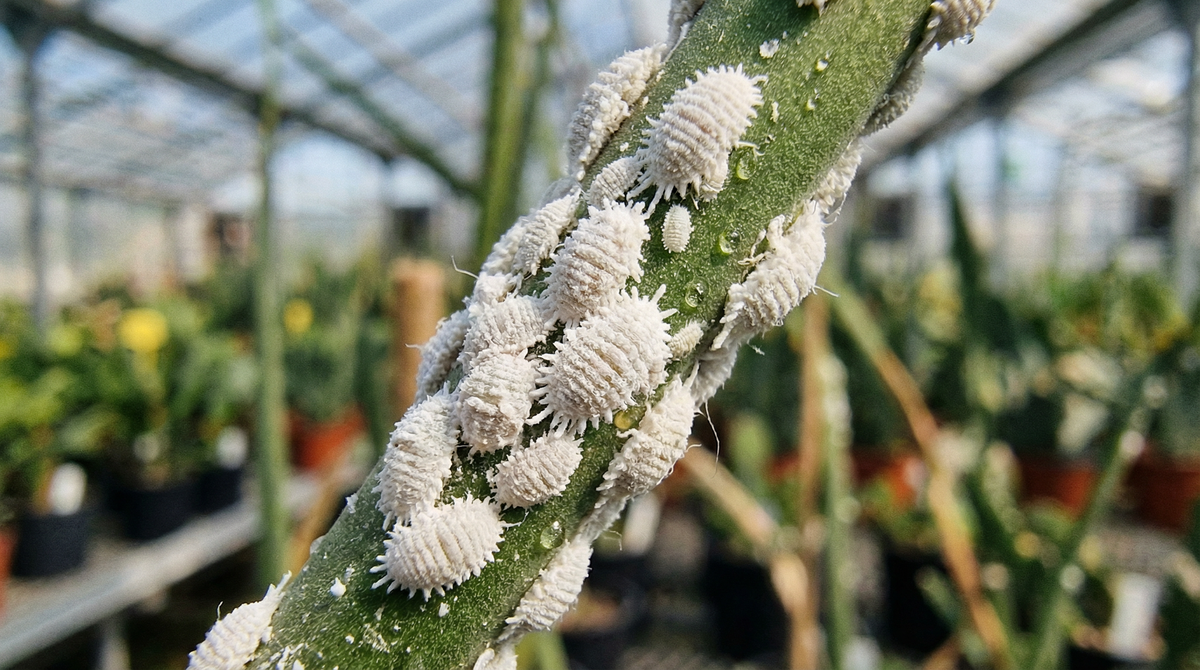
Mealybugs (family Pseudococcidae, with the citrus mealybug Planococcus citri the most familiar) are soft, sap-sucking insects easily recognized by the white, cottony wax that covers their bodies and coats infested plants. Common on houseplants, greenhouse crops, and outdoor ornamentals, they cluster in protected crevices where they drain plant sap, weaken growth, and foul foliage with sticky honeydew. Slow-moving but prolific, mealybugs can build up quickly in warm conditions and are notoriously persistent. With a beneficial rating of −5, they are a pest to be managed promptly before a small colony becomes an entrenched infestation.
Identification and Description
Adult female mealybugs are small — 2 to 4 millimeters — soft, oval, flattened insects covered in a powdery white or grayish wax, often with short waxy filaments fringing the body like tiny legs. They tend to gather in white, cottony masses in leaf axils, along stems, on the undersides of leaves, and in the crevices where leaves meet stems, and their egg sacs look like fluffy cotton. The mobile young, called crawlers, are tiny, pale yellow, and lightly waxed, and are the stage that spreads to new plants. Adult males are entirely different — minute, gnat-like, winged insects that do not feed and live only to mate. The telltale signs of mealybugs are the white cottony clusters, sticky honeydew, and the black sooty mold that grows on that honeydew, plus yellowing, wilting, and stunted growth.
Life Cycle
Mealybugs reproduce rapidly. A female lays up to 600 eggs in a protective cottony, waxy sac, usually tucked into a sheltered spot on the plant. The eggs hatch in one to two weeks into mobile crawlers, which settle to feed. Female nymphs pass through three instars and mature in about a month, while male nymphs go through two instars and then a cocooned pupal stage before emerging as the short-lived winged adults. The complete cycle takes one to three months depending on temperature and host. Outdoors there are typically two generations per year, but in the warm, stable conditions of a greenhouse or a heated home as many as eight generations are possible — which is why indoor infestations seem never to end. Mealybugs overwinter as eggs or nymphs in protected places such as under bark, in branch crevices, or in the root zone of host plants.
Habitat and Range
Native to tropical and subtropical regions worldwide, mealybugs are found throughout the United States — Northeast, Southeast, Midwest, Southwest, West, and Pacific Northwest — living outdoors in warm areas and year-round on indoor and greenhouse plants everywhere. They thrive in gardens, greenhouses, on houseplants, and in orchards, favoring warm, humid conditions. They attack a wide range of plants, especially citrus, coleus, fuchsia, cactus and succulents, dracaena, and many ornamentals and houseplants, and lush, over-fertilized plants with high nitrogen and soft new growth are especially prone.
Role in the Garden
Mealybugs are a serious pest rated −5. By inserting their piercing-sucking mouthparts and draining sap, they sap plant vigor, causing yellowing, leaf drop, wilting, stunted or distorted growth, and — in heavy infestations — plant death. As they feed they excrete copious sticky honeydew, which coats leaves and fruit and grows unsightly black sooty mold that further reduces photosynthesis; the honeydew also attracts ants. Some mealybug species transmit plant viruses as well. They offer no benefit to the garden and, because they hide in crevices and resist wetting thanks to their waxy coat, they can be stubborn to eliminate.
Managing Mealybugs
Control combines physical removal, biological control, and careful spraying. For small infestations, dab each mealybug with a cotton swab dipped in 70% isopropyl alcohol, which cuts through the wax and kills them on contact — highly effective on houseplants. A strong spray of water dislodges colonies from sturdier plants. Insecticidal soap and horticultural oil smother them, but demand thorough coverage into every crevice and leaf axil where they hide, and usually need repeating to catch newly hatched crawlers. Biological control is excellent: encourage or introduce natural predators including ladybugs, lacewings, and especially the mealybug destroyer beetle (Cryptolaemus montrouzieri), whose larvae are dedicated mealybug hunters. Controlling ants is crucial — ants tend and protect mealybugs from predators in exchange for honeydew, so keeping ants off plants lets natural enemies do their work. Finally, avoid over-fertilizing with nitrogen, isolate and inspect new plants before bringing them indoors, and prune out heavily infested growth.
Companion Planting
Aromatic herbs can help deter mealybugs around susceptible plants. Rosemary, thyme, garlic, and chives are useful repellent companions, and marigolds help discourage a range of pests including mealybugs. In some settings a sacrificial trap plant can be used to lure mealybugs away from more valuable crops, where they can then be destroyed.
Staying Ahead of the Cotton
Mealybugs are easiest to beat early. Wipe out small colonies with alcohol swabs, hose off or soap-spray larger ones with thorough coverage, recruit the mealybug destroyer and other predators, keep ants away so those predators can hunt, and ease off the nitrogen — and you can clear this cottony sap-sucker from your plants and keep new infestations from taking hold.