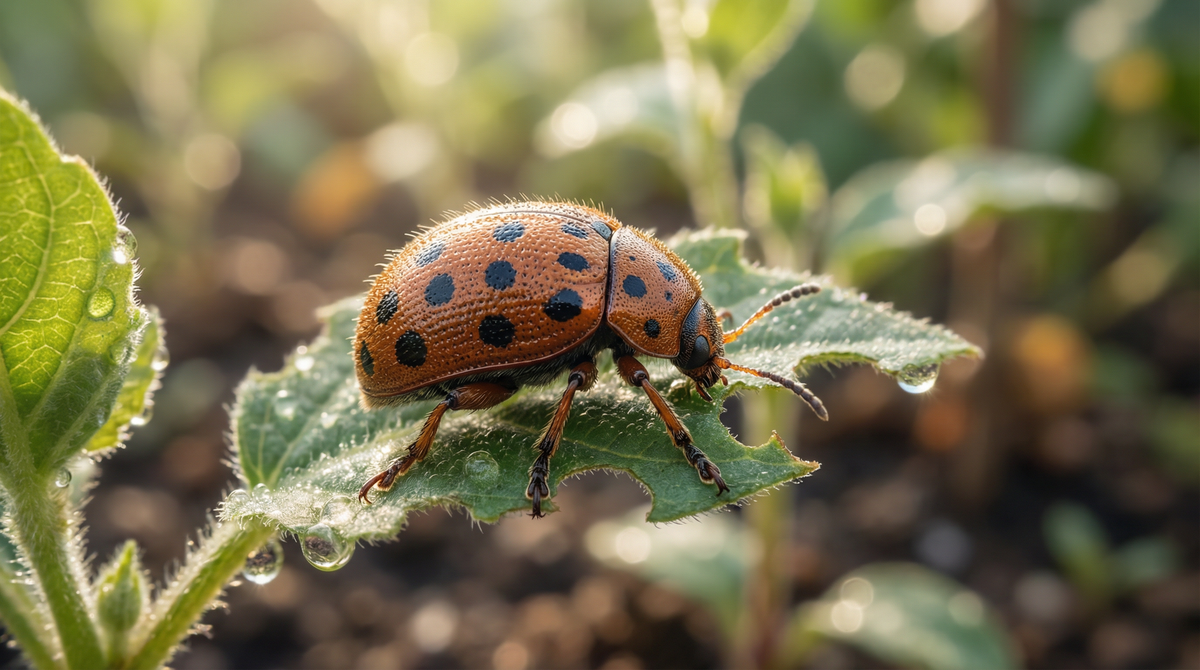
The Mexican bean beetle (Epilachna varivestis) is the notorious exception in a family of garden heroes — one of the very few members of the lady beetle family (Coccinellidae) that is a plant-eating pest rather than a predator. Where its cousins devour aphids, this "vegetarian ladybug" and its spiny yellow larvae skeletonize the leaves of beans, and a heavy infestation can defoliate a bean patch. Because it looks so much like a beneficial ladybug, it is often misidentified. With a beneficial rating of −5, the Mexican bean beetle is a significant pest for anyone growing beans, and knowing how to recognize and manage it is essential.
Identification and Description
The adult is easily mistaken for a large ladybug: rounded, dome-backed, about 6 to 7 millimeters long, and colored a coppery yellow to orange-brown with sixteen black spots arranged in three rows across its wing covers. The clues that it is a pest are its bean-colored, non-red body and — decisively — the fact that you find it feeding on bean foliage. The larvae are the more damaging and more distinctive stage: plump, bright yellow, oval grubs covered in conspicuous branched black-tipped spines, feeding in groups on the undersides of leaves. The bright yellow egg clusters, laid on end on the leaf underside, closely resemble those of beneficial ladybugs, so it is worth learning to tell them apart before destroying any. The signature damage is skeletonized, lacy leaves — the beetles scrape away the lower leaf surface, leaving a fine web of veins that turns brown.
Life Cycle
The Mexican bean beetle undergoes complete metamorphosis — egg, larva, pupa, adult. Adults overwinter in plant debris and sheltered spots and emerge in spring to find bean plants. Females lay clusters of 40 to 75 bright yellow eggs on the undersides of leaves; these hatch in one to two weeks. The spiny yellow larvae feed voraciously on the leaf undersides for two to four weeks through four instars, then pupate right on the leaves, the pupal stage lasting about a week to ten days. The complete cycle takes roughly 30 to 40 days in summer, and there can be one to three generations per year depending on climate (activity spanning about June through October). Multiple overlapping generations mean populations can escalate through the season if left unchecked.
Habitat and Range
Native to the southern plateau region of Mexico, the Mexican bean beetle is established across much of the United States — Northeast, Southeast, Midwest, West, and Pacific Northwest — with its heaviest pressure in the East. It inhabits gardens, meadows, agricultural fields, and wooded edges. Its hosts are legumes: lima beans, snap beans, cowpeas, and soybeans are favorites, along with alfalfa, clovers, lupines, and Chinese wisteria, which can serve as alternate hosts.
Role in the Garden
The Mexican bean beetle is a serious pest rated −5, unusual among ladybugs precisely because it damages rather than protects plants. Both adults and the spiny larvae feed on bean leaves, scraping the tissue and leaving foliage skeletonized and lacy; heavy feeding also extends to pods and stems. Severe infestations can defoliate plants, sharply reducing yield or killing them outright. Because it so resembles a beneficial insect, the first task is correct identification — followed by prompt, persistent management to keep it from building across generations.
Managing the Mexican Bean Beetle
Control combines vigilance, physical measures, and biological control. Handpicking is effective in a home garden: regularly scout leaf undersides and crush the yellow egg clusters, spiny larvae, and adults — targeting the eggs and larvae has the biggest impact. Floating row covers placed over young plants exclude the overwintered adults early in the season (remove at flowering if pollination is needed). Trap crops — an early planting of beans — lure beetles for concentrated destruction before they reach the main crop. A standout biological control is the parasitic wasp Pediobius foveolatus, a specialized natural enemy that parasitizes the larvae and can be purchased and released for excellent season-long suppression. For heavier infestations, organic insecticides such as neem oil, pyrethrum, or spinosad can be applied, with thorough coverage of leaf undersides where the larvae feed. Cleaning up crop debris at season's end removes overwintering shelter and reduces next year's numbers.
Companion Planting
Strongly scented companions can help confuse the beetles and mask host plants. Garlic, rosemary, and summer savory are useful aromatic deterrents, and marigolds and nasturtium are known to repel Mexican bean beetles. A classic pairing is potatoes with beans: the potatoes are said to repel the bean beetle while the beans repel the Colorado potato beetle — a mutually protective planting. These tactics work best alongside handpicking, row covers, and Pediobius releases.
Protecting the Bean Patch
The Mexican bean beetle is the ladybug that turned pest, and beans are its target. Learn to distinguish it from beneficial ladybugs, scout and crush eggs and spiny larvae, cover young plants, release Pediobius foveolatus wasps, and interplant garlic, marigolds, and potatoes — and clean up thoroughly each fall. Consistent attention keeps this coppery, spotted defoliator from turning your bean leaves to lace.