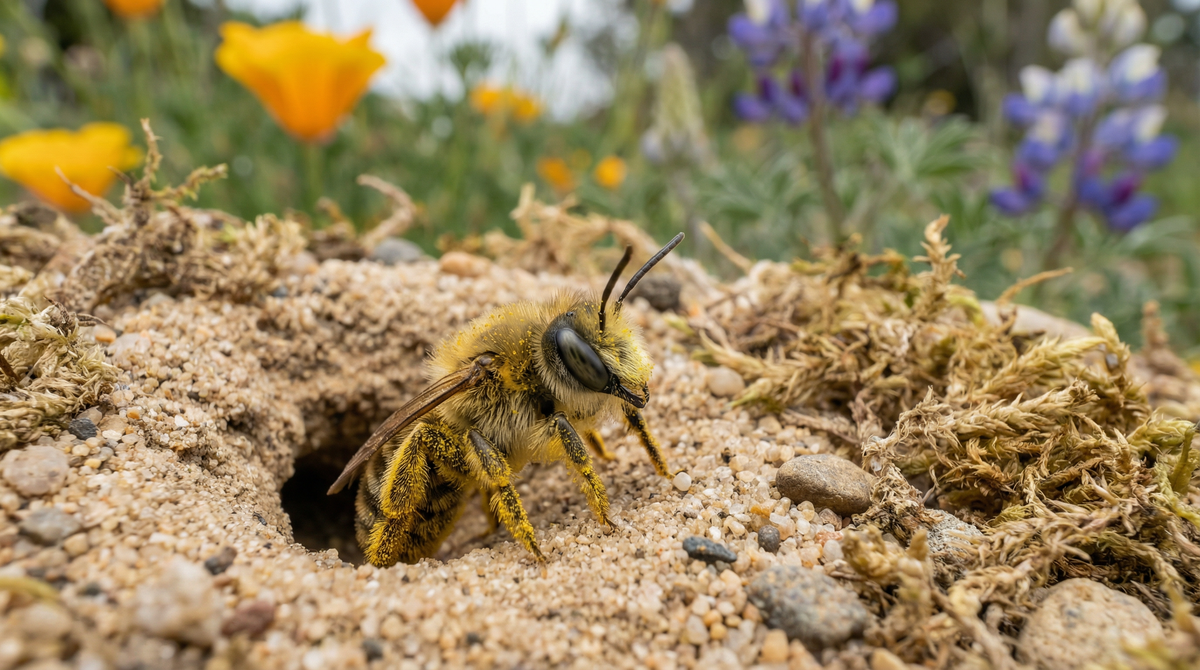
Mining bees (family Andrenidae) are gentle, solitary, ground-nesting native bees that are among the first pollinators to appear each spring. Named for their habit of excavating nest tunnels in the soil, these bees quietly pollinate fruit trees, berries, and early wildflowers just as the garden wakes up. Often overlooked and sometimes mistaken for honeybees or even small wasps, mining bees are docile, non-aggressive, and enormously valuable. With a beneficial rating of 5 out of 5, they are pollinators worth welcoming, and supporting them costs nothing more than leaving a patch of bare, sunny ground undisturbed.
Identification and Description
Mining bees are small to medium bees, generally 8 to 17 millimeters long, most often dark-bodied and covered with soft hairs that can be brown, tan, reddish, or grayish; many species have pale hair bands on the abdomen and a somewhat fuzzy thorax. The genus Andrena is the largest and most familiar, with hundreds of species across North America. They are easily confused with honeybees but tend to be a bit smaller and are seen flying low over bare soil in spring. The surest sign of mining bees is their nests: small mounds of excavated soil, each with a pencil-sized hole at the center, often clustered in loose aggregations across a sunny patch of thin lawn or bare ground. Despite these congregations, each female nests alone — they are solitary, not colonial like honeybees or yellowjackets — and they are remarkably gentle, rarely if ever stinging.
Life Cycle
Mining bees have a single generation per year timed to spring. Adults emerge from their underground burrows in early spring, and after mating each female excavates a tunnel in the soil that can reach up to a foot deep. Off the main tunnel she builds several small brood cells, and in each she packs a ball of pollen and nectar, lays a single egg on top, and seals it. The egg hatches into a larva that feeds on the provision, then pupates and transforms into an adult later in the year. The new adult typically remains in its underground cell through the winter and emerges the following spring to begin the cycle again. This means mining bees are active for only a few weeks each spring (roughly March through June), which makes protecting their nesting ground during that window especially important.
Habitat and Range
Mining bees are nearly cosmopolitan, with their greatest diversity in the temperate Northern Hemisphere, and they are found throughout the United States — Northeast, Southeast, Midwest, Southwest, West, and Pacific Northwest. They favor sunny, well-drained sites with thin grass or bare soil for nesting: gardens, lawns, meadows, and forest edges. Because the females dig into the ground, they need open, undisturbed soil, and they avoid dense turf, heavy mulch, and wet ground — a preference that points directly to how to encourage them.
Role in the Garden
Mining bees are supremely beneficial, earning a top rating of 5, and their early-season timing makes them especially valuable. As they gather pollen and nectar they pollinate a wide range of spring-blooming plants, including fruit trees, blueberries, and early wildflowers, often working in cool weather when honeybees are less active. As generalist pollinators visiting many kinds of flowers, they support both garden crops and native plants. They cause no damage whatsoever: their small soil mounds are harmless and temporary, they do not damage lawns or plants, and their gentle disposition means they pose no threat to people or pets. A springtime aggregation of mining bees is a sign of a healthy, pollinator-friendly garden.
Attracting and Supporting Mining Bees
Because mining bees are wholly beneficial, the goal is simply to accommodate them. The single most important step is to leave areas of bare, undisturbed ground in a sunny, well-drained spot — a patch of thin lawn, an unmulched border, or a sandy bank all make ideal nesting habitat. Avoid the things they dislike: don't blanket potential nesting areas with heavy mulch or dense turf, and don't overwater those spots, since wet soil deters them. Plant a diversity of spring-blooming flowers and fruit trees to feed emerging adults, and aim for continuous blooms from early spring onward to support them and other pollinators. Crucially, avoid pesticides, especially in spring when the bees are active and when sprays on blooms would poison the pollen they collect for their young. If you notice their small mounds in the lawn in spring, simply leave them be — the bees will finish nesting within a few weeks and the mounds will disappear.
Welcoming the First Bees of Spring
Mining bees ask for almost nothing and give a great deal. Leave a sunny patch of bare earth for them to dig in, plant early blossoms and fruit trees, hold off on mulch and sprays in their nesting areas, and tolerate their harmless springtime mounds — and these gentle native bees will return each year to pollinate your garden at the very start of the season, when their work matters most.