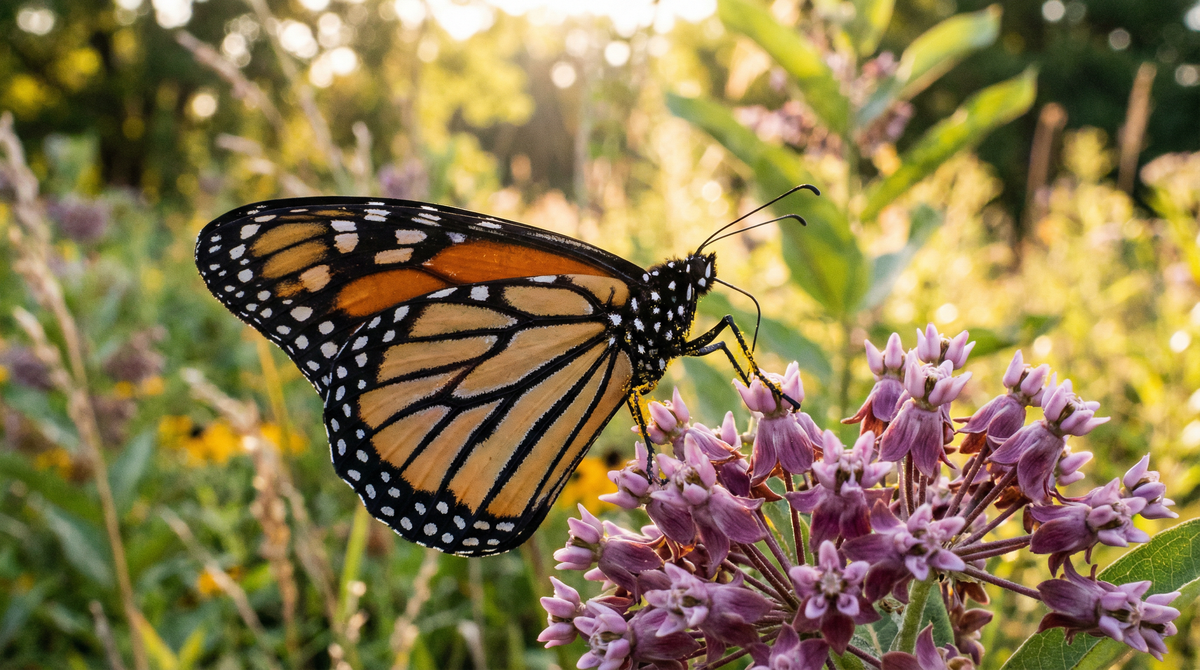
The monarch butterfly (Danaus plexippus) is perhaps the most beloved and recognizable butterfly in North America — an icon of gardens, meadows, and one of the most extraordinary migrations in the natural world. With its bold orange-and-black wings and its remarkable multi-generational journey between the northern United States and Canada and the mountains of central Mexico, the monarch is both a cherished pollinator and a powerful symbol of conservation. With a beneficial rating of 5 out of 5, and facing serious population declines, the monarch is a butterfly every gardener can and should help support, chiefly by planting the milkweed its caterpillars cannot live without.
Identification and Description
Adult monarchs are large butterflies with a wingspan of roughly 9 to 10 centimeters, their wings a striking deep orange crossed and bordered with black veins and dotted with white spots along the margins. Males have a small black scent-gland spot on a vein of each hindwing that females lack. The caterpillar is equally famous: boldly banded in yellow, black, and white stripes, with a pair of black filaments (tentacles) at each end, growing to about 4.5 centimeters. The chrysalis is a beautiful jade-green case studded with a line of gold spots. The monarch's warning coloration is honest advertising — by feeding on milkweed the caterpillars accumulate bitter toxins that make both larvae and adults distasteful to predators. The similar viceroy butterfly mimics the monarch's pattern.
Life Cycle and Migration
The monarch undergoes complete metamorphosis — egg, larva, pupa, adult. Eggs are laid singly on the undersides of young milkweed leaves and hatch in 3 to 8 days. The caterpillar passes through five instars, each lasting 3 to 5 days, growing from a few millimeters to about 4.5 centimeters, feeding exclusively on milkweed. The jade chrysalis stage lasts 8 to 15 days, and the whole cycle from egg to adult can take as little as 25 days in summer heat or up to seven weeks in cool spring conditions. Fewer than 10% of eggs and caterpillars typically survive to adulthood, given weather, predators, and disease. Summer breeding adults live just 2 to 5 weeks, but the special migratory generation that emerges in late summer lives 8 to 9 months — long enough to fly thousands of miles and overwinter. The eastern population overwinters clustered in oyamel fir forests in central Mexico, while the western population overwinters in coastal California groves of eucalyptus, Monterey pine, and Monterey cypress, returning north over successive generations in spring (monarchs are present roughly March through November).
Habitat and Range
Native to North America, the monarch ranges across the entire United States — Northeast, Southeast, Midwest, Southwest, West, and Pacific Northwest. It uses gardens, meadows, forest edges, fields, and wetlands, anywhere milkweed grows for the caterpillars and nectar flowers grow for the adults. The migratory routes tie together vast stretches of the continent, which is why habitat loss and milkweed decline across that range have such an outsized effect on monarch numbers.
Role in the Garden
The monarch is supremely beneficial, rated 5, both as a pollinator and as a flagship species for conservation. As adults sip nectar from bloom to bloom they pollinate many garden and wild flowers, and their presence supports the broader web of life. The caterpillars feed only on milkweed — never on garden vegetables or ornamentals — so they cause no crop damage; that milkweed feeding is exactly what the species needs to survive. Beyond their ecological value, monarchs bring beauty and wonder to the garden and offer an unmatched opportunity to teach children about metamorphosis and migration. Supporting monarchs is one of the most meaningful contributions a home garden can make to wildlife.
Attracting and Supporting Monarchs
Because monarchs are beneficial and in decline, the goal is to attract and actively support them. The single most important step is to plant native milkweed (Asclepias species suited to your region) — it is the only food monarch caterpillars can eat, and without it they cannot reproduce. Pair milkweed with a succession of nectar-rich flowers that bloom spring through fall — goldenrod, cosmos, zinnia, lantana, butterfly bush, and lilac are all excellent — to fuel adults, and especially to sustain the migratory generation in late summer and fall. Provide a water source such as a shallow dish with pebbles or a patch of damp sand for "puddling." Most critically, avoid pesticides and herbicides: insecticides kill caterpillars and adults, and herbicides destroy the milkweed and wildflowers monarchs depend on. Where possible, choose regionally native milkweed and avoid tropical milkweed in warm climates where it can disrupt migration and harbor disease.
Guardians of the Migration
No garden gesture does more for a threatened icon than planting milkweed for the monarch. Add native milkweed for the caterpillars, fill the beds with season-long nectar flowers for the adults, keep water available, and put away the sprays — and your garden becomes a waystation on one of the planet's greatest migrations, helping these orange-and-black travelers complete their extraordinary journey year after year.