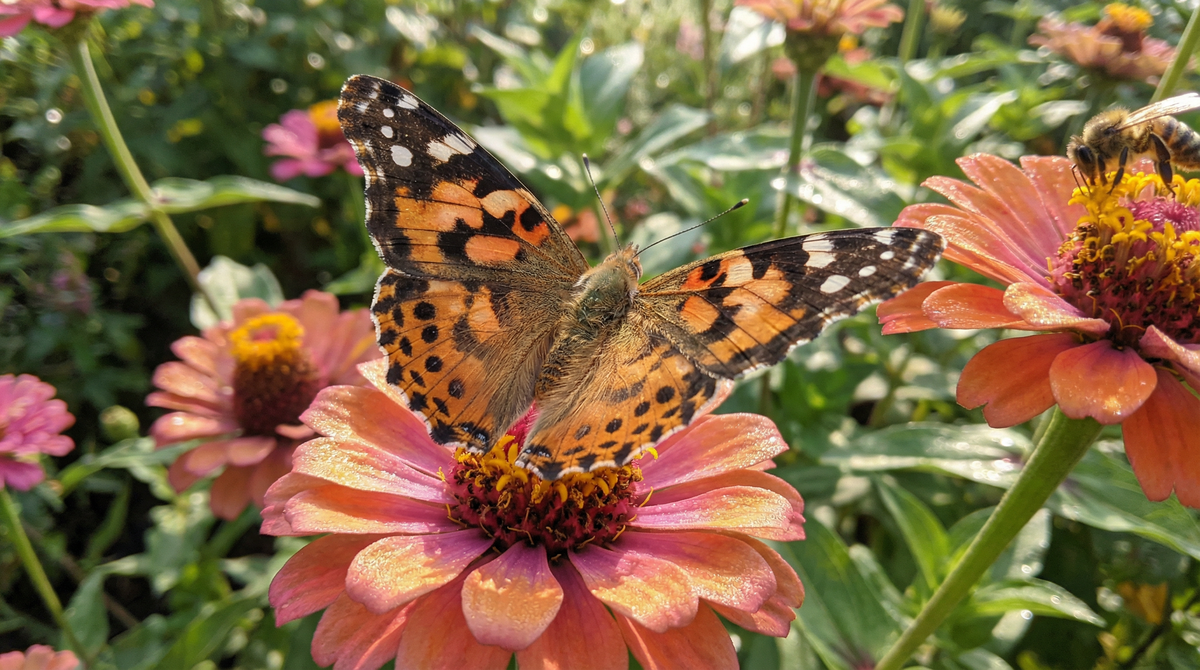
The painted lady (Vanessa cardui) is often called the most widespread butterfly in the world — a beautiful, adaptable, migratory species found on nearly every continent. With its orange, black, and white patterned wings and its habit of visiting a huge range of flowers, the painted lady is a familiar and welcome sight in gardens everywhere. It is also the butterfly most often raised in classroom kits, thanks to its fast, reliable life cycle. With a beneficial rating of 4 out of 5, the painted lady is a valued pollinator whose caterpillars feed largely on weeds, making it an easy and rewarding butterfly to support.
Identification and Description
Adult painted ladies are medium-sized butterflies with a wingspan of about 5 to 7 centimeters. The upperwings are a warm orange marked with black patches and white spots near the wingtips, while the underwings are intricately patterned in marbled gray, brown, white, and rose, with a row of small eyespots — beautiful camouflage when the wings are folded. They are easily confused with the related American lady and West Coast lady; the painted lady has four small eyespots on each hindwing underside, which helps distinguish it. The caterpillar is spiny and variable, generally grayish or purplish-black with pale mottling and branching spines, and it feeds within a silk-and-leaf shelter it spins on its host plant. The chrysalis is a subtle gray-brown with metallic gold flecks.
Life Cycle
The painted lady undergoes complete metamorphosis — egg, larva, pupa, adult — and does so quickly, completing the cycle from egg to adult in about 3 to 4 weeks. Eggs are laid singly on host plants and hatch in 3 to 5 days. The caterpillar feeds and grows for 5 to 10 days, sheltering in a webbed nest of leaves, then forms a chrysalis in which the pupal stage lasts 7 to 10 days. The adult emerges and lives about 2 to 4 weeks. This rapid development allows several generations per season. Unlike many butterflies, the painted lady does not typically overwinter in cold regions; instead it migrates to warmer areas such as Mexico and the southwestern United States to remain active and breed through the winter, then recolonizes northern regions over successive generations in spring and summer (present roughly March through November).
Habitat and Range
The painted lady is nearly cosmopolitan, occurring on almost every continent, and is found throughout the United States — Northeast, Southeast, Midwest, Southwest, West, and Pacific Northwest. It favors open, sunny environments: gardens, meadows, fields, parks, and dunes. Its caterpillars feed on an exceptionally broad range of host plants — over a hundred species — with thistles, mallows, and legumes such as clover and alfalfa among the favorites, which is part of why the species is so successful and widespread.
Role in the Garden
The painted lady is a beneficial pollinator, rated 4. As adults move from flower to flower gathering nectar, they pollinate a wide variety of garden and wild plants, and their fondness for tall composite flowers makes them frequent visitors to pollinator gardens. Their caterpillars feed largely on weeds like thistles and mallows rather than on prized crops, so they rarely cause meaningful damage; on the uncommon occasions they feed on garden plants, the impact is minor and easily tolerated. There is essentially no reason to control them — they are a lovely, low-impact addition to the garden and a boost to pollination.
Attracting Painted Ladies
Because painted ladies are beneficial, the goal is simply to attract them. Plant a diversity of nectar-rich flowers that bloom across the season, with special emphasis on the tall composite (Asteraceae) flowers in the 3-to-6-foot range that painted ladies love — thistles, asters, cosmos, blazing star (liatris), ironweed, zinnias, and Joe-Pye weed are all excellent, along with clover and alfalfa. Provide a sunny, open area with some shelter from wind to make the space inviting. Because the caterpillars use a wide range of host plants, tolerating a few "weeds" such as thistles and mallows helps support the full life cycle. As with all butterflies, avoid pesticides, which kill caterpillars and adults alike; no specific plants are known to repel painted ladies, so the garden can be planned entirely to welcome them.
A Note on Companion Planting
Interplanting Asteraceae flowers — asters, cosmos, zinnias, and Joe-Pye weed — among vegetable and fruit crops draws painted ladies and other pollinators into the garden, which can improve pollination and yields. Their generalist habits and love of composite blooms make them one of the easiest pollinators to attract with a diverse, flower-rich planting.
The World's Wanderer
Few butterflies travel as far or adapt as readily as the painted lady. Fill the garden with tall asters, cosmos, zinnias, and blazing star, leave a few thistles and mallows for the caterpillars, offer a sunny sheltered spot, and skip the sprays — and you will host generations of these globe-trotting, flower-loving pollinators throughout the growing season.