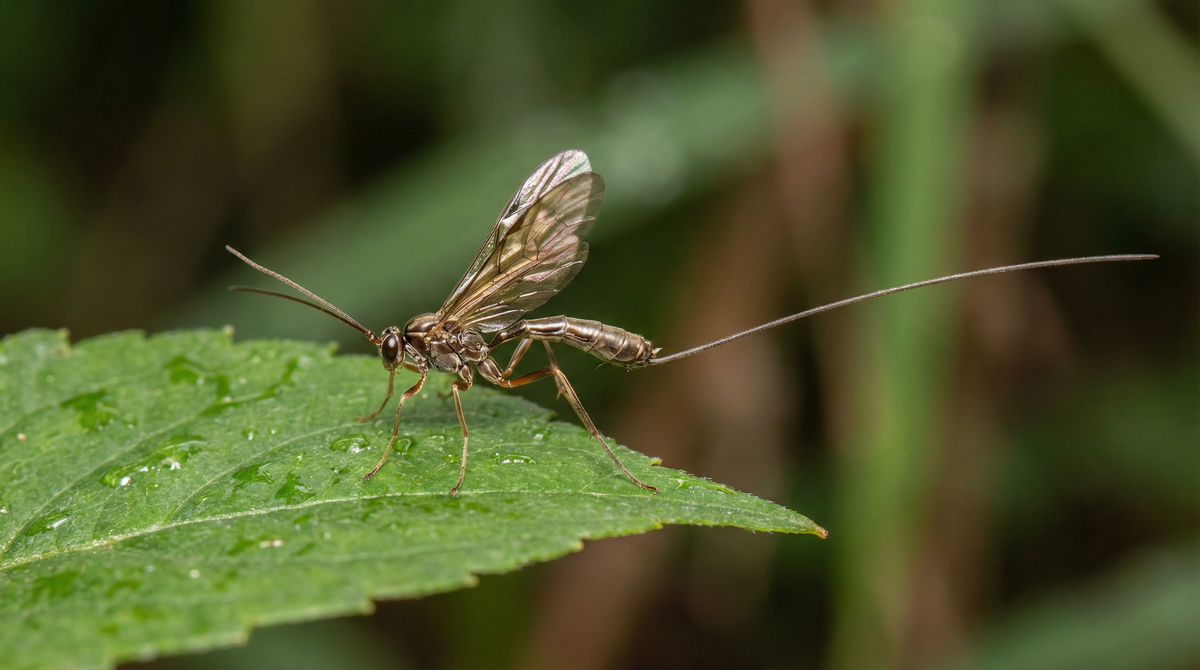
Parasitic wasps are among the most powerful — and most overlooked — allies in the garden. This vast group of tiny, mostly harmless wasps (including the family Braconidae along with ichneumonids, chalcids, and many others) controls pests by using them as living nurseries: the female lays her eggs on or inside a host insect, and her larvae devour it from within. Nearly every garden pest has one or more parasitic wasps that specialize in attacking it, which makes these insects a cornerstone of natural biological control. With a beneficial rating of 5 out of 5, parasitic wasps are exactly the kind of quiet, hardworking ally an organic garden is built to shelter.
Identification and Description
Parasitic wasps are extremely diverse, ranging from almost microscopic species a fraction of a millimeter long to slender wasps a couple of centimeters long with long, trailing ovipositors. Most are tiny, dark, and narrow-waisted, with thread-like antennae, and they are so small and unobtrusive that gardeners rarely notice the adults — they do not sting people and pose no threat. The signs of their work are easier to spot than the wasps themselves: bloated, browned "mummified" aphids glued to leaves (each containing a developing wasp), and the clusters of small white cocoons riding on the backs of hornworms and other caterpillars, a classic sight that gardeners sometimes mistake for eggs. Those cocoons mean the caterpillar has already been parasitized and is doomed — a reason to leave it in place.
Life Cycle
Parasitic wasps undergo complete metamorphosis — egg, larva, pupa, adult. The female seeks out a specific host and lays her eggs on or inside it; on hatching, the larvae feed on the host, eventually killing it. The larva then pupates, often spinning a cocoon on or beside the host's body, and the adult wasp emerges to hunt for new hosts. Crucially, the adults feed on nectar and pollen, not on pests — so flowers are as important to sustaining them as hosts are. Life cycles vary enormously by species: some complete a generation in just a few weeks and produce multiple generations per season (active roughly April through October), while others take a year or more. Overwintering strategies vary too — some overwinter as larvae or pupae inside their hosts, others as adults sheltered in leaf litter, under bark, or in protected crevices.
Habitat and Range
Parasitic wasps are found worldwide and throughout the United States — Northeast, Southeast, Midwest, Southwest, West, and Pacific Northwest. They occur in gardens, meadows, forests, and agricultural fields — essentially anywhere host insects and flowering plants coexist. Because both hosts and nectar sources are needed, a diverse garden with a mix of pests-in-check and abundant small flowers is ideal habitat.
Role in the Garden
Parasitic wasps are supremely beneficial, earning the top rating of 5, and their value lies in their precision and reach. Collectively they attack an enormous range of pests — aphids, caterpillars (including tomato and tobacco hornworms, cabbage worms, and armyworms), whiteflies, scale, beetle larvae, sawflies, and many more — often targeting a specific pest with remarkable efficiency. Because they seek out hosts actively and reproduce inside them, they can suppress infestations in ways broad sprays cannot, reaching pests hidden in foliage or inside stems and leaves. Many commercially available biocontrols — such as Trichogramma for caterpillar eggs, Aphidius for aphids, and Pediobius for bean beetles — are parasitic wasps. They cause no damage to plants and no harm to people, making them one of the most valuable groups of insects a gardener can encourage.
Attracting and Supporting Parasitic Wasps
Because parasitic wasps are wholly beneficial, the goal is to attract and retain them, and the key is flowers. Adults need nectar and pollen, but their tiny mouthparts require small, shallow, easily accessible blooms — plants in the carrot family (Apiaceae) such as dill, fennel, cilantro, and Queen Anne's lace, and in the aster family (Asteraceae) such as yarrow, are especially attractive. Plant a variety of these to provide a continuous succession of blooms through the season so adults always have food. Just as important, avoid broad-spectrum insecticides, which kill parasitic wasps along with the pests and undo their work. Finally, tolerate a low level of pest insects rather than eliminating them entirely — the pests are the hosts the wasps need to reproduce, so a garden scrubbed completely clean of aphids and caterpillars starves its own biological controls. Learning to recognize aphid mummies and caterpillar cocoons, and leaving them undisturbed, protects the next generation of wasps.
Nature's Precision Pest Control
Parasitic wasps quietly do more pest control than almost any spray. Fill the garden with dill, fennel, yarrow, and Queen Anne's lace, keep small flowers blooming all season, put away the broad-spectrum insecticides, tolerate a few pests to feed the wasps, and leave those aphid mummies and hornworm cocoons in place — and you will host an invisible army of these tiny wasps, seeking out and destroying pests throughout your garden.