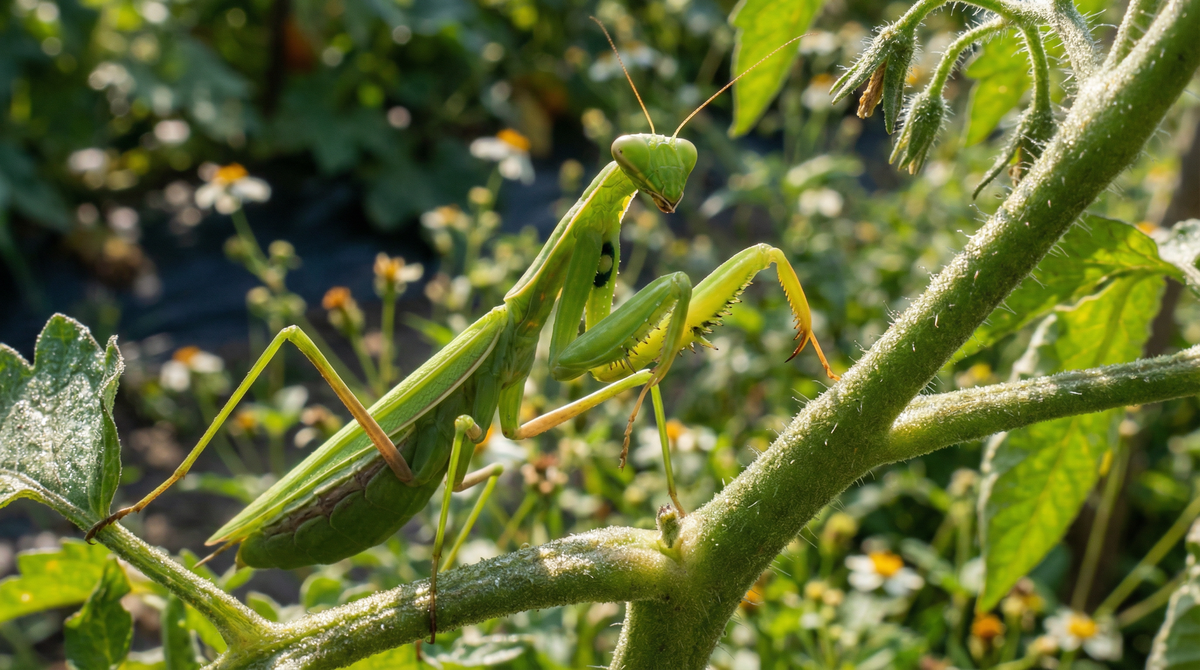
The praying mantis is one of the most fascinating and charismatic predators in the garden — a patient, formidable hunter named for the prayer-like pose of its folded, spined front legs. The European mantis (Mantis religiosa) is one of the familiar species found in North American gardens, alongside the native Carolina mantis and the introduced Chinese mantis. With its swiveling, triangular head and lightning-fast strike, the mantis is a captivating sight and a genuine ally against many garden pests. With a beneficial rating of 4 out of 5, it earns a welcome place in the garden, tempered only by the fact that its indiscriminate appetite includes beneficial insects too.
Identification and Description
Praying mantises are large, elongated insects, commonly 5 to 8 centimeters long, in shades of green or brown that camouflage them beautifully among foliage and stems. Their most distinctive features are the powerful, folded raptorial front legs lined with sharp spines for seizing prey, and a highly mobile, triangular head that can rotate nearly 180 degrees — unique among insects — with two large compound eyes that give excellent stereoscopic vision for judging strikes. Adults have wings, and many can fly, especially the males. The nymphs look like miniature, wingless versions of the adults. The egg case, or ootheca, is a distinctive frothy, tan, papery mass hardened around a twig or stem, easily spotted in winter and a reliable sign that mantises are present.
Life Cycle
The praying mantis undergoes incomplete metamorphosis with three stages — egg, nymph, and adult. In fall the female lays her eggs encased in a protective foamy ootheca attached to a twig, stem, or other structure, and the eggs overwinter inside it. They hatch in spring, releasing dozens to hundreds of tiny nymphs at once. The nymphs resemble small adults and grow through several molts over the course of the season before reaching adulthood. The whole process takes several months, with a single generation per year (active roughly May through October). The adults die off in the fall, leaving the overwintering egg cases to carry the population into the next year — which is why protecting oothecae through winter is important.
Habitat and Range
Praying mantises are found worldwide in temperate and tropical habitats, and across the United States — Northeast, Southeast, Midwest, Southwest, West, and Pacific Northwest. They favor gardens, meadows, forests, and areas with shrubs and tall grasses that offer perches for ambush hunting, shelter, and places to attach egg cases. A structurally diverse, plant-rich garden with plenty of prey insects makes ideal mantis habitat.
Role in the Garden
The praying mantis is a beneficial predator, rated 4, and a voracious one. It is a sit-and-wait ambush hunter that seizes and consumes a wide range of insects — including many pests such as flies, moths, crickets, grasshoppers, beetles, and caterpillars — using those spined forelegs to grip prey while it feeds. A garden with resident mantises has an extra layer of pest control and the pleasure of observing a truly remarkable insect. The one caveat that keeps it from a perfect score is that the mantis is an indiscriminate generalist: it will just as readily eat beneficial insects — bees, butterflies, and other predators — and even other mantises, so it does not selectively target pests the way parasitic wasps or lady beetles do. On balance, though, it is a welcome and valuable presence, and its impact on beneficials is usually modest in a healthy garden.
Attracting and Supporting Praying Mantises
Because the mantis is beneficial, the goal is to attract and support it. Provide a habitat rich in flowering plants that draw the prey insects mantises hunt — dill, fennel, marigolds, cosmos, yarrow, rosemary, and members of the rose and raspberry families all bring in the insects that become mantis food. Include tall grasses and shrubs to give mantises perches for ambushing prey, shelter, and structures on which to attach their egg cases. Crucially, avoid broad-spectrum pesticides, which kill mantises and wipe out the prey they depend on. Gardeners can also purchase oothecae and place them in the garden in early spring, though building good habitat tends to sustain a more reliable resident population. If you find a natural egg case on a twig in winter, leave it in place (or relocate it gently to a sheltered branch) so the nymphs hatch safely in spring.
The Garden's Patient Hunter
Few insects capture the imagination like the praying mantis, poised motionless among the leaves waiting to strike. Fill the garden with flowering plants and shrubby cover, protect the papery egg cases through winter, and skip the broad-spectrum sprays — and you can enjoy this remarkable ambush predator patrolling your garden all season, adding both pest control and endless fascination.