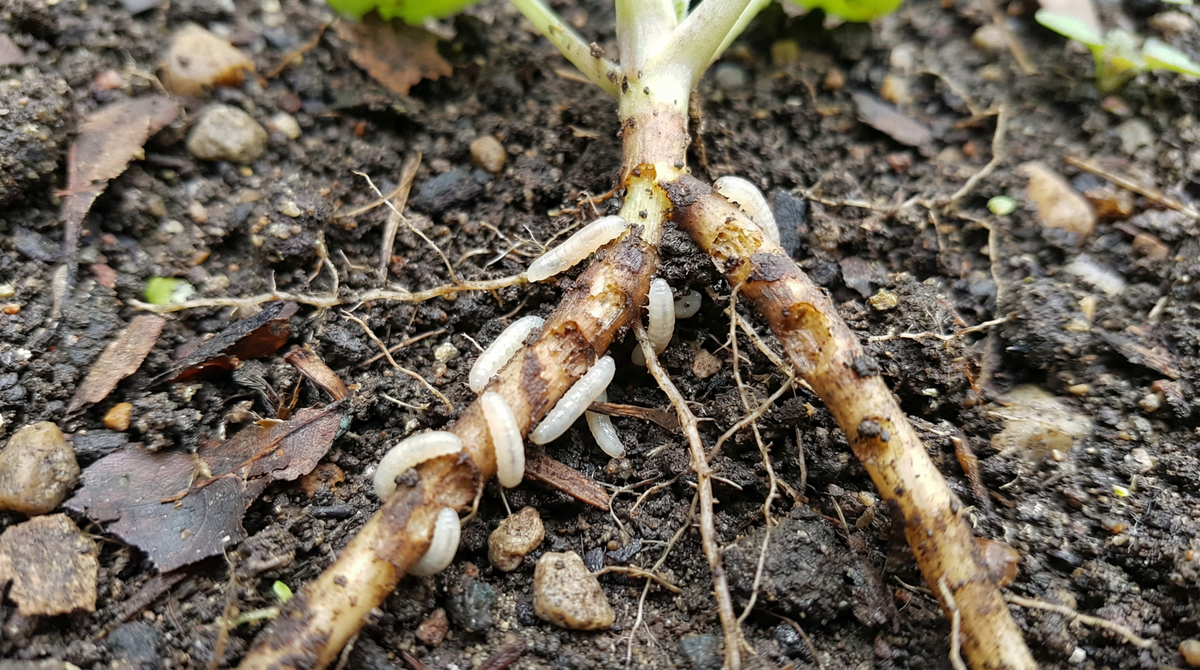
Root maggots are the destructive larvae of several small flies in the family Anthomyiidae — most notably the cabbage maggot, onion maggot, and carrot rust fly — that attack the roots of vegetables from below the soil. Because the damage happens underground and out of sight, root maggots are often not noticed until a plant suddenly wilts, yellows, or collapses. Cool, moist spring conditions favor them, and they are among the more frustrating pests precisely because they strike where they cannot be seen. With a beneficial rating of −4, root maggots call for a prevention-first approach centered on keeping the egg-laying adult flies away from crops.
Identification and Description
The adults are small, delicate, gray flies that closely resemble houseflies but are smaller and more slender — easy to overlook as they hover near the soil at the base of plants. The damaging stage is the larva: a small, white, legless, tapering maggot up to about a centimeter long that burrows through the soil to feed on roots. Because they live underground, the maggots themselves are usually found only by pulling up a failing plant and examining the roots, where the tunneling larvae and their brown feeding scars are visible. The clearest above-ground signs are sudden wilting, yellowing, stunted growth, and collapse of seedlings and transplants, and root crops that are riddled with slimy brown tunnels.
Life Cycle
Root maggots overwinter as pupae in the soil near previously infested crops. In spring the adult flies emerge and lay their eggs in the soil right at the base of host plants. The eggs hatch in 4 to 10 days, and the small white maggots burrow down to feed on the roots, causing significant damage over a larval period of about three weeks. The mature larvae then pupate in the soil for at least two weeks before emerging as the next generation of adults. There are typically several overlapping generations through the growing season (activity spanning roughly April through September), with the first spring generation often the most damaging to young transplants. This overwintering-in-soil, multi-generation cycle is why crop rotation and fall cleanup are so important.
Habitat and Range
Root maggots are native to the Holarctic region and are found across the cooler parts of the United States, particularly the Northeast, Midwest, and Pacific Northwest, where damp, cool springs suit them. They occur in gardens and agricultural fields wherever their host crops grow. Different species specialize on different crops: cabbage and other brassicas (cabbage, cauliflower, collards, kale, broccoli, turnips, radish) and onions and carrots are the primary targets, and radishes in particular are highly susceptible.
Role in the Garden
Root maggots are a serious pest rated −4. By tunneling into and destroying root systems, the larvae cut off a plant's ability to take up water and nutrients, causing wilting, stunting, and death — and they ruin root crops directly, boring slimy tunnels through radishes, turnips, carrots, and onions that make them inedible. The wounds they leave also open the door to rot organisms and secondary infections. Seedlings and transplants are especially vulnerable, and because the maggots are shielded underground, damage is often well advanced before it is discovered, making prevention far more effective than trying to rescue an infested crop.
Managing Root Maggots
Control centers on stopping the adult flies from laying eggs and on attacking the larvae in the soil. Floating row covers installed at planting are the single most effective measure, physically excluding the egg-laying flies from the crop (rotate covers to beds that were not infested the previous year). Collars of cardboard or paper fitted snugly around the base of individual transplants deter flies from laying eggs at the stem. Dusting the soil around plants with diatomaceous earth, wood ash, or hot pepper repels adult flies. If an infestation takes hold, apply beneficial nematodes (Steinernema feltiae, S. carpocapsae, and Heterorhabditis bacteriophora) to the soil to parasitize and kill the maggots, and encourage or introduce rove beetles (Dalotia coriaria), which prey on root maggot eggs and larvae. Yellow sticky traps help monitor and reduce adult flies so you can time other measures. Finally, practice crop rotation and remove and destroy all crop debris and infested roots at season's end to cut down the overwintering pupae.
Companion Planting
Strongly aromatic plants can help confuse and deter the flies. Interplanting alliums such as garlic and onions among susceptible crops may offer some protection, and other aromatic herbs can mask the scent of host plants. Intercropping host crops with non-host plants makes it harder for the flies to locate their targets. These tactics work best as part of a program built around row covers, collars, and rotation.
Protecting Roots from Below
Root maggots do their damage unseen, so the winning strategy is to keep the flies out before they ever lay eggs. Cover crops with row cover, collar your transplants, dust with diatomaceous earth, rotate your beds, and clean up roots and debris each fall — and back it up with beneficial nematodes and rove beetles if maggots appear. Prevention, more than any rescue, is what keeps this hidden pest from hollowing out your root crops.