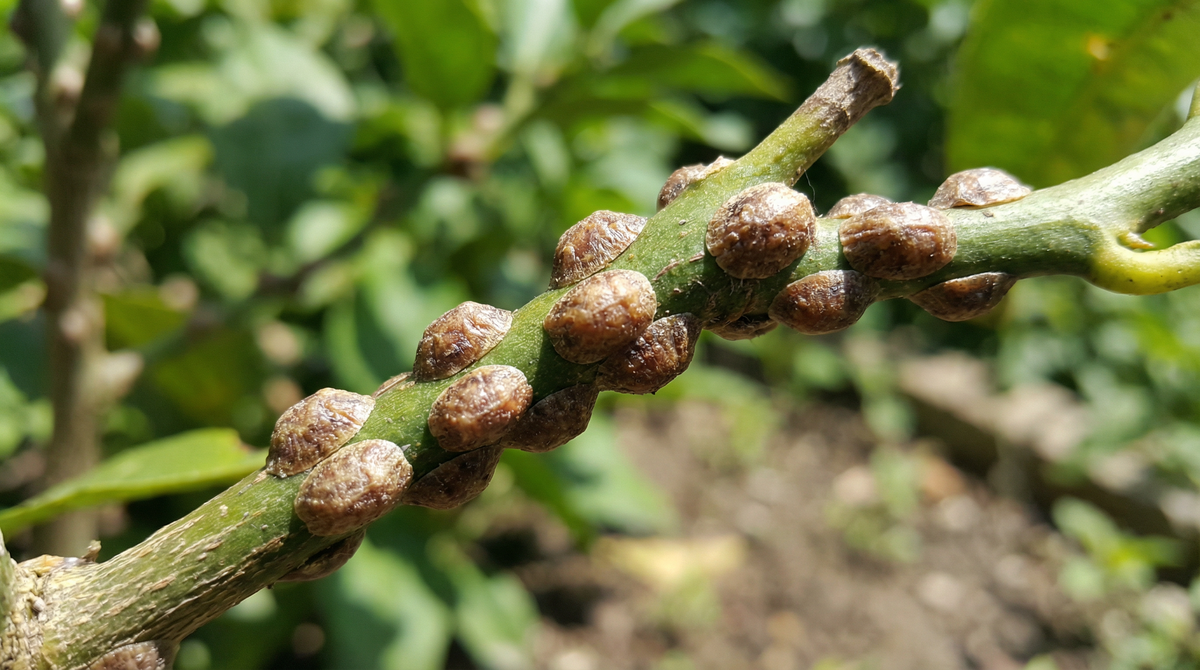
Scale insects (superfamily Coccoidea) are among the strangest and most easily overlooked pests in the garden — small, often immobile insects that attach themselves to stems and leaves beneath a protective waxy shell and quietly drain plant sap. Because a settled scale looks more like a bump, blister, or fleck of crust than a living insect, infestations often go unrecognized until a plant is visibly declining. Common on trees, shrubs, and houseplants, scales come in hundreds of species. With a beneficial rating of −4, they are a significant pest, but one that healthy plants and natural predators can usually keep in check.
Identification and Description
Scale insects are generally small, 1 to 5 millimeters, and fall into two broad groups. Armored scales secrete a hard, separate, shell-like covering — round, oval, or oyster-shaped — over their bodies. Soft scales have a smoother, waxy or cottony body and typically excrete sticky honeydew. Settled scales appear as small, immobile bumps or crusty encrustations along stems, leaf veins, and the undersides of leaves, in shades of brown, tan, white, gray, or black; they can be scraped off with a fingernail, revealing the soft insect beneath. The only mobile stage is the tiny crawler — a minute, six-legged nymph that hatches and wanders briefly before settling permanently. Telltale signs include the bumps themselves, sticky honeydew (from soft scales), black sooty mold growing on that honeydew, and yellowing, stippled, or dropping leaves.
Life Cycle
Scale insects have a simple life cycle — egg, nymph (crawler), and adult. The adult female lays eggs, often sheltered beneath her own protective scale, and these hatch into tiny mobile crawlers. The crawlers move to a suitable feeding site, settle, insert their mouthparts, and begin feeding, at which point they secrete their protective waxy covering and — in the females — lose their legs and remain immobile for the rest of their lives. Males, when present, develop through pre-pupal and pupal stages into tiny winged adults that do not feed and live only briefly to mate. Some species have multiple generations per year (much activity spanning roughly April through July, and year-round indoors). Overwintering varies by species — some as eggs under the mother's scale, others as immature fertilized females tucked in bark crevices. The mobile crawler stage is the key vulnerability, since the settled adults are shielded by their wax.
Habitat and Range
Scale insects occur worldwide and throughout the United States — Northeast, Southeast, Midwest, Southwest, West, and Pacific Northwest — infesting gardens, landscapes, indoor plants, trees, and shrubs. Many species are host-specific, and infestations often build on stressed or unhealthy plants, while vigorous, well-cared-for plants with active populations of natural predators tend to resist them. Indoors and in mild climates scales can persist and reproduce year-round.
Role in the Garden
Scale insects are a serious pest rated −4. By inserting their piercing-sucking mouthparts and continuously draining sap, they weaken plants, causing yellowing, stunted growth, leaf and needle drop, dieback of twigs and branches, and — in heavy, sustained infestations — the death of the plant. Soft scales compound the damage by excreting copious honeydew, which coats leaves and grows unsightly black sooty mold that further blocks light and photosynthesis, and which attracts ants. Because settled scales are protected by wax and often blend into the bark, populations can build unnoticed, making early detection and the health of the plant especially important.
Managing Scale Insects
Control combines physical removal, well-timed sprays, and biological control. For light infestations, manual removal works well — scrub the scales off with a soft brush or dab them with a cotton swab dipped in soapy water or 70% isopropyl alcohol, which breaks down the wax. Horticultural oils and insecticidal soaps are the mainstay for larger infestations: they smother scales and are most effective against the vulnerable crawler stage, so timing sprays to when crawlers are active (and repeating to catch successive hatches) is essential, since the waxy adults resist contact sprays. Dormant-season horticultural oil on woody plants smothers overwintering scales before growth begins. Encourage natural predators — lady beetles (including scale-specialist species), lacewings, and parasitic wasps are highly effective and often control scales on their own in a pesticide-free garden. Controlling ants is important, because ants protect scales from these predators in exchange for honeydew. Prune out and destroy heavily infested branches, and keep plants healthy and unstressed with proper watering and feeding, since vigorous plants resist scale far better.
Companion Planting and Habitat
The most useful "companion" strategy is to plant a diversity of flowering plants that attract and sustain the beneficial insects — lady beetles and parasitic wasps in particular — that prey on scales. A garden rich in small-flowered nectar sources and free of broad-spectrum pesticides keeps these natural enemies present and working, which is often enough to hold scale populations in check.
Uncovering a Hidden Pest
Scale insects hide in plain sight, so the first step is learning to recognize the bumps and honeydew for what they are. Scrub or dab off light infestations, spray oil or soap when crawlers are active, protect the lady beetles and parasitic wasps that hunt them, keep ants at bay, and above all keep your plants healthy and unstressed — and you can bring this sap-sucking, wax-armored pest back under control without harsh chemicals.