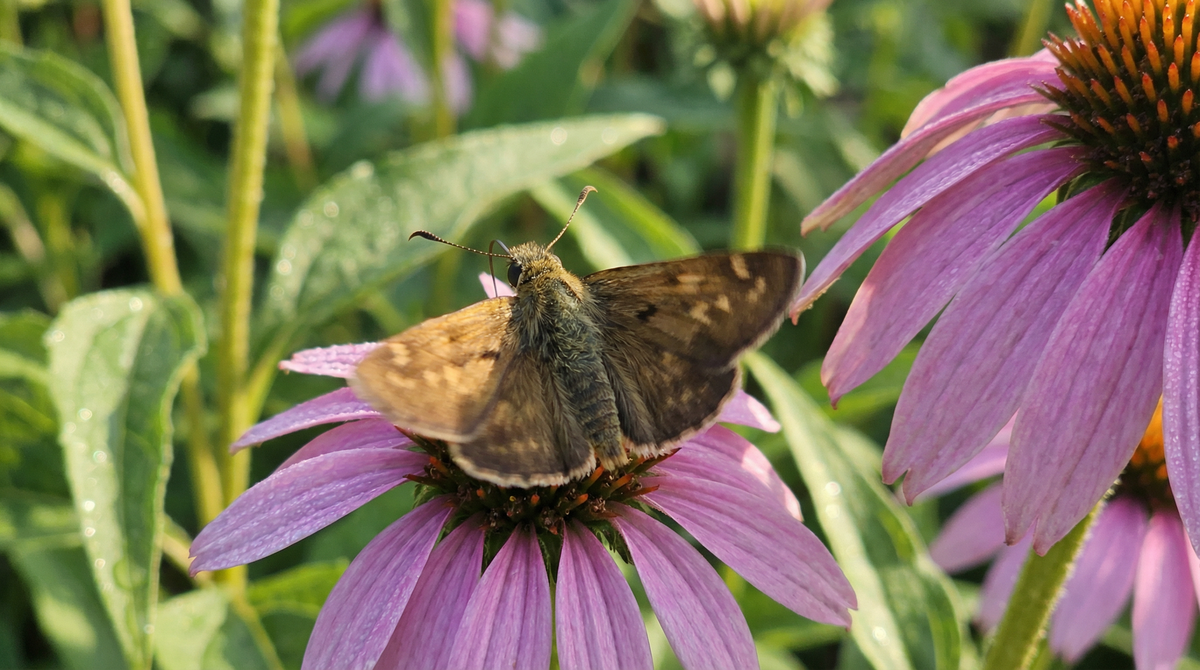
Skipper butterflies (family Hesperiidae) are the small, energetic, often overlooked members of the butterfly world — named for their quick, darting, "skipping" flight. Stouter-bodied and more moth-like than typical butterflies, skippers are a huge and diverse group, and many are important pollinators that visit a wide range of garden flowers. Their caterpillars mostly feed on grasses and legumes rather than garden crops, making them easy to welcome. With a beneficial rating of 4 out of 5, skippers add both pollination and lively movement to a flower garden, and supporting them is largely a matter of planting nectar flowers and tolerating a few native grasses.
Identification and Description
Skippers are generally small butterflies, often 2 to 4 centimeters across, with thick, hairy, moth-like bodies, large heads, and proportionally short wings. Many are colored in warm oranges, browns, tans, and golds, though some spread-wing skippers are darker with white or translucent spots. A distinctive feature is their hooked or clubbed antennae — the tips bend back into a small hook, unlike the simple clubs of most butterflies. They often rest in a characteristic pose with the forewings and hindwings held at different angles, giving a "jet plane" silhouette. Their flight is fast, low, and erratic — the darting "skip" that gives them their name. The two broad groups are the grass skippers, whose caterpillars feed on grasses, and the spread-wing skippers, whose larvae favor legumes and other broadleaf plants. Skipper caterpillars are smooth with a noticeably narrow "neck" behind a large head, and live within shelters they build from leaves.
Life Cycle
Skippers undergo complete metamorphosis — egg, larva, pupa, adult — and details vary by species, but grass skippers share a common pattern. The female lays eggs on or near the host plant, often on grass stems or the undersides of grass blades, and these hatch in a few weeks. The caterpillar builds a protective tube or shelter from folded, silk-tied leaf blades, feeding from within it for safety. Many skippers overwinter as caterpillars inside a sturdier grass-blade tube or cocoon, resuming feeding in spring before pupating; adults then emerge after a pupal stage of about two to three weeks. Depending on the species and region there may be one or more generations per year, with adults most active in the warm months (roughly June through August). This grass-tube overwintering is why leaving some undisturbed tall grass helps skippers persist.
Habitat and Range
Skippers are found worldwide and throughout the United States — Northeast, Southeast, Midwest, Southwest, West, and Pacific Northwest. They frequent gardens, meadows, woodland clearings, glades, riverbanks, and field margins — open, sunny, flower-rich places near the grasses and legumes their caterpillars need. Because grass skippers depend on native and turf grasses and spread-wing skippers on legumes and shrubs, a garden that includes both flowers and some grassy or shrubby habitat supports the widest range of species.
Role in the Garden
Skippers are beneficial pollinators, rated 4. As adults they are frequent, active flower visitors, sipping nectar through a long proboscis and transferring pollen among a wide variety of blooms — their abundance and energy make them meaningful contributors to garden and wildflower pollination. Their caterpillars feed mainly on grasses and legumes, not on prized vegetables or ornamentals, so they cause no meaningful crop damage; the occasional feeding on lawn or wild grasses is inconsequential. Skippers are harmless, lively, and a welcome sign of a healthy, diverse habitat.
Attracting and Supporting Skippers
Because skippers are beneficial, the goal is to attract and support them. Provide a continuous supply of nectar-rich flowers for the adults — coneflowers, asters, milkweeds, clover, and marigolds are all excellent, and skippers favor clustered, easily accessed blooms they can perch on. Just as important, supply larval host plants: leave patches of native and turf grasses (such as Kentucky bluegrass or Bermuda grass) for grass skippers, and include legumes and shrubs like locust and wisteria for spread-wing skippers. Maintain some areas of undisturbed tall grass to provide shelter and overwintering sites for the caterpillars in their grass-blade tubes. As with all butterflies, avoid broad-spectrum insecticides, which kill skippers and other pollinators; there are no plants known to repel them, so the whole garden can be planned to welcome them.
A Note on Companion Planting
Interplanting nectar sources like coneflowers, asters, and milkweeds among vegetable and fruit crops draws skippers and other pollinators into the garden, which can improve yields. Bordering the garden with native grasses or keeping a designated wild patch provides the larval food and shelter that keep a resident skipper population coming back year after year.
The Garden's Lively Little Pollinators
Skippers may be small and easy to miss, but their darting energy and steady flower visits make them valuable and delightful garden residents. Plant coneflowers, asters, and milkweeds for the adults, leave some native grasses and a wild patch for the caterpillars, skip the sprays, and you will keep these quick little pollinators skipping through your garden all summer long.