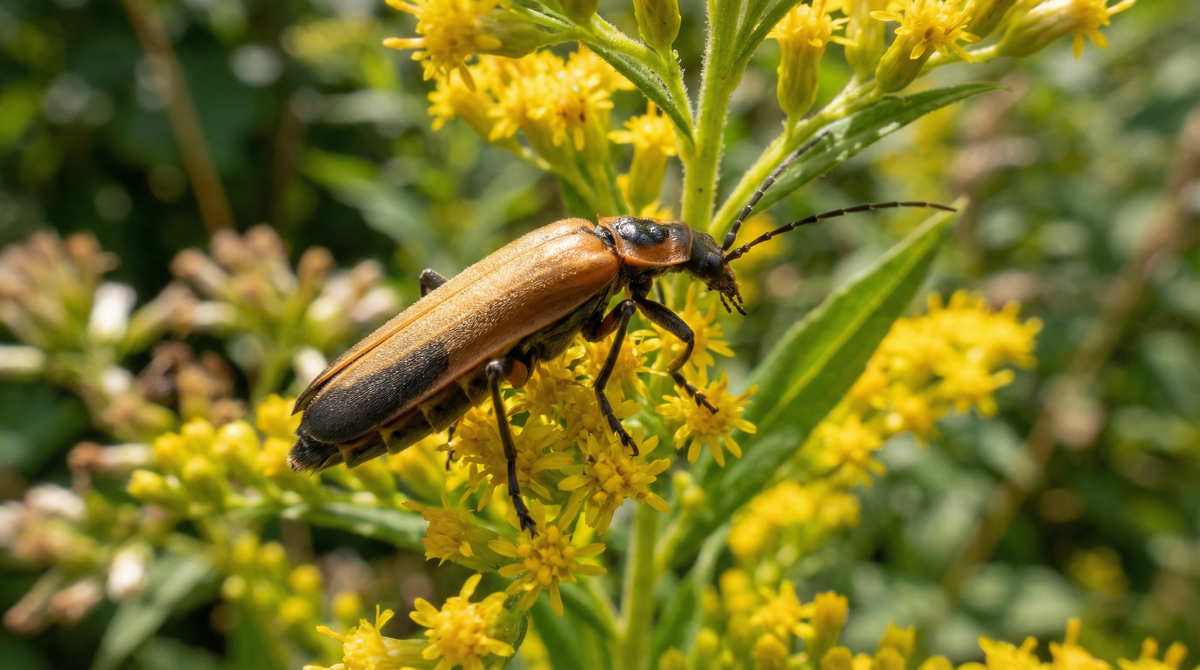
Soldier beetles (family Cantharidae) are doubly useful garden allies — beneficial as both pollinators and predators. The goldenrod soldier beetle (Chauliognathus pennsylvanicus) is one of the most familiar, a soft-bodied orange-and-black beetle that swarms goldenrod and other late-summer flowers, feeding on pollen and nectar while its larvae hunt pests in the soil. Sometimes called "leatherwings" for their soft, cloth-like wing covers, soldier beetles are harmless to people and plants and are a welcome sign of a healthy, flower-rich garden. With a beneficial rating of 4 out of 5, they are an insect to attract and enjoy rather than control.
Identification and Description
Soldier beetles are elongated, soft-bodied beetles, roughly 1 to 1.5 centimeters long, most commonly colored in yellow-orange and black — the goldenrod soldier beetle is orange with a black spot on each wing cover and a black band. Unlike hard-shelled beetles, their wing covers (elytra) are soft and leathery, giving rise to the nickname "leatherwing." They have long antennae and a somewhat flattened body, and they are often seen in numbers clustered on flower heads, especially goldenrod, in late summer. They are sometimes mistaken for fireflies (a related family) or for pest beetles, but soldier beetles neither bite nor harm plants. The larvae are quite different — elongated, flattened, dark, and velvety, covered in fine dense hairs, living in soil and leaf litter.
Life Cycle
Soldier beetles undergo complete metamorphosis — egg, larva, pupa, adult. Females lay their eggs in the soil, and the flattened, dark larvae hatch and become active in damp places such as leaf litter, under rocks, and in loose soil, where they prey on other insects. The larvae overwinter in the soil, leaf litter, and under bark, then pupate in spring or early summer. Adults emerge from late spring to midsummer and remain active into early fall (most conspicuous roughly June through September). Depending on climate there are one to two generations per year. Because the larvae overwinter and pupate in undisturbed soil and litter, leaving some permanent, mulched, undug areas is key to supporting the next generation.
Habitat and Range
Native to eastern North America, the goldenrod soldier beetle is found across the Northeast, Southeast, and Midwest, with related soldier beetle species occurring more widely. They inhabit gardens, meadows, forest edges, open fields, prairies, and grasslands — open, sunny, flower-rich settings, often near moist habitats that suit their soil-dwelling larvae. A garden with abundant late-season blooms and some undisturbed, mulched ground offers everything they need.
Role in the Garden
Soldier beetles are beneficial on two fronts, earning a rating of 4. As adults they feed on pollen and nectar, and in moving from flower to flower they act as pollinators — they are particularly important visitors to goldenrod and other late-summer flowers when many other pollinators are winding down. They also eat some soft-bodied pests such as aphids as adults. As larvae they are valuable predators, hunting through soil and leaf litter for insect eggs, small caterpillars, aphids, grasshopper eggs, and other soft-bodied prey. This combination of pollination and pest control, from a beetle that does no damage to plants or people, makes the soldier beetle a genuine asset to the garden.
Attracting and Supporting Soldier Beetles
Because soldier beetles are beneficial, the goal is to attract and support them. Provide a diversity of flowering plants that offer pollen and nectar, especially members of the sunflower (Asteraceae) and umbel (Apiaceae) families — goldenrod, yarrow, cosmos, dill, fennel, milkweed, catnip, hydrangea, and wild lettuce are all excellent, and white and yellow flowers are especially attractive. Aim for blooms that continue into late summer and fall, when adult soldier beetles are most active. Just as important, leave some areas of the garden undisturbed with permanent plantings and mulch, providing the moist, sheltered soil and leaf litter the larvae need to hunt, overwinter, and pupate. Offer a shallow dish of water to help draw them in, and — as with all beneficial insects — avoid broad-spectrum insecticides, which kill soldier beetles and the prey their larvae depend on. There are no plants known to repel them, so the garden can be planned entirely to welcome them.
A Two-in-One Garden Ally
The soldier beetle quietly delivers both pollination and pest control across the season. Plant goldenrod, yarrow, fennel, and cosmos for the flower-feeding adults, leave a mulched, undisturbed corner for the predatory larvae, keep water available, and skip the sprays — and you will host clouds of these cheerful orange leatherwings working your late-summer blooms while their young patrol the soil below.