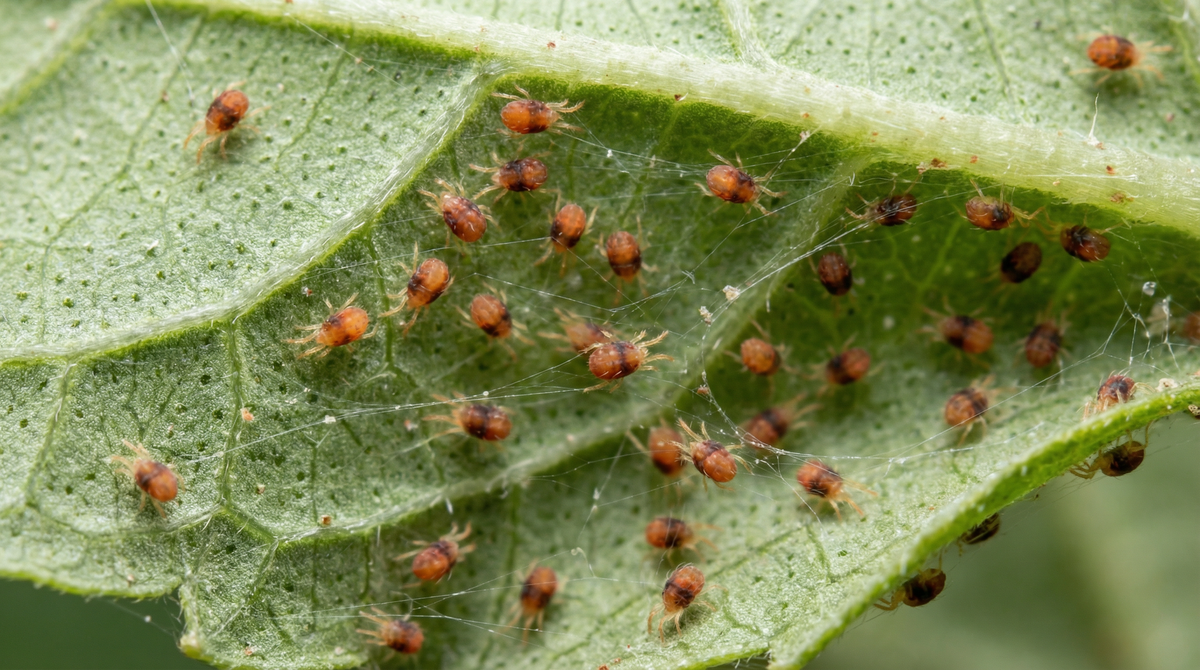
Spider mites (family Tetranychidae) are tiny, sap-sucking pests that can do enormous damage before a gardener even realizes they are present. Though often lumped in with insect pests, they are actually arachnids — relatives of spiders and ticks — and, like spiders, many spin fine silk webbing over the plants they infest. Thriving in hot, dry conditions, spider mites reproduce with astonishing speed, and a small population can explode into a plant-covering infestation in just a week or two. With a beneficial rating of −4, they are a serious pest, especially in greenhouses, on houseplants, and during hot, dry spells outdoors.
Identification and Description
Spider mites are extremely small — typically less than 0.5 millimeter, about the size of a grain of ground pepper — and are barely visible to the naked eye, appearing as tiny moving dots, often greenish, yellowish, orange, or reddish (the two-spotted spider mite, a common species, is pale with two dark spots). Because the mites themselves are so hard to see, gardeners usually detect them by their damage: fine, pale stippling or speckling on the upper leaf surface, where mites have drained the contents of individual cells, giving leaves a bronzed, dusty, or sandblasted look. As infestations worsen, leaves yellow, dry, and drop, and fine silk webbing appears over leaf undersides, stems, and growing tips. A useful test is to hold a sheet of white paper under a suspect leaf and tap it — dislodged mites show up as slowly moving specks.
Life Cycle
Spider mites develop through four stages — egg, larva, nymph, and adult — and do so with remarkable speed. In hot conditions (around 80°F) the entire cycle can be completed in as little as 5 to 7 days. Eggs are laid on leaf undersides and hatch in 1 to 2 days into six-legged larvae, which feed briefly before molting into the eight-legged nymphal stages (protonymph and deutonymph), each lasting a few days, before the adult emerges. Adult females live 2 to 4 weeks and can lay hundreds of eggs, driving explosive population growth — which is why infestations seem to erupt overnight in warm weather. Mated adult females overwinter in protected places such as under loose bark, in soil cracks, and in leaf litter and debris, emerging to reproduce when conditions warm. Peak activity runs roughly June through September.
Habitat and Range
Common pest spider mites are of Eurasian origin and are now found throughout the United States — Northeast, Southeast, Midwest, Southwest, West, and Pacific Northwest — in gardens, greenhouses, orchards, fields, and on houseplants. They flourish in hot, dry conditions and are especially damaging to drought-stressed plants, which is a defining feature of their biology: dusty, water-stressed plants in hot weather are prime targets. Frequent hosts include tomatoes, peppers, strawberries, corn, beans, and cannabis, along with many ornamentals and houseplants.
Role in the Garden
Spider mites are a serious pest rated −4. By piercing individual leaf cells and sucking out their contents, they destroy the plant's photosynthetic tissue, causing the characteristic stippling that progresses to bronzing, yellowing, leaf drop, and — in heavy infestations — defoliation and even plant death. Their extraordinary reproductive rate means damage can escalate rapidly, and their tendency to develop resistance makes chemical-only approaches unreliable. Because they are shielded on leaf undersides and within webbing, and because hot dry weather accelerates them, prevention and early detection are far more effective than trying to rescue a badly infested plant.
Managing Spider Mites
Control begins with prevention and hinges on moisture and natural enemies. Keeping plants properly watered and unstressed is the first line of defense, since drought stress and heat are what let mite populations explode. Regularly spraying the undersides of leaves with a strong jet of water knocks mites off, kills many, and raises humidity that discourages them — a simple, highly effective routine at the first sign of trouble. The standout biological control is predatory mites, especially Phytoseiulus persimilis, which hunt and consume spider mites and can clear infestations; other natural predators include lady beetles, lacewings, and minute pirate bugs. Horticultural oil, neem oil, and insecticidal soap smother mites and their eggs, but demand thorough coverage of all surfaces, especially leaf undersides, and repeat applications to catch the fast-hatching generations. Avoid broad-spectrum insecticides, which kill the predatory mites and often make spider mite outbreaks worse.
Companion Planting
Some plants help deter spider mites or support their predators. Cilantro, dill, garlic, and chrysanthemums are cited as deterrents — either repelling the mites directly or drawing in beneficial predators — and neem-family effects add to their usefulness. More broadly, maintaining a diverse garden with plenty of flowering plants sustains the populations of predatory mites and insects that keep spider mites in check naturally.
Beating the Heat-Loving Mite
Spider mites exploit hot, dry, dusty, stressed conditions, so the winning strategy is to deny them those conditions. Keep plants well watered, hose down leaf undersides regularly, unleash predatory mites, spray oil or soap thoroughly when needed, and skip the broad-spectrum sprays that kill their enemies — and you can keep this tiny, fast-breeding arachnid from bronzing and defoliating your plants.