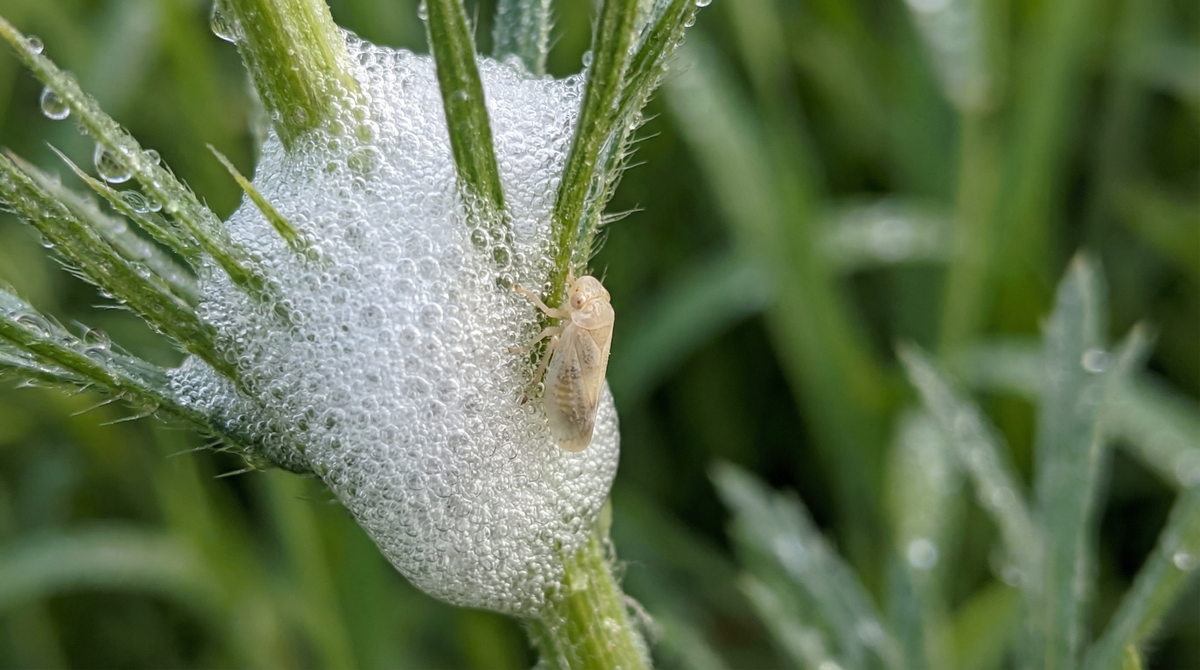
The spittlebug (Philaenus spumarius, the meadow spittlebug) is best known not for the insect itself but for the frothy blob of "spit" it leaves on plant stems in late spring — a foamy mass that puzzles many gardeners the first time they see it. Inside that froth lives the immature spittlebug, a small sap-sucking nymph that produces the foam for protection. The adults, by contrast, are called froghoppers for their frog-like faces and prodigious jumping ability. A member of the order Hemiptera, the spittlebug is generally a minor pest — its damage is usually slight — earning a beneficial rating of just −1, more curiosity than catastrophe in most gardens.
Identification and Description
The most recognizable sign of a spittlebug is the spittle mass itself: a white, frothy, bubbly glob that looks like spit, tucked into leaf axils and along stems, most common in late spring and early summer. Hidden inside is the nymph — a small, soft, pale green or yellowish insect that sucks plant sap and whips air into its excretions to create the protective foam. The adult froghopper is a small, stout, wedge-shaped insect, roughly 6 millimeters long, mottled brown, gray, or tan (the meadow spittlebug is quite variable in color), with the ability to leap explosively when disturbed — froghoppers are among the highest-jumping animals relative to their size. Adults are far less noticeable than the conspicuous nymphal foam.
Life Cycle
The spittlebug has a straightforward life cycle with a single generation per year. It overwinters as eggs laid in plant debris, leaves, and stems. Nymphs emerge in late April or early May and begin feeding on plants, immediately producing their signature spittle mass, which shields them from predators, parasites, and drying out. The nymphal stage lasts five to eight weeks. After maturing into winged adult froghoppers, they leave the foam behind and move to grassy areas and pastures to feed. In September and October the females return to lay the eggs that will overwinter and start the next generation. Activity spans roughly April through October, but the eye-catching foam is a spring-and-early-summer phenomenon.
Habitat and Range
Native to Europe, North Africa, and parts of Asia, the meadow spittlebug is now found throughout the United States — Northeast, Southeast, Midwest, Southwest, West, and Pacific Northwest. It inhabits gardens, meadows, pastures, and areas with broadleaf weeds. It has a very wide host range, and in gardens is often found on ornamental grasses, roses, chrysanthemums, clover, strawberries, and various herbs, as well as on many weeds.
Role in the Garden
The spittlebug is only a minor pest, rated −1. Both nymphs and adults feed by sucking plant sap, but the damage is usually slight — occasional stunting, slight distortion, or wilting of new growth on heavily infested plants, and cosmetic concern over the foam itself. On most established garden plants the effect is negligible and no control is needed. The main exceptions are when populations are unusually high on strawberries, herbs, or nursery stock, where feeding can reduce vigor or yield. Notably, in some regions Philaenus spumarius is a concern as a potential vector of the bacterial plant pathogen Xylella fastidiosa — a serious disease of olives, grapes, and other crops in affected areas — which can make the spittlebug more significant where that disease is present. In the typical home garden, though, it remains a low-impact curiosity.
Managing Spittlebugs
Because the spittlebug is a minor pest, aggressive control is rarely warranted. The simplest approach is physical removal: pick off the nymphs by hand or, more easily, blast the spittle masses off plants with a strong spray of water, which dislodges and kills many nymphs and washes away the protective foam. Reducing nearby broadleaf weeds limits the spittlebug's food sources, egg-laying sites, and habitat, helping keep numbers down. If treatment is truly needed on a valued plant, insecticidal soaps and oils such as neem or citrus oil can be effective, but they must be applied directly to the nymphs, since the surrounding spittle acts as a barrier that shields them from sprays — so wash away the foam first or target the exposed insect. Cleaning up plant debris in fall removes some overwintering eggs.
A Note on Companion Planting
No specific companion plants are known to repel spittlebugs, but maintaining a diverse, healthy garden ecosystem supports the natural predators and plant vigor that keep this minor pest in check. Vigorous plants tolerate the light feeding easily, so good general growing practices are usually all that is required.
More Curiosity Than Threat
For most gardeners the spittlebug is a harmless oddity — a bit of foam to hose off rather than a pest to battle. Rinse away the spittle masses with water, keep weeds down, and only reach for soap or oil in the rare case of a heavy infestation on a valued plant. Except where Xylella disease is a concern, the spittlebug can generally be enjoyed as one of the garden's stranger sights and left largely alone.