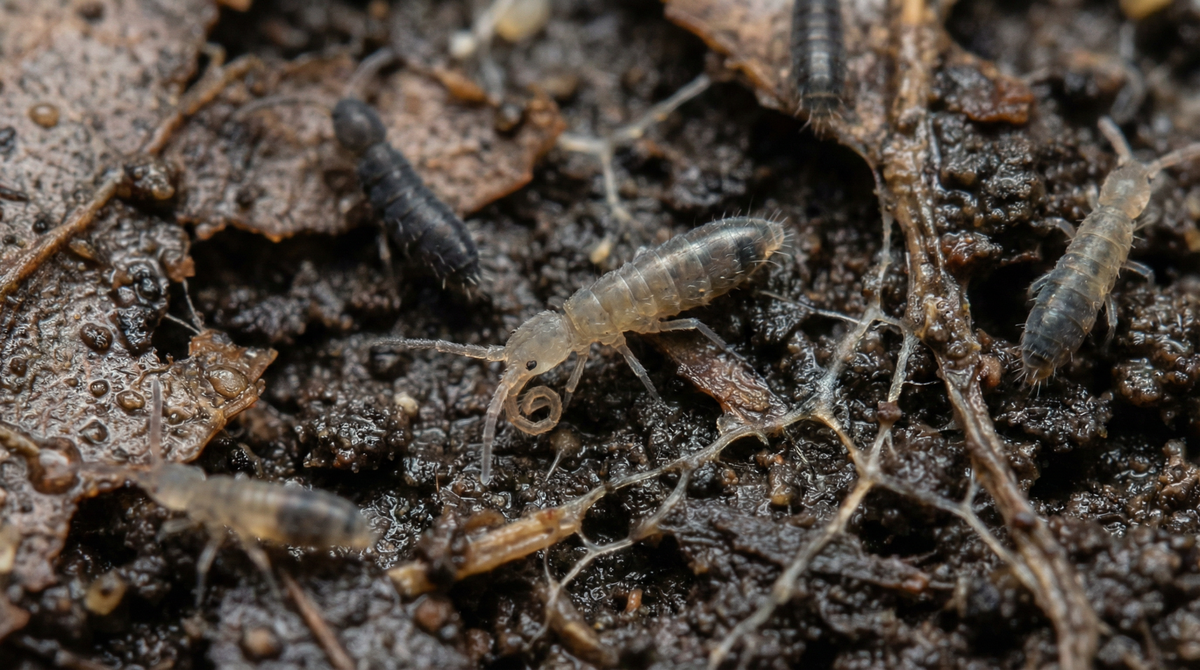
Springtails (class Collembola) are among the most abundant animals on Earth — tiny, ancient, six-legged creatures that live by the thousands in a single square foot of healthy soil, quietly recycling organic matter beneath our feet. Named for the springing organ many use to catapult themselves away from danger, springtails are key members of the soil food web, breaking down decaying plant material and helping build fertile, living soil. Though occasionally a nuisance indoors or a minor pest of seedlings, they are overwhelmingly beneficial, earning a rating of 3 out of 5, and their presence is a reliable sign of rich, moist, biologically active ground.
Identification and Description
Springtails are very small, typically 1 to 3 millimeters long, soft-bodied, and wingless, in colors ranging from white and gray to brown, black, purple, or even iridescent blue. They are technically not insects but hexapods, closely related to them. Their defining feature is the furcula — a forked, tail-like appendage folded beneath the abdomen that, when released, snaps against the ground and flings the springtail several times its body length into the air, an escape mechanism that gives the group its name (not all species have a well-developed one). In gardens they are usually noticed only when disturbed — a sprinkling of tiny hopping specks in damp soil, compost, or leaf litter, or occasionally massed on the surface of water, moist patios, or even snow (the winter-active "snow fleas").
Life Cycle
Springtails have a simple development — egg, juvenile, and adult — with the juveniles resembling smaller versions of the adults. Eggs are laid in moist soil, and the young molt multiple times as they grow, continuing to molt even after reaching adulthood. The complete cycle can be as short as four to six weeks, and in favorable, moist conditions springtails produce multiple overlapping generations per year, allowing populations to build rapidly. They are active year-round and remarkably cold-hardy; some species remain active on the surface of snow in winter. Springtails overwinter in various stages — egg, juvenile, or adult — in soil, leaf litter, and other protected, moist environments.
Habitat and Range
Springtails are cosmopolitan, found worldwide and throughout the United States — Northeast, Southeast, Midwest, Southwest, West, and Pacific Northwest. They live wherever there is moisture and organic matter: gardens, meadows, forests, leaf litter, soil, under tree bark, around ponds and lakes, in moss, and on the surface of still water and snow. Moisture is the common requirement — springtails need damp conditions and are drawn to moist soil, decaying vegetation, mold, fungi, bacteria, and algae, which are both their habitat and their food.
Role in the Garden
Springtails are beneficial members of the soil food web, rated 3. As decomposers, they feed on decaying plant matter, fungi, bacteria, algae, and mold, breaking these materials down and accelerating the recycling of nutrients into forms plants can use. In doing so they help build humus, improve soil structure, and support healthy microbial activity, and they also serve as food for many small predators. A thriving springtail population is a sign of rich, living soil. Their downsides are minor and situational: in very wet conditions large numbers can occasionally nibble on tender seedling roots or emerging shoots, and they sometimes become a harmless nuisance indoors around overwatered houseplants or damp areas. On balance, they are a helpful and welcome part of the garden ecosystem.
Supporting and Managing Springtails
Because springtails are overwhelmingly beneficial, the goal in the garden is usually to support them rather than control them. Maintain moist soil rich in organic matter — a layer of mulch, compost, and leaf litter around plants feeds springtails and the whole soil food web, and building healthy soil benefits every plant that grows in it. They require no special companion planting; simply fostering a living, organic-rich soil is enough.
In the rare cases where springtails become a problem — nibbling seedlings in overly wet conditions or swarming around houseplants — the fix is simply to reduce moisture. Allow the soil surface to dry out between waterings, improve air circulation and drainage, and avoid overwatering; springtails cannot tolerate dry conditions and populations quickly subside. Several plant-derived oils — cider vinegar, lavender, eucalyptus, tea tree, neem, and cedar oil — are cited as repellents if a deterrent is wanted indoors, but for garden populations, drying out the environment is all that is needed.
Tiny Engineers of Living Soil
Springtails do their work out of sight, but a garden's fertility depends on countless small decomposers like them. Keep the soil moist and rich with mulch and compost, and these springing little hexapods will flourish as part of a healthy soil food web — turning leaf litter and decay into the fertile ground your plants need. Only when they gather in overwatered spots is any action warranted, and then simply letting things dry out restores the balance.