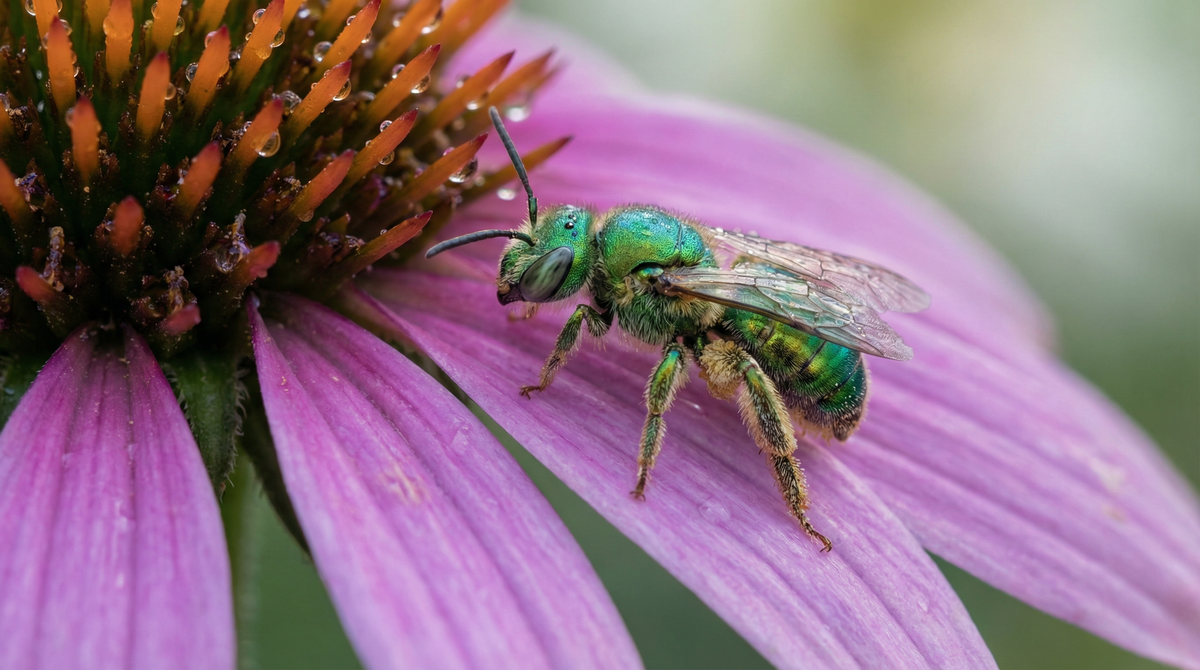
Sweat bees (family Halictidae) are small, often dazzlingly colored native bees that are among the most important and underappreciated pollinators in the garden. Their curious common name comes from their attraction to human perspiration, which they lap up for its salt and moisture — a harmless habit, though it can lead to the occasional mild sting if one is swatted. Ranging from dull brown to brilliant metallic green and gold, sweat bees pollinate a huge variety of flowers and crops. With a beneficial rating of 4 out of 5, they are a valuable ally worth attracting, and supporting them is as simple as offering flowers and a bit of undisturbed ground.
Identification and Description
Sweat bees are small, generally 3 to 10 millimeters long — often noticeably smaller than a honeybee. Many are strikingly beautiful, with brilliant metallic green, blue, bronze, or gold bodies that catch the light, while others are more subdued brown or black, sometimes with pale abdominal bands. Like other bees they carry pollen on hairs on their legs. They are easily overlooked because of their size, but a close look at flowers on a sunny day often reveals these jewel-toned little bees working the blooms. They are docile and non-aggressive; only females can sting, and they do so only if pressed against the skin, delivering a very mild sting. Their attraction to sweat is a reliable field clue to their identity.
Life Cycle
Sweat bees undergo complete metamorphosis — egg, larva, pupa, adult. A female builds a nest cell, provisions it with a mass of pollen and nectar, lays an egg on the provision, and seals the waterproof cell. The larva hatches, consumes the stored food, pupates within the cell, and emerges as an adult. Depending on species and climate there can be multiple generations per year. Sweat bees are remarkably varied in their social behavior — some are entirely solitary, while others are semi-social, with the first generation of daughters becoming workers that help their mother raise the next brood. The final generation of females each season mates and then overwinters. Mated females spend the winter in diapause in their nests — in the ground, in rotting wood, or under logs — emerging to start new nests in spring (adults are active over a long season, roughly February through November depending on region).
Habitat and Range
Sweat bees are found worldwide, on every continent except Antarctica, and throughout the United States — Northeast, Southeast, Midwest, Southwest, West, and Pacific Northwest. They occupy gardens, meadows, forests, river banks, and wood piles. Most sweat bees are ground-nesters, excavating tunnels in bare or sparsely vegetated soil, while some, such as Augochlora pura, nest in rotting wood — so both open soil and decaying logs provide important nesting habitat.
Role in the Garden
Sweat bees are highly beneficial pollinators, rated 4. Because they are abundant, active over a long season, and visit an enormous range of flowers, they contribute significantly to the pollination of garden flowers, wildflowers, and many crops — they are known to be effective pollinators of tomatoes and other vegetables, as well as of countless native plants. Their small size lets them work small and open flowers efficiently. They cause no plant damage, and their sweat-seeking behavior, while sometimes a minor annoyance on hot days, is entirely harmless. A garden humming with these tiny metallic bees is a garden with strong, resilient pollination.
Attracting and Supporting Sweat Bees
Because sweat bees are beneficial, the goal is to attract and support them. Provide nesting habitat: since most are ground-nesters, leave some areas of bare, undisturbed soil in sunny spots where females can dig their tunnels, and for wood-nesting species leave rotting logs or a woodpile. Plant a diversity of flowers that bloom throughout the season to provide continuous nectar and pollen — open-faced composite flowers like asters, sunflowers, black-eyed Susans, coneflowers, and daisies are excellent, along with salvias, penstemons, and rock rose. Including native plants such as New Jersey tea, pale beardtongue, wild hyacinth, tall coreopsis, and germanders further supports sweat bees and other native pollinators, and planting tomatoes takes advantage of their pollination. Most importantly, avoid pesticides, which kill bees directly and contaminate the pollen they gather; note too that strong artificial scents, insect repellents, and citrus or peppermint oils tend to deter them, so keep the garden as natural as possible where you want them working.
Jewels of the Pollinator Garden
Small, gleaming, and endlessly busy, sweat bees are pollination powerhouses hiding in plain sight. Leave a patch of bare sunny soil and a rotting log for nesting, fill the garden with season-long flowers like asters, sunflowers, and coneflowers, and skip the sprays and strong scents — and these jewel-toned native bees will reward you with steady, effective pollination from early spring to late fall.