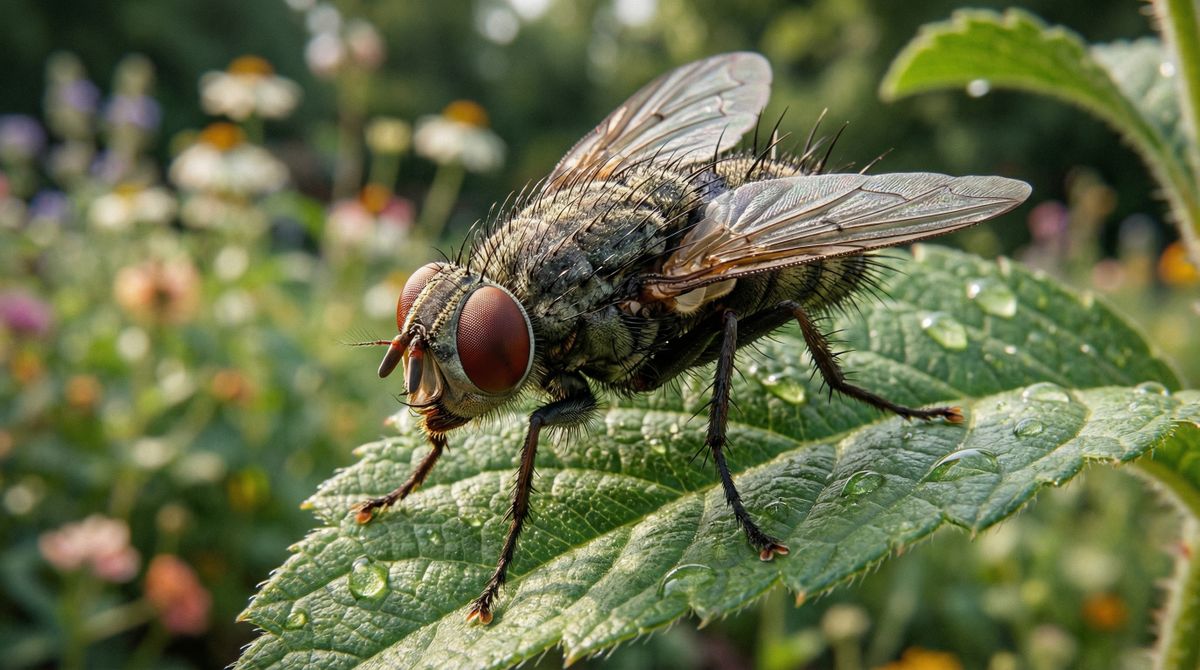
Tachinid flies (family Tachinidae) are among the most important — and most overlooked — natural pest controllers in the garden. This enormous family of flies parasitizes a huge range of pest insects: the female lays her eggs on or in a host, and her maggots consume it from the inside, much as parasitic wasps do. Because they attack caterpillars, beetles, squash bugs, and many other pests, tachinid flies are a cornerstone of biological control, quietly rivaling parasitic wasps in their value. With a beneficial rating of 5 out of 5, these unassuming flies are exactly the kind of ally an organic garden is designed to nurture.
Identification and Description
Tachinid flies are a diverse group, but many look like large, stout, bristly houseflies, generally gray, black, or brownish, and typically 5 to 15 millimeters long. Their most useful field mark is their conspicuous stiff bristles, especially prominent on the abdomen and rear of the body, giving them a distinctly spiny appearance. Some species are more colorful, with orange or reddish markings. Because they resemble ordinary flies, they are almost always overlooked, and gardeners are more likely to notice the results of their work — parasitized caterpillars or beetles, sometimes bearing tiny white eggs glued to their backs where a female has laid them. The larvae are pale internal maggots, rarely seen until they emerge from a dead host to pupate.
Life Cycle
Tachinid flies undergo complete metamorphosis — egg, larva, pupa, adult — with remarkably diverse reproductive strategies. Most commonly, the female glues her eggs to the outside of a host insect; when they hatch, the maggots burrow in and feed on the host's internal tissues, eventually killing it. Other species inject eggs directly into the host, lay eggs on foliage to be eaten by the host, or hatch their eggs internally and deposit live larvae on or near a host. After maturing, the larva emerges from the dead host to pupate, either in the soil or within the host's remains. The adult fly that emerges is not parasitic — it feeds on nectar, pollen, and other organic matter, which is why flowers are essential to sustaining tachinid populations. There are typically several generations per year (adults active roughly May through September). Overwintering varies: some species overwinter as pupae in soil or leaf litter, others as larvae inside their living, overwintering hosts.
Habitat and Range
Tachinid flies are found worldwide and throughout the United States — Northeast, Southeast, Midwest, Southwest, West, and Pacific Northwest. They frequent gardens, meadows, forest edges, and orchards — anywhere host insects and flowering plants coexist. Because the adults need nectar and pollen while the larvae need hosts, a diverse garden with abundant small flowers and a tolerance for some pests provides ideal habitat.
Role in the Garden
Tachinid flies are supremely beneficial, earning the top rating of 5, and their value comes from the breadth of pests they attack. Collectively they parasitize a wide array of garden pests — caterpillars (including armyworms, cutworms, cabbage worms, and gypsy moth larvae), beetles (such as Japanese beetles and Colorado potato beetles), squash bugs and stink bugs, sawflies, grasshoppers, and more. By seeking out these hosts and killing them from within, tachinid flies provide natural, self-sustaining pest control that reaches pests other methods miss. The adults also contribute modest pollination as they visit flowers for nectar. They cause no harm to plants or people, making them one of the most valuable insect groups a gardener can encourage.
Attracting and Supporting Tachinid Flies
Because tachinid flies are wholly beneficial, the goal is to attract and retain them, and — as with parasitic wasps — the key is flowers with shallow, accessible nectar that suit the adults' short mouthparts. Plants in the carrot family (Apiaceae) such as dill, fennel, parsley, cilantro, and angelica, and the daisy family (Asteraceae) such as yarrow, chamomile, feverfew, coreopsis, Shasta daisies, asters, and boltonia are especially effective; white and other small, open flowers are favored. Plant a succession of blooms through the season so adults always have nectar. Interplanting these flowers near crops prone to caterpillars, beetles, and squash bugs positions the flies where their offspring can find hosts. Crucially, avoid broad-spectrum pesticides, which kill tachinid flies along with the pests, and tolerate a low level of host pests so the flies always have somewhere to reproduce. Learning to recognize the white eggs on a caterpillar's back — and leaving those parasitized pests in place — protects the next generation of flies.
Unsung Heroes of Pest Control
Tachinid flies look like ordinary flies but do extraordinary work, parasitizing many of the garden's worst pests. Fill the beds with dill, fennel, yarrow, and other small-flowered plants, keep blooms coming all season, put away the broad-spectrum sprays, and tolerate a few pests to feed the next generation — and these bristly, unassuming flies will patrol your garden, quietly turning caterpillars, beetles, and squash bugs into nurseries for more of themselves.