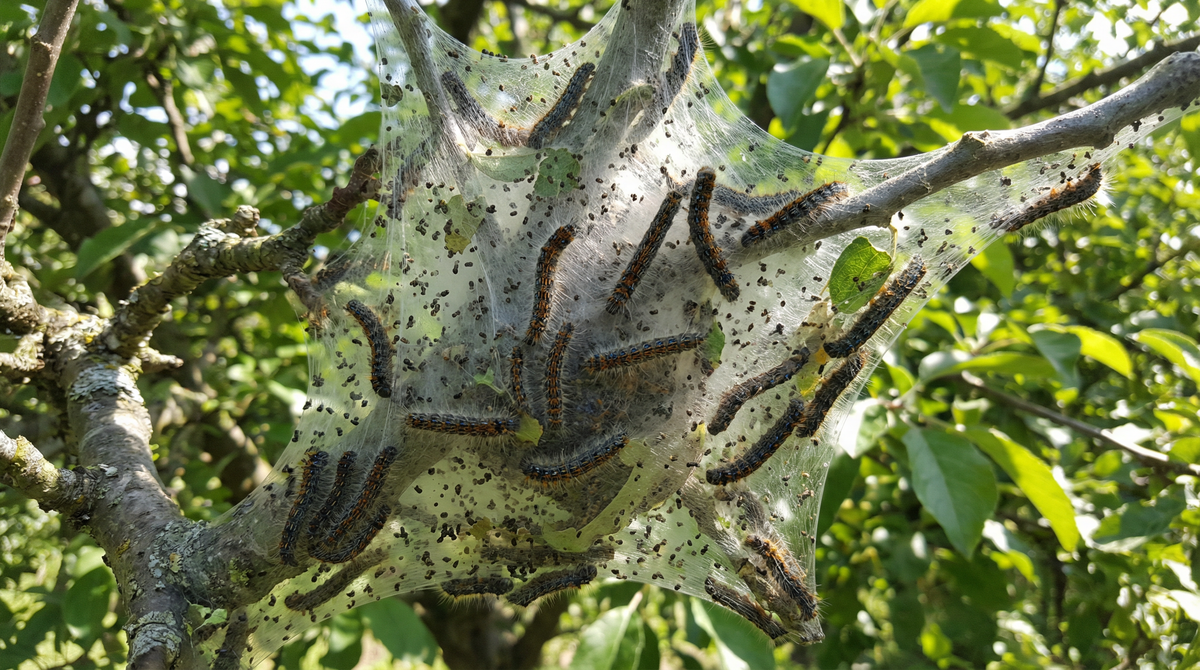
Tent caterpillars (genus Malacosoma) are the makers of the conspicuous silken nests that appear in the crotches of trees each spring, and the social caterpillars that stream out of them to devour the new leaves. Native to North America, these caterpillars — including the eastern tent caterpillar, forest tent caterpillar, and western tent caterpillar — can defoliate ornamental and fruit trees during their brief but intense feeding period. Though the damage looks alarming, healthy trees usually recover, which keeps the tent caterpillar in the moderate-pest category with a beneficial rating of −4. Understanding its early-spring timing is the key to keeping it in check.
Identification and Description
The most obvious sign of tent caterpillars is the silken tent itself — a dense, webbed nest built in the fork or crotch of a branch (this distinguishes the eastern tent caterpillar from the fall webworm, whose looser webs enclose the branch tips later in the year). The caterpillars are hairy and boldly marked; the eastern tent caterpillar is black with a distinctive white stripe down its back, flanked by blue and reddish-brown markings, growing to about 5 to 6 centimeters. The adult is a stout, hairy, tan-to-brown moth. The egg masses are also distinctive: hardened, dark, varnished-looking bands that encircle small twigs, easily spotted on bare branches in winter.
Life Cycle
Tent caterpillars have one generation per year and overwinter as eggs in those hardened, dark masses wrapped around twigs. The larvae hatch in early spring, typically around March, timed to coincide with the opening of the host tree's buds so the young caterpillars have tender new leaves to eat. These social caterpillars immediately begin constructing a communal silken tent in a branch crotch, retreating to it for shelter and emerging to feed on nearby foliage. They grow through five to six instars over four to six weeks, reaching about 2 to 2.5 inches, then leave the nest to find a protected spot and spin a cocoon. The adult moth emerges roughly three weeks later, mates, and the female lays the egg mass that will overwinter and start the cycle again. Because everything hinges on that early-spring hatch, winter and early-spring action is the most effective.
Habitat and Range
Tent caterpillars are native to North America and found across the entire United States — Northeast, Southeast, Midwest, Southwest, West, and Pacific Northwest — in gardens, orchards, and forests. They favor trees in the rose family and related hosts: wild cherry (a special favorite), apple, crabapple, plum, peach, pear, and hawthorn are all commonly attacked. Wild cherry along woodland edges often serves as a reservoir from which caterpillars spread to nearby orchard and ornamental trees.
Role in the Garden
The tent caterpillar is a moderate pest rated −4. During their spring feeding the caterpillars can strip significant amounts of foliage — occasionally defoliating whole branches or small trees — and their unsightly tents and the mess of frass beneath them are a nuisance in ornamental settings. However, because the feeding happens early and is usually finished by early summer, healthy, established trees typically leaf out again and recover with little lasting harm. The greater concern is on young, newly planted, or already-stressed trees, and on fruit trees where repeated heavy defoliation can reduce vigor and yield. It is a manageable pest rather than a catastrophic one.
Managing Tent Caterpillars
Control is most effective early and relies on physical removal and targeted biologicals. In winter, scout bare branches for the dark, varnished egg masses and prune them out and destroy them before they hatch — an easy, high-impact step. In early spring, remove and destroy small tents by hand while the caterpillars are young and still clustered inside (do this in the early morning or evening when they are in the nest); tents can be scraped out or the supporting branch pruned. Avoid the temptation to burn tents in the tree, which damages the tree far more than the caterpillars do. For larger infestations, Bacillus thuringiensis var. kurstaki (Btk) is highly effective — apply it to the foliage the caterpillars will eat, targeting young larvae for best results. Encourage natural enemies such as birds, predatory beetles, and parasitic wasps and flies, which attack tent caterpillars and help suppress outbreaks.
Companion Planting
Aromatic plantings can help deter egg-laying moths. Interplanting strongly scented herbs such as sage, dill, oregano, and rosemary among or near susceptible trees can confuse the moths and discourage them from laying nearby, and nasturtium can be used as a trap crop to draw egg-laying moths away from valued plants, after which the affected leaves are removed and destroyed. These tactics support, rather than replace, egg-mass removal and early tent destruction.
Catching the Tents Early
Tent caterpillars make a dramatic spring appearance but are usually more nuisance than menace. Prune out the varnished egg masses in winter, pull and destroy the small tents as soon as they appear, reach for Btk on young larvae if numbers are high, and support the birds and parasites that prey on them — and remember that a healthy tree will bounce back. A little early-season attention keeps these silken nests from spoiling your spring trees.