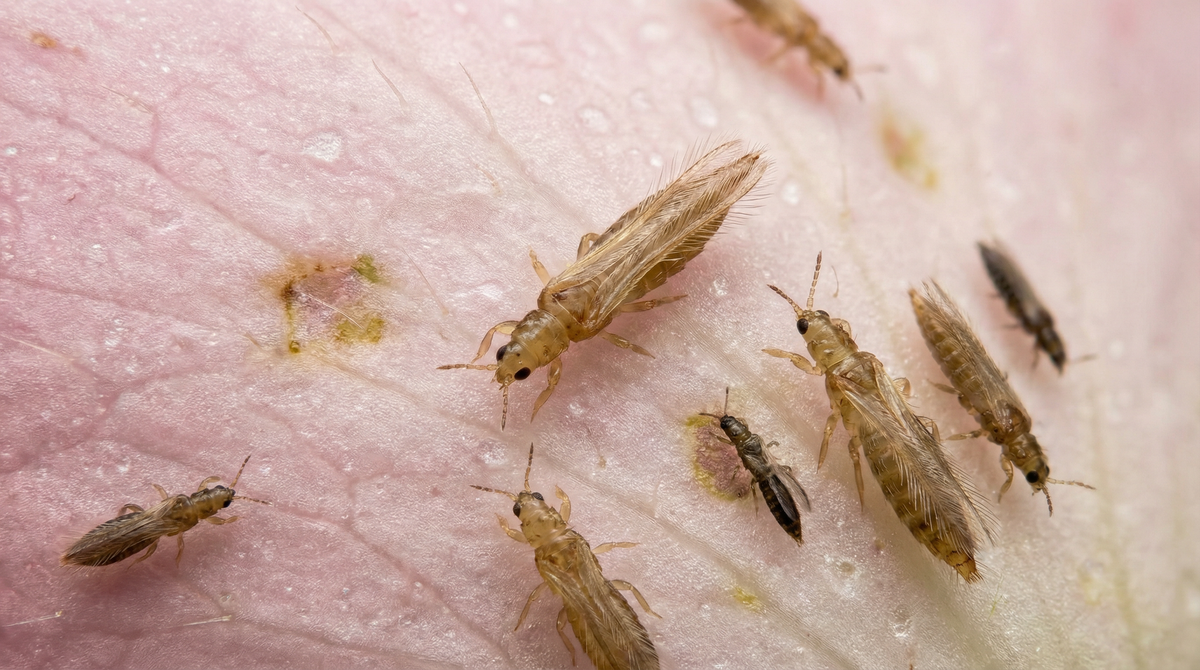
Thrips (order Thysanoptera) are tiny, slender insects that rasp and suck the surface of leaves, flowers, and fruit, leaving behind a telltale silvery stippling. Barely visible to the naked eye, they make up for their size with sheer numbers and speed, breeding through many generations in a single season and often building up unnoticed until damage appears. Some species also transmit destructive plant viruses. Common in gardens, greenhouses, and landscapes, thrips are a moderate but persistent pest, earning a beneficial rating of −3. A combination of monitoring, natural predators, and targeted sprays usually keeps them manageable.
Identification and Description
Thrips are extremely small — typically 1 to 2 millimeters, about the size of a comma — and slender, in shades of yellow, brown, or black. Under magnification they have narrow bodies and distinctive fringed wings (the name Thysanoptera means "fringe-winged"), though they are weak fliers and often disperse on the wind. Because the insects themselves are so hard to see, thrips are usually identified by their damage: fine silvery or whitish stippling and streaking on leaves and petals where they have rasped away the surface and drained the cells, often accompanied by tiny dark specks of black frass. Affected leaves may become discolored, distorted, or papery, flowers may be flecked or fail to open properly, and fruit can be scarred. Tapping a suspect flower or leaf over white paper dislodges the fast-moving thrips as tiny slivers.
Life Cycle
Thrips have an unusual development sometimes described as intermediate between incomplete and complete metamorphosis: they pass through egg, two feeding nymph (larval) stages, a non-feeding prepupal stage, and a pupal stage before becoming adults. Females insert their eggs inside plant tissue, where they hatch in 3 to 5 days. The nymphs feed for one to three weeks, then drop to the soil (or shelter on the plant) to pass through the resting prepupal and pupal stages. In warm conditions the whole cycle can be completed in as little as 8 to 15 days, allowing up to 15 generations per year in some regions, while adults live about 45 days. This explosive reproductive potential is why thrips populations can surge so quickly. Adults typically overwinter in plant debris, soil, and under bark, with some species overwintering as eggs or pupae.
Habitat and Range
Thrips are found throughout the United States — Northeast, Southeast, Midwest, Southwest, West, and Pacific Northwest — in gardens, agricultural fields, greenhouses, and landscapes; native range varies by species (the important western flower thrips, Frankliniella occidentalis, is native to western North America). They attack a very wide range of plants, and are especially drawn to flowers — onions, gladiolus, and roses are frequent targets — and to yellow, blue, and white blooms. Over-fertilized plants with lush, soft growth are particularly attractive, and warm, dry conditions and enclosed greenhouses favor rapid buildup.
Role in the Garden
Thrips are a moderate pest rated −3. Their rasping-and-sucking feeding causes the characteristic silvery stippling and can distort and discolor leaves, flowers, and fruit, reducing both plant health and the appearance of ornamentals and marketable produce. On most robust garden plants the damage is cosmetic to moderate, but heavy infestations can stunt growth and disfigure blooms. The more serious concern is that certain thrips are efficient vectors of plant viruses — notably tomato spotted wilt virus and impatiens necrotic spot virus — which can be far more damaging than the feeding itself. It is worth noting that not all thrips are pests; a few species are predatory and beneficial, but the common plant-feeding thrips are the ones that trouble gardens.
Managing Thrips
Control combines monitoring, biological control, and targeted treatment. Sticky traps in yellow or blue help monitor and trap adult thrips and signal when populations are rising. For active infestations, insecticidal soap is effective, with two applications about three days apart recommended to catch newly hatched nymphs. Dormant oil sprayed on fruit trees kills overwintering thrips, and diatomaceous earth dusted on leaf undersides abrades them. The most sustainable approach is biological control: encourage natural predators — minute pirate bugs, lacewings, and lady beetles — by planting flowers that attract them, and release predatory mites such as Amblyseius cucumeris, which are highly effective against thrips in gardens and greenhouses. Avoid over-fertilizing with nitrogen, which produces the soft growth thrips favor, and remove spent flowers and plant debris that harbor them.
Companion Planting and Cultural Controls
The key companion-planting strategy is to attract the beneficial insects that prey on thrips — pirate bugs, lacewings, and ladybugs — by growing a diversity of small-flowered plants throughout the season. Reflective mulches laid at the base of plants also help deter thrips by confusing their orientation, a simple and effective cultural control especially useful for protecting young or virus-susceptible plants.
Staying Ahead of a Fast Breeder
Thrips are small and fast-multiplying, so early detection and biological control are the winning combination. Hang sticky traps to monitor, unleash pirate bugs, lacewings, and predatory mites, spray insecticidal soap in repeated applications when needed, lay reflective mulch, and ease off the nitrogen — and you can keep this tiny rasping pest, and the viruses it can carry, from spoiling your leaves, flowers, and fruit.